
Sky Stories
This carousel shares Sky Stories from more than 30 cultures around the world! The designs for each animal or painting incorporate cultural art styles based on historical knowledge, literature and oral history, and traditional arts. They also incorporate some representation of the scientific phenomenon associated with the celestial body or theme. When possible, figures were designed by or in collaboration with a crew member with personal heritage of the culture being represented.
Below you can find photos and descriptions of each. (We’re working on getting official portraits done! There are also additional photos of the painting in progress on our Facebook page and in the Gallery.)
Hrímfaxi (Norse)
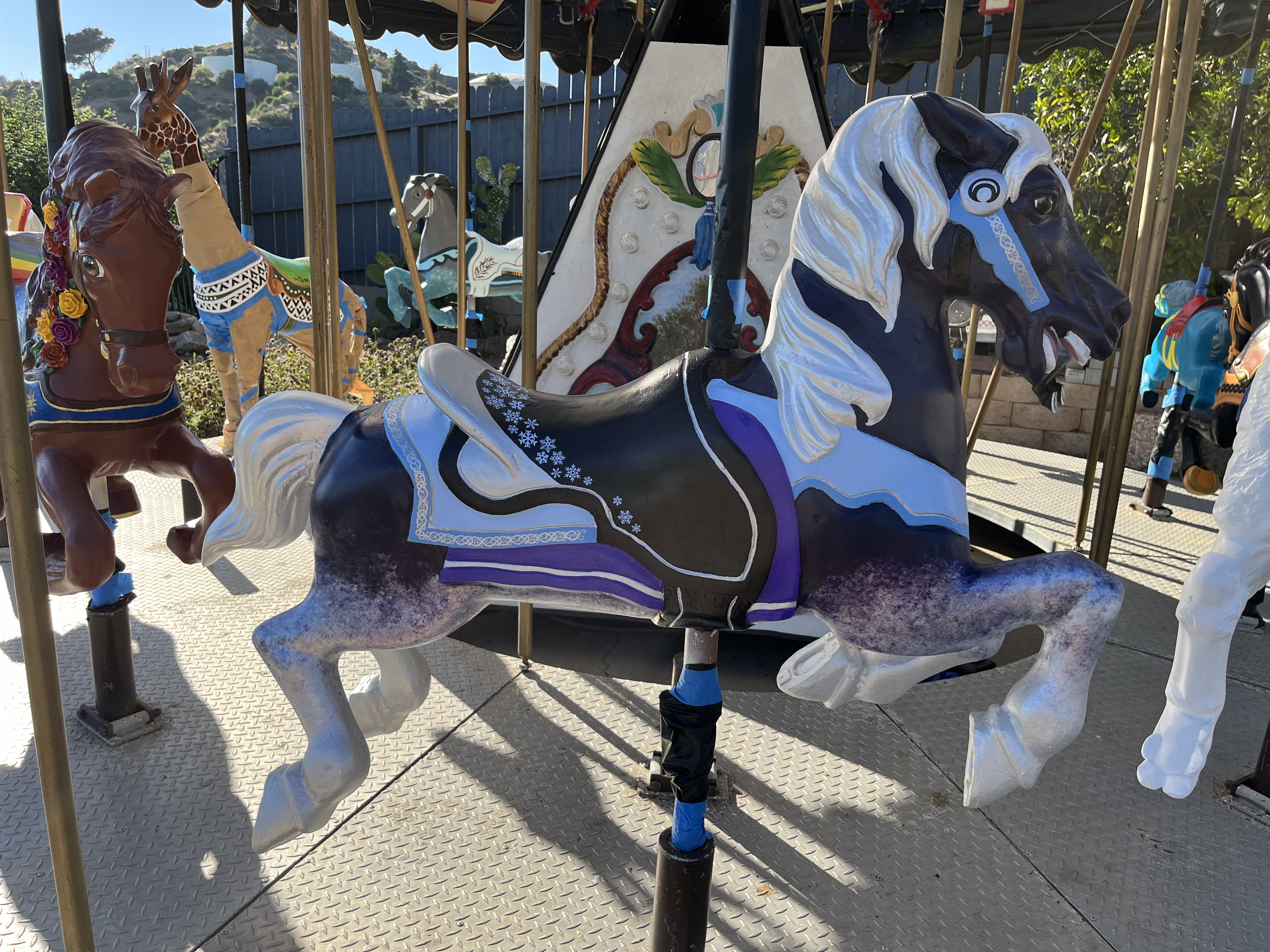
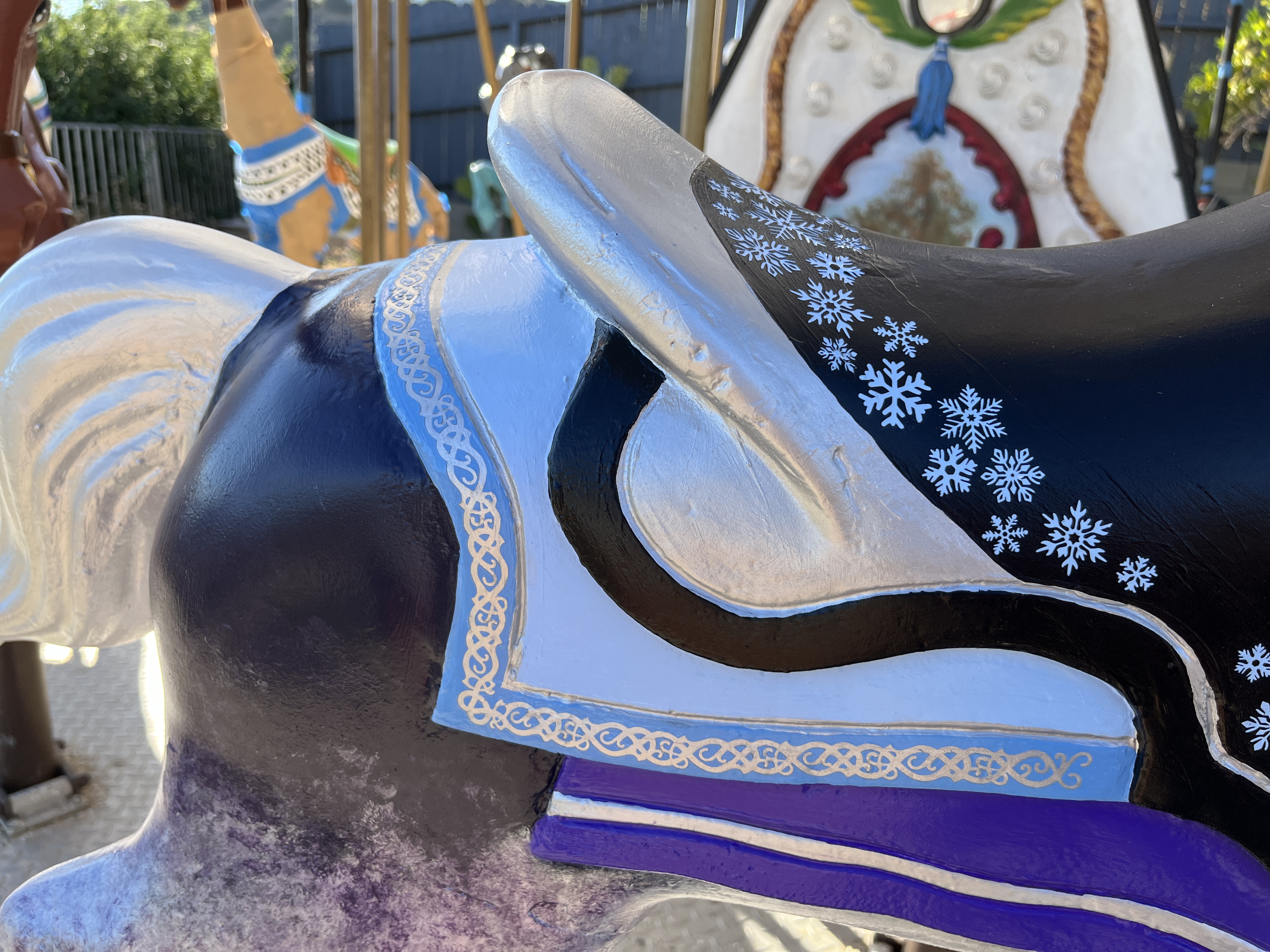
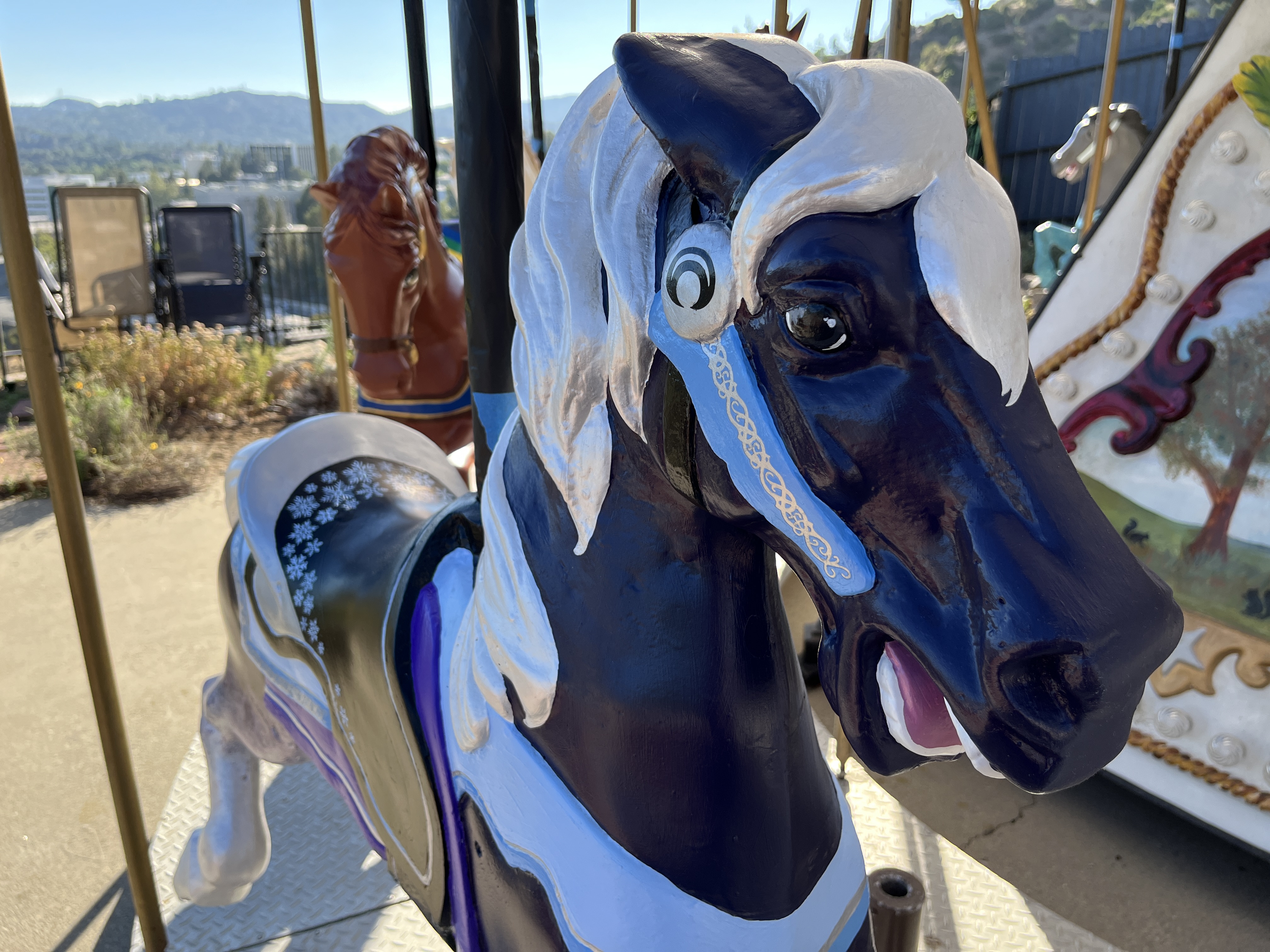
Meaning “Rime Mane” with Skinfaxi (“Shining Mane”), these horses bear the Norse gods of night (Nott) and day (Dagr) across the sky. It is said to be Skinfaxi’s mane which lights the world below each day, and froth from Hrimfaxi’s bit which makes the morning dew.
The elements of night, ice, and the Moon are combined here in the horse’s saddle. The stark black line against silver depicts the bright edge of a crater wall lit by the Sun in the Moon’s polar reaches. The floors of such craters lie in permanent shadow and receive no warmth from the Sun, allowing ice to gather there in large deposits.
Brihati (Hindu)

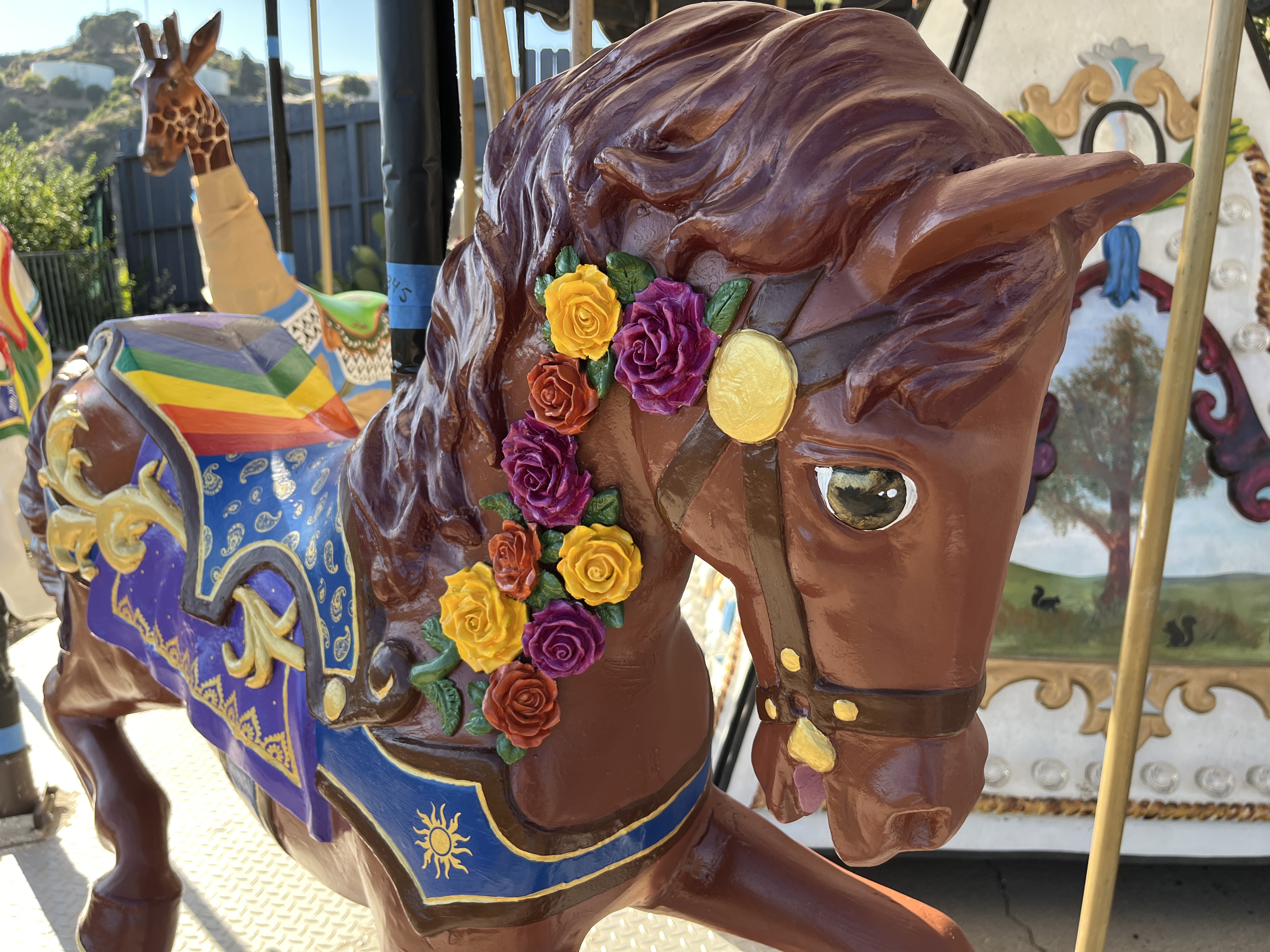
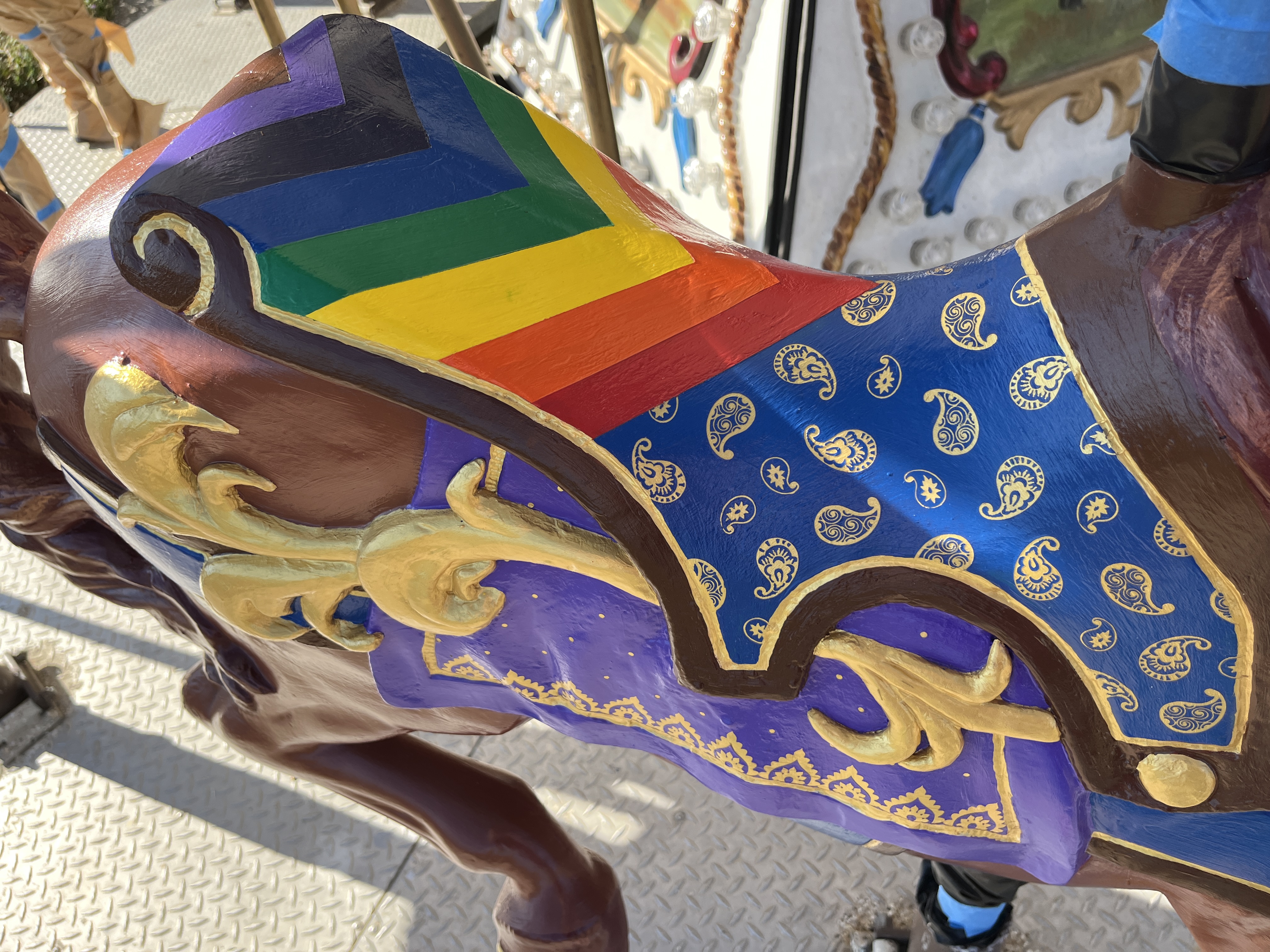
This horse helps draw the solar chariot of Surya, Hindu god of the Sun. It is said that Surya has seven horses, one for each color of the rainbow, for each day of the week, and for each type of Vedic verse (after which they are named). The group of horses is represented by the rainbow stripes of the saddle. The saddle and blankets are inspired by the bright colors and elaborate embroidery of traditional sari garments.
The paisley pattern on blue in the saddle is meant to depict water droplets in the sky, with colors spreading out from them like light refracting into a rainbow as it travels through rainy or humid atmosphere.
Hun Chuen (Mayan)
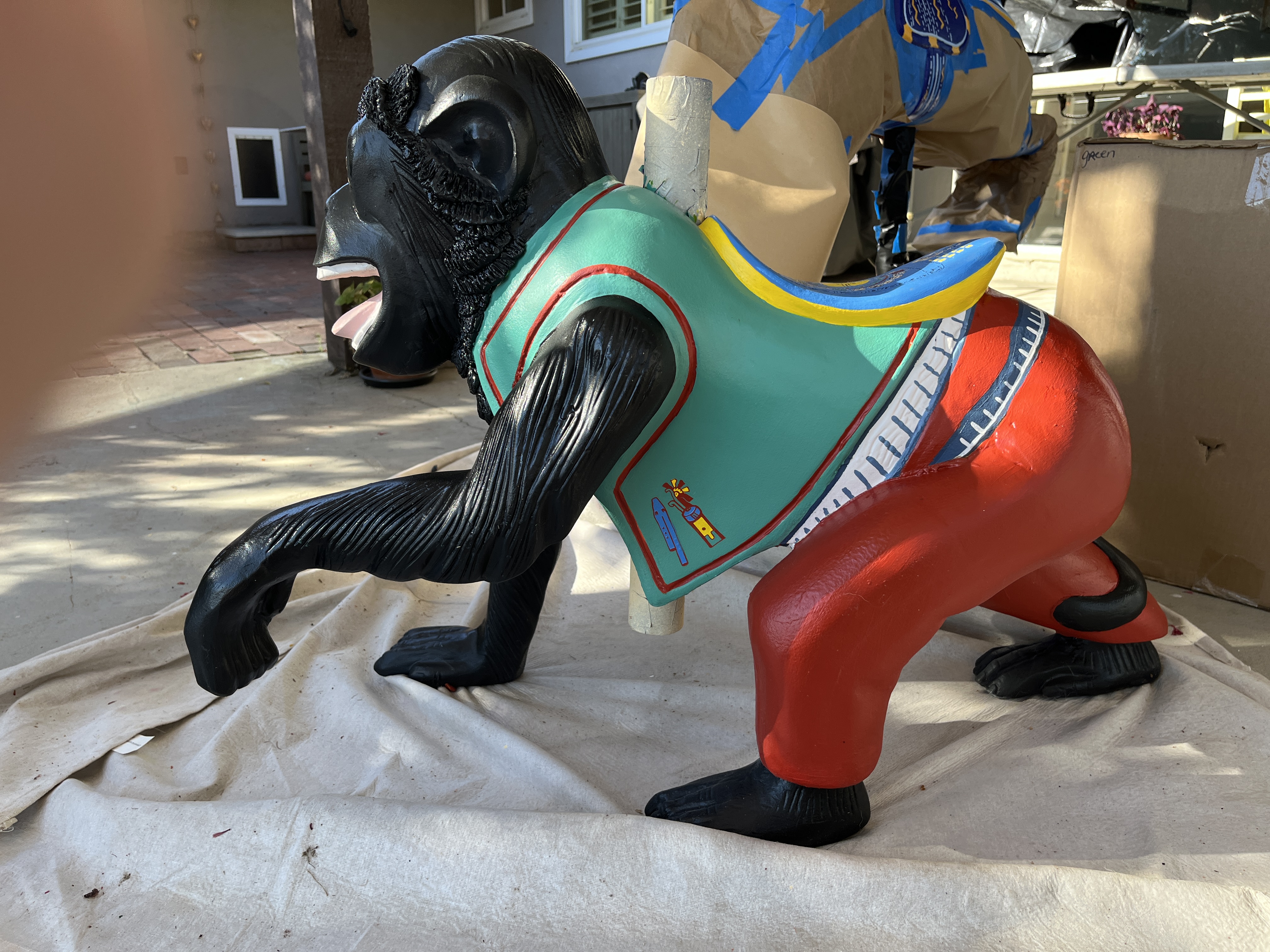
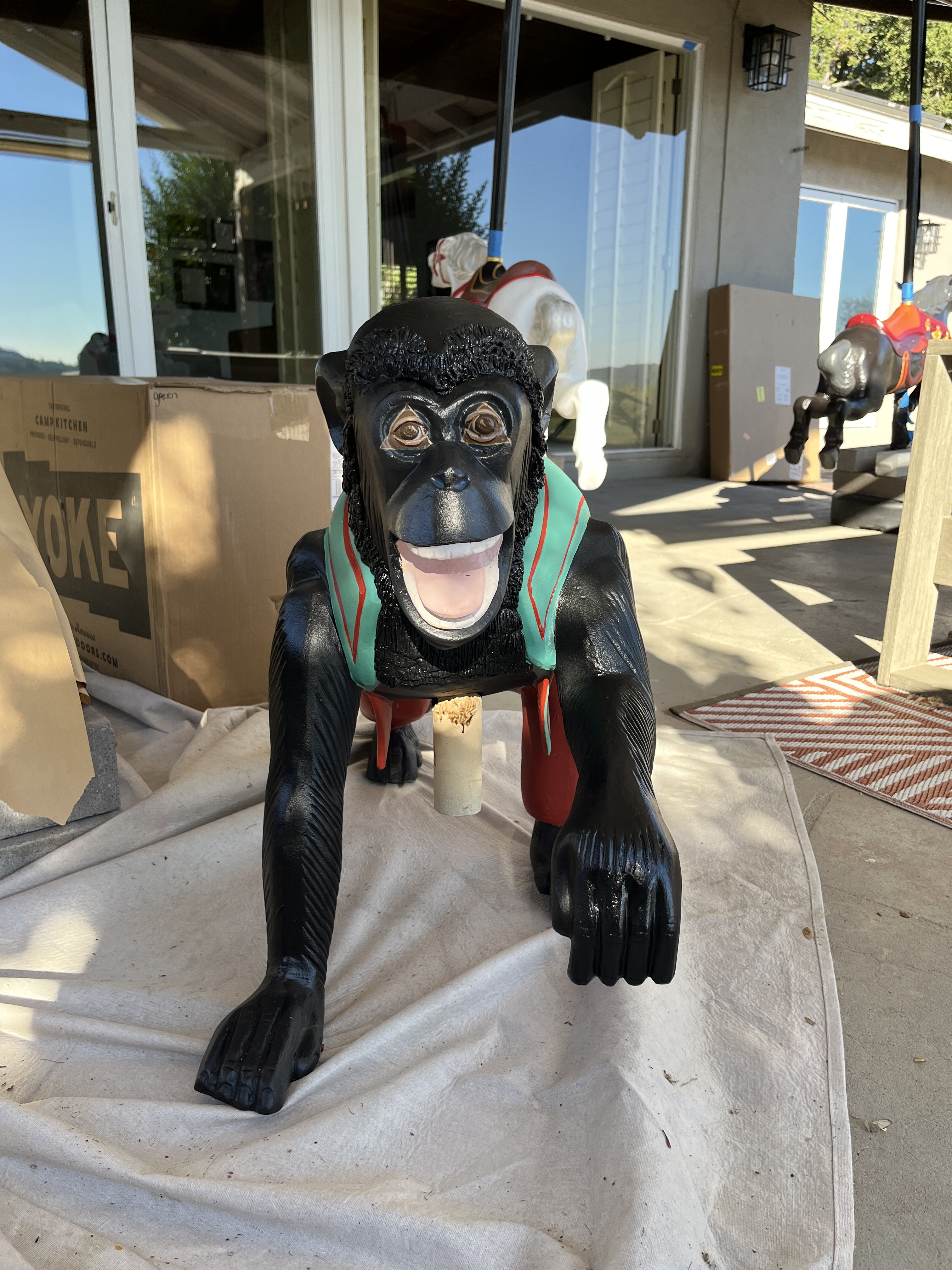
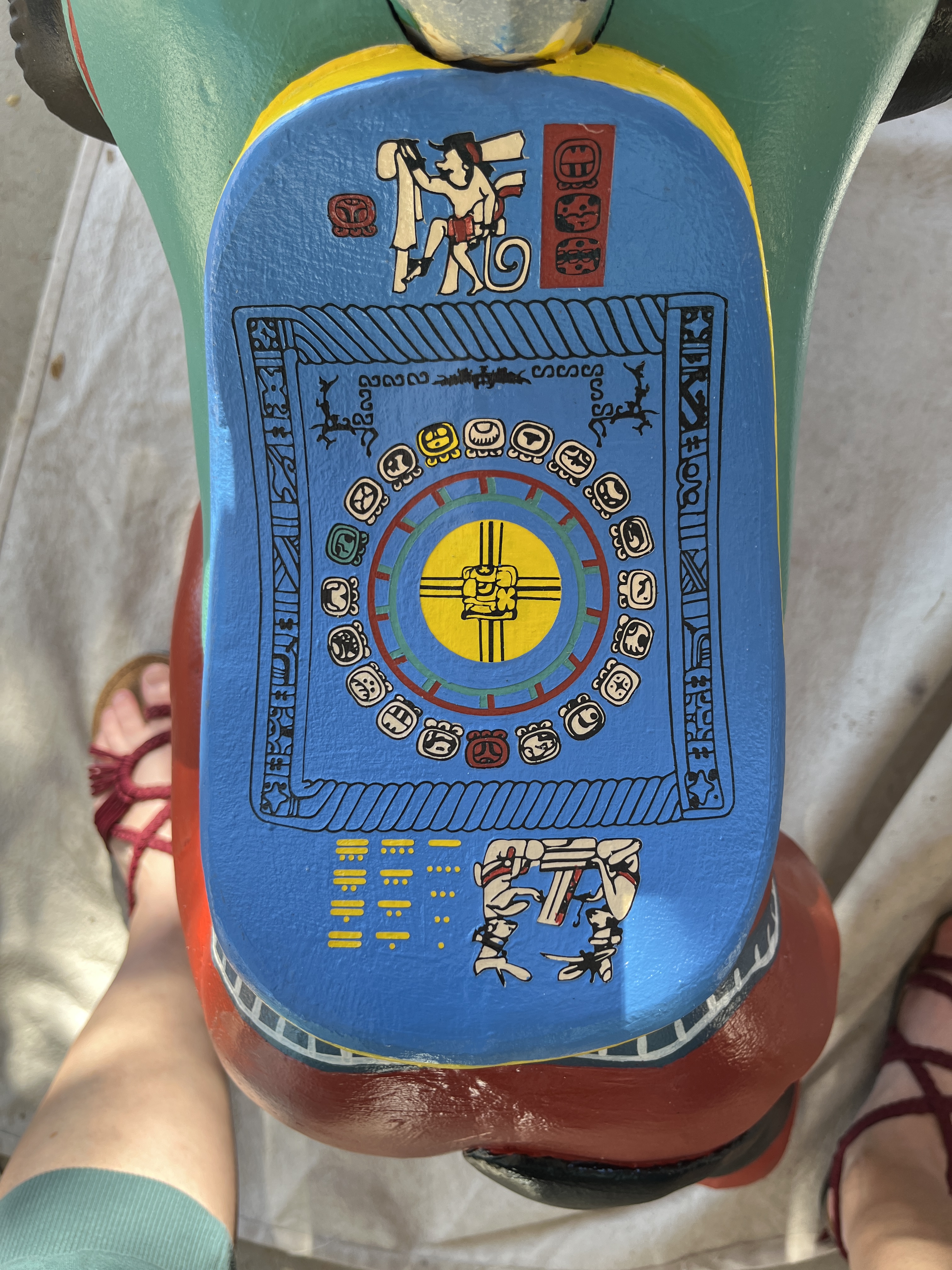
Hun Chuen is Classical Mayan for One Monkey, who with his brother One Artisan was a god of music, writing, and the arts in the Mayan creation story. Once men, they were turned into howler monkeys during a famous rivalry with their half-brothers, the Hero Twins, and their movement back and forth between the jungle and their grandmother’s house in the story described the motion of Mars that ancient Mayans observed in the sky. There are ~7 million modern Maya in Mesoamerica today across several ethnolinguistic groups.
The One in their names links them to the sacred Tzolk’in calendar which is based on a repeating cycle of 13 numbers combined with 20 day names to produce 260 unique days. This number relates to Mars’ orbit, which is featured on the saddle.
Pegasus (Greek)
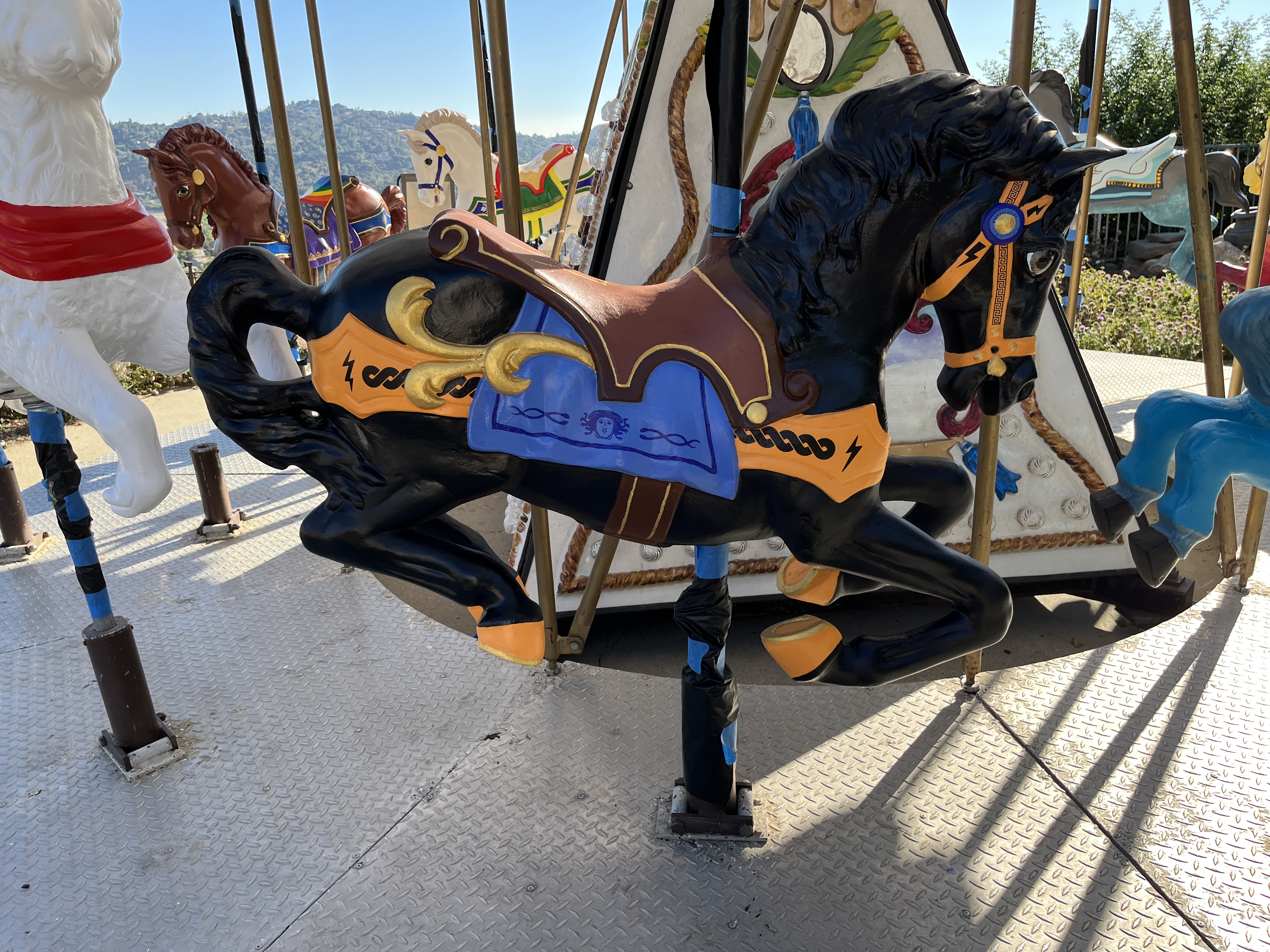
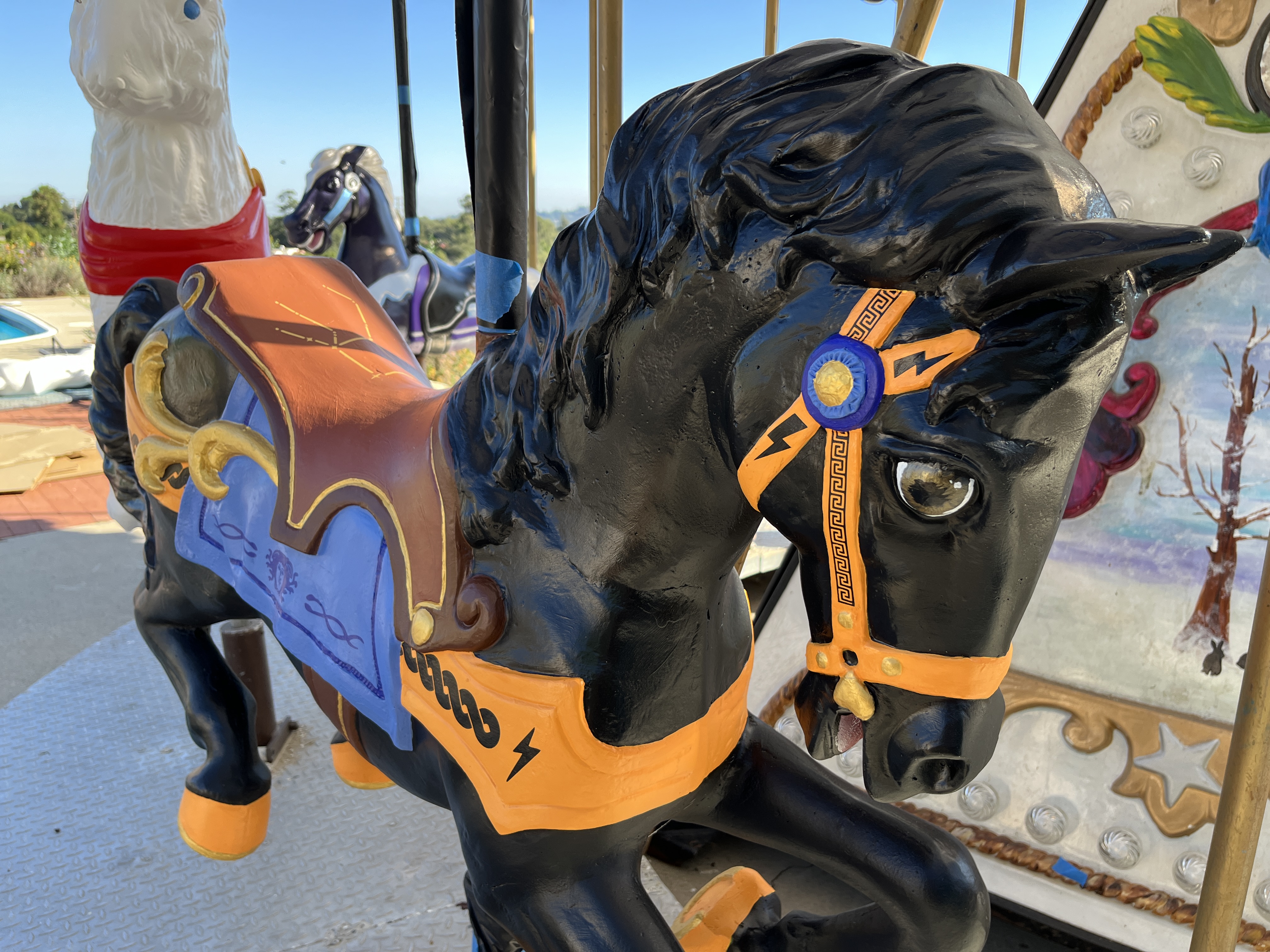
Pegasus connects us to the stars and our past with black and terracotta colors and geometric designs evoking ancient Greek pottery. Pegasus was born from Medusa’s blood, carried the hero Bellerophon, and could create springs with the strike of his hoof. He eventually ended up on Mount Olympus where he carried the thunder and lightning bolts of Zeus until he was placed in the sky as a constellation.
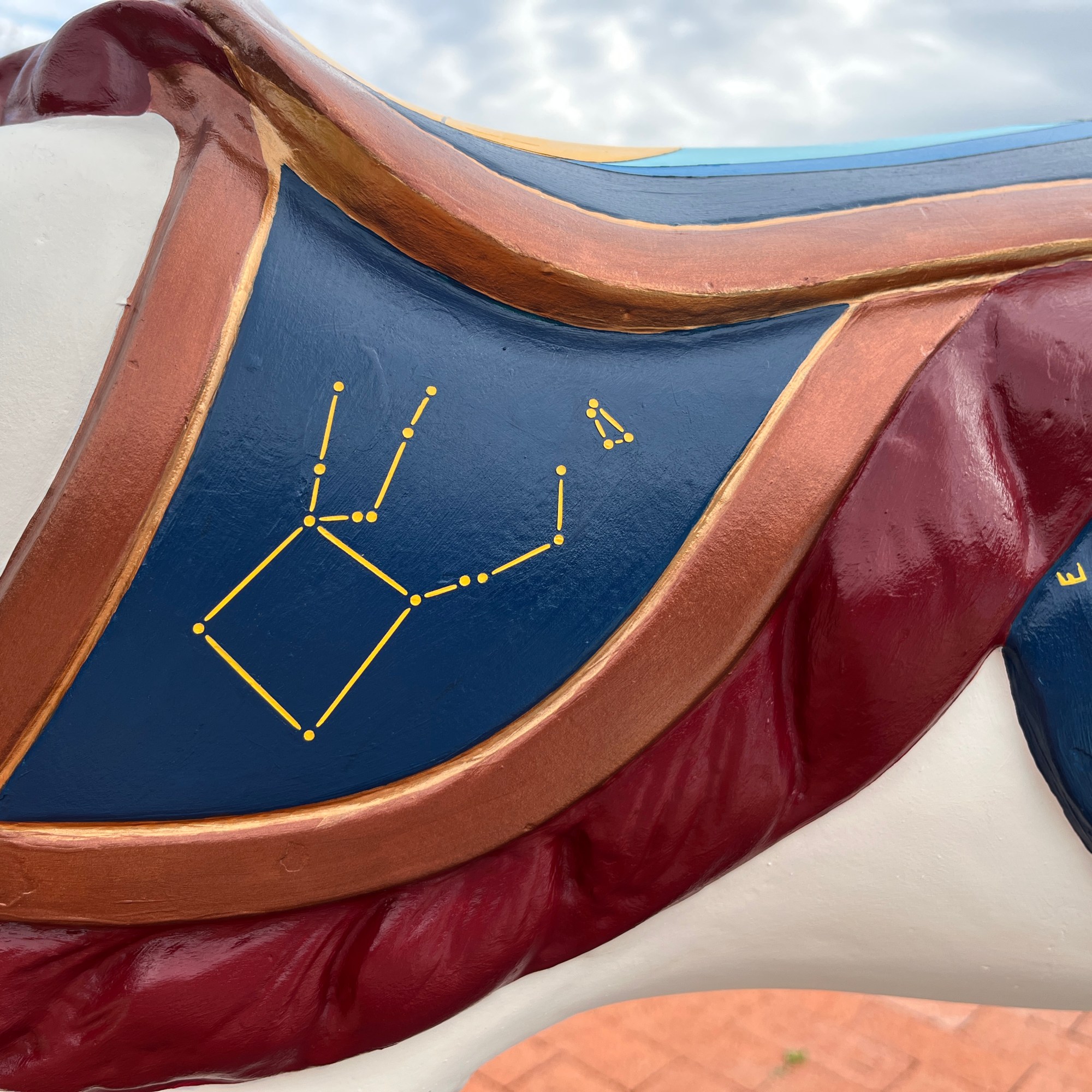
Depicted on the saddle, this constellation reminds us of the way we, as humans, relate to and wish to understand the sky above. Pegasus also has a foal named Celeris in the sky as the Equuleus or “little horse” constellation. These were created by Ptolemy and Hipparchus, ancient astronomers who developed the mathematical frameworks we use to study the cosmos today.
Eous (Roman)
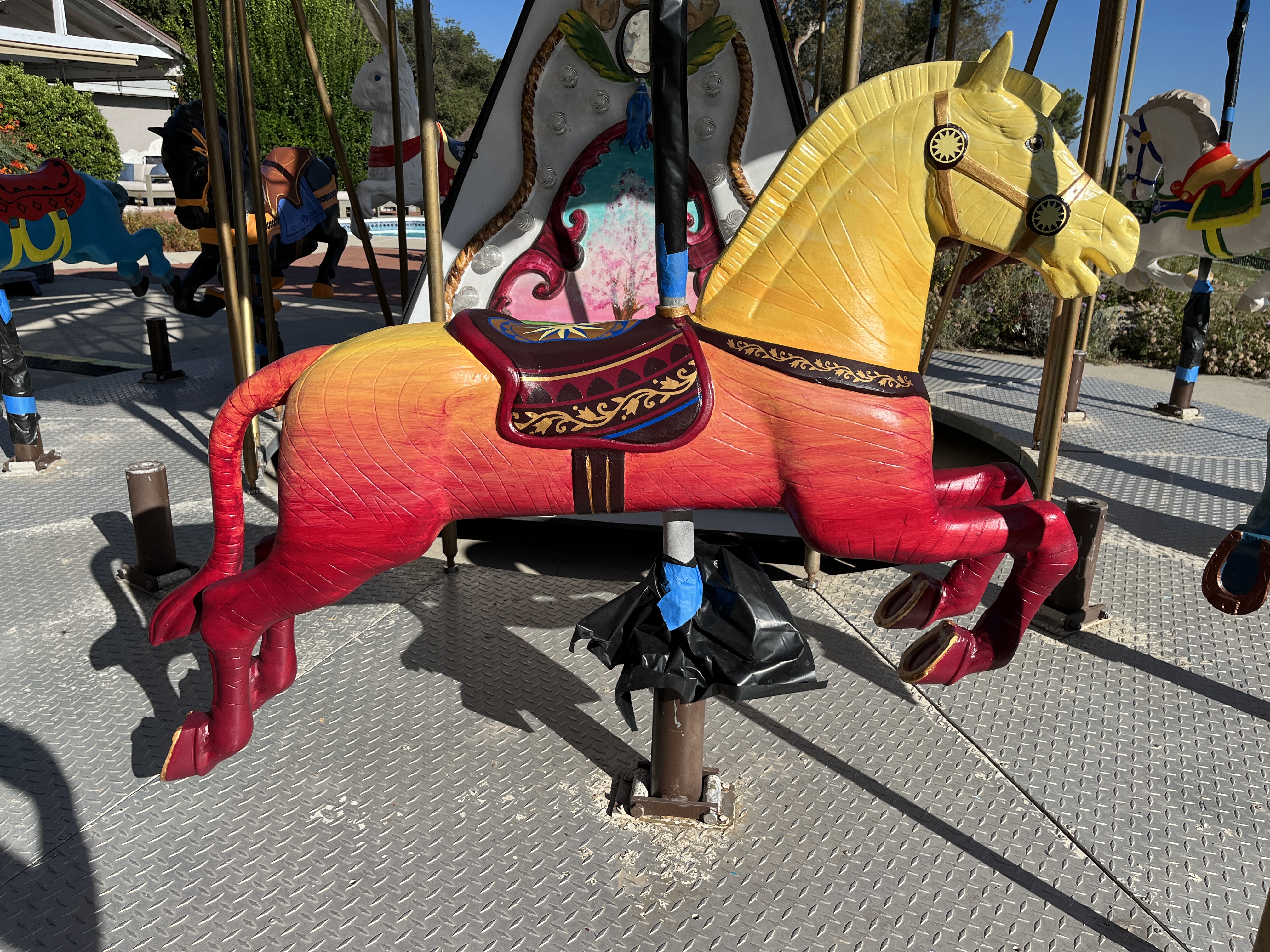
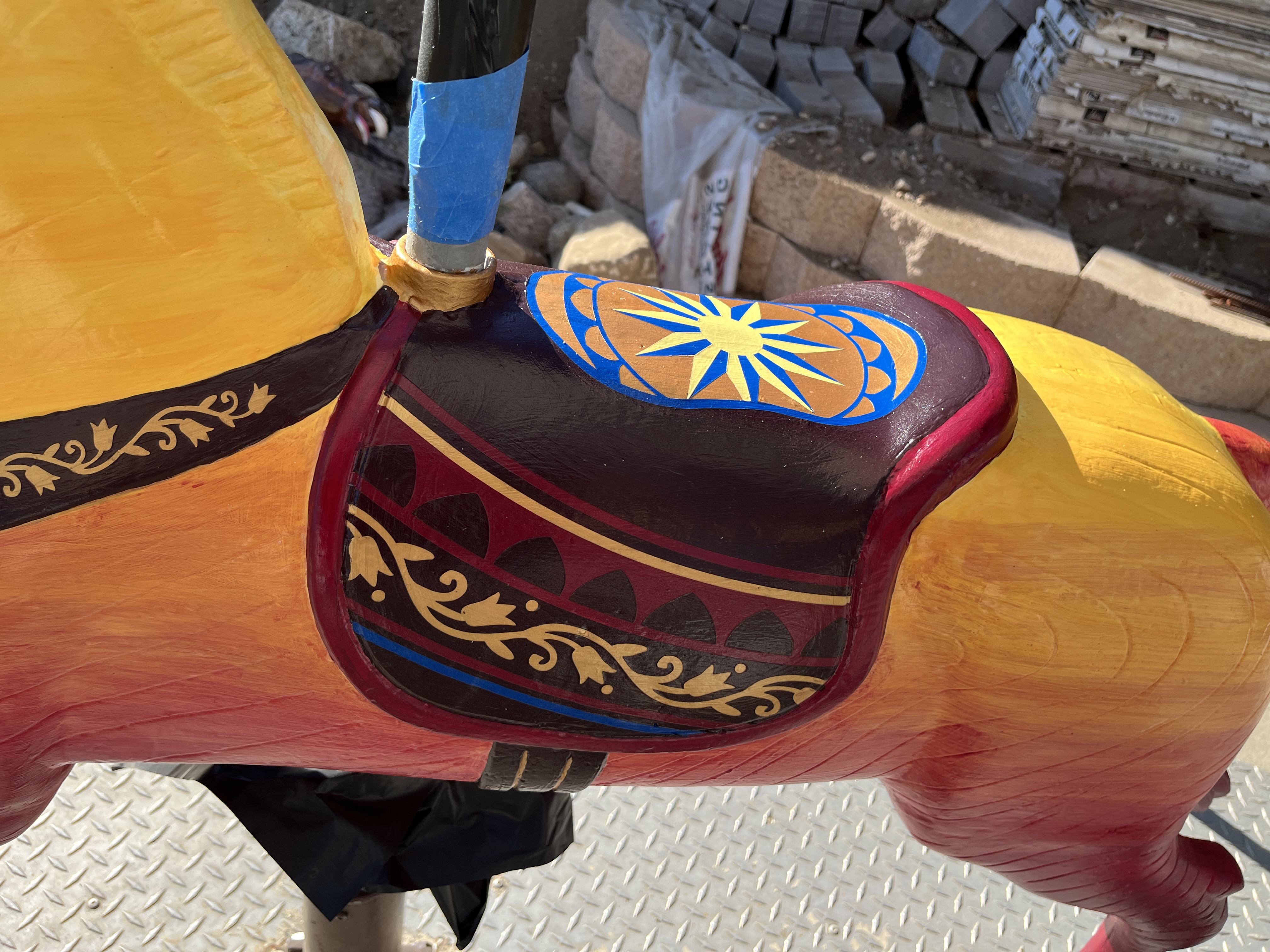
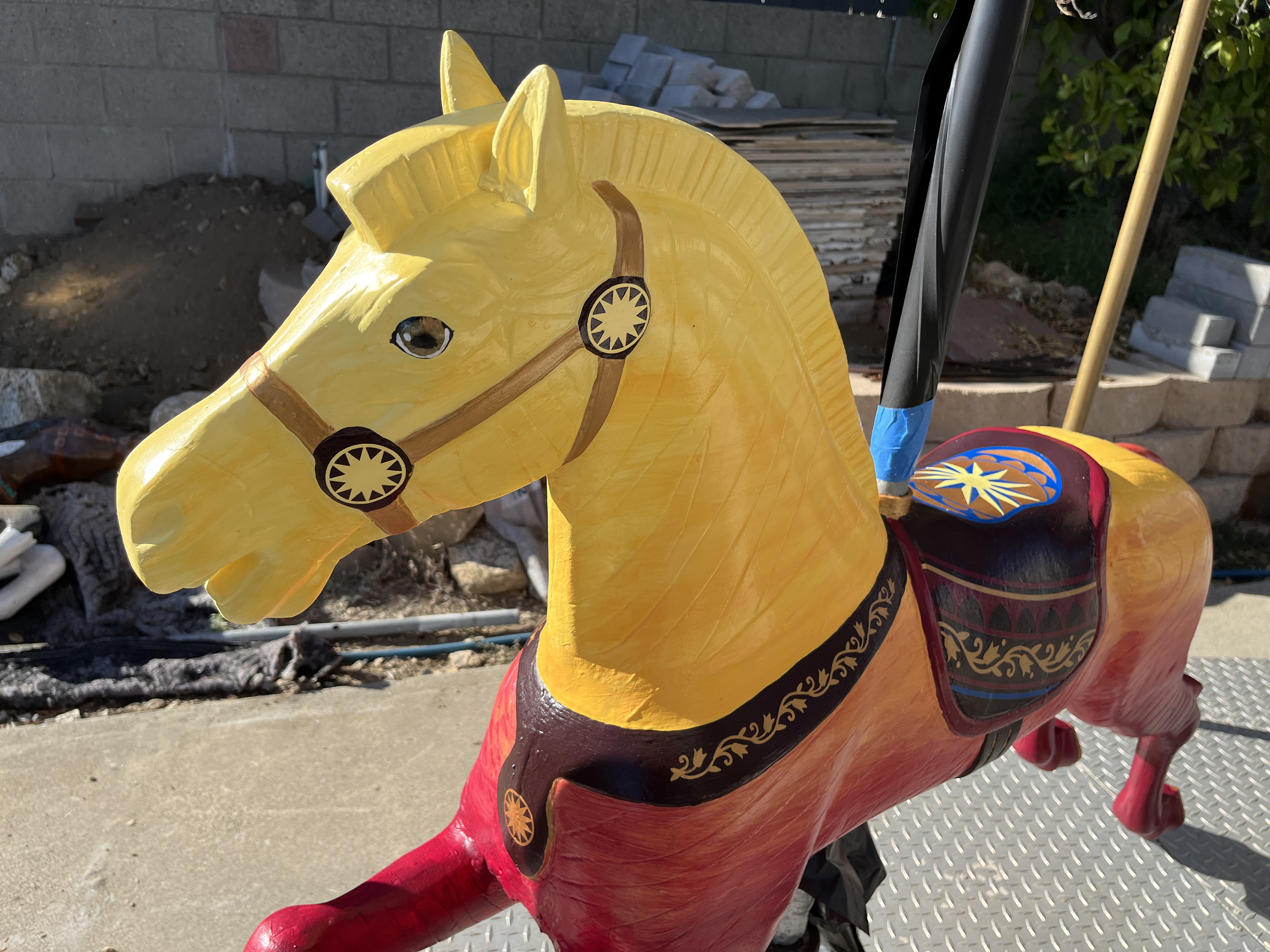
The god Sol (Greek Helios) drives a chariot across the sky each day drawn by four steeds named Pyrois (“The Fiery One”), Eous (“He of the Dawn”), Aethon (“Blazing”), and Phlegon (“Burning”). At the edge of the sky when he descends to the sea, he stops to bathe and rest the horses each night. Sol is youthful and golden-eyed, with a solar crown of twelve rays upon his head. The saddle designs are taken from Roman mosaics.
Eous’ saddle shows a burst of light, with first blue scattering in every direction and mostly red extending beyond. The sky appears blue because blue wavelengths scatter easily in the atmosphere and bounce into our eyes. The peanut shape indicates the directions of scattering. However, light must travel farther during sunrise and sunset, and it is mostly red light which survives journey and gives them their warm hues.
Yutu (Chinese)


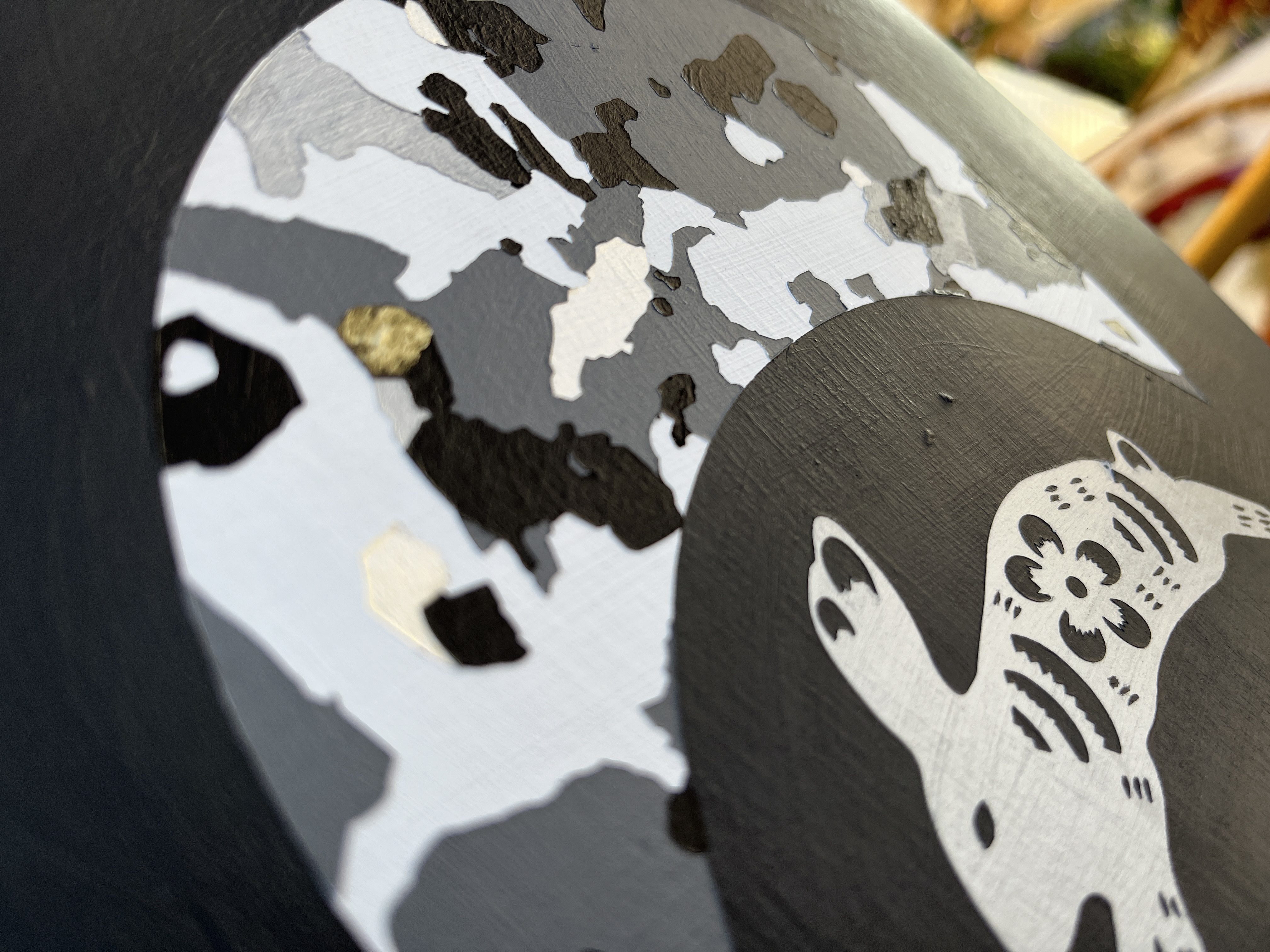
Yutu (the Jade Rabbit) was sent to live on the Moon with the Moon princess Chang’e after sacrificing himself in a selfless act. He lives under a cinnamon tree and uses a mortar and pestle to pound herbs, creating the elixir of life for the gods. In China, he is celebrated during the mid-Autumn festival along with the Moon. Other versions of the Jade Rabbit also exist from Japanese, Vietnamese, and other Asian cultures.
Here we imagine Yutu as studying Moon rocks in his mortar and pestle. The saddle crescent bears an image taken under a microscope of a thin slice of Moon rock called a “thin section,” used by scientists to understand its mineralogy. The Chinese space agency has sent several spacecrafts to the Moon named for Chang’e, including two rovers named Yutu and Yutu-2.
Énbarr (Irish Celtic)
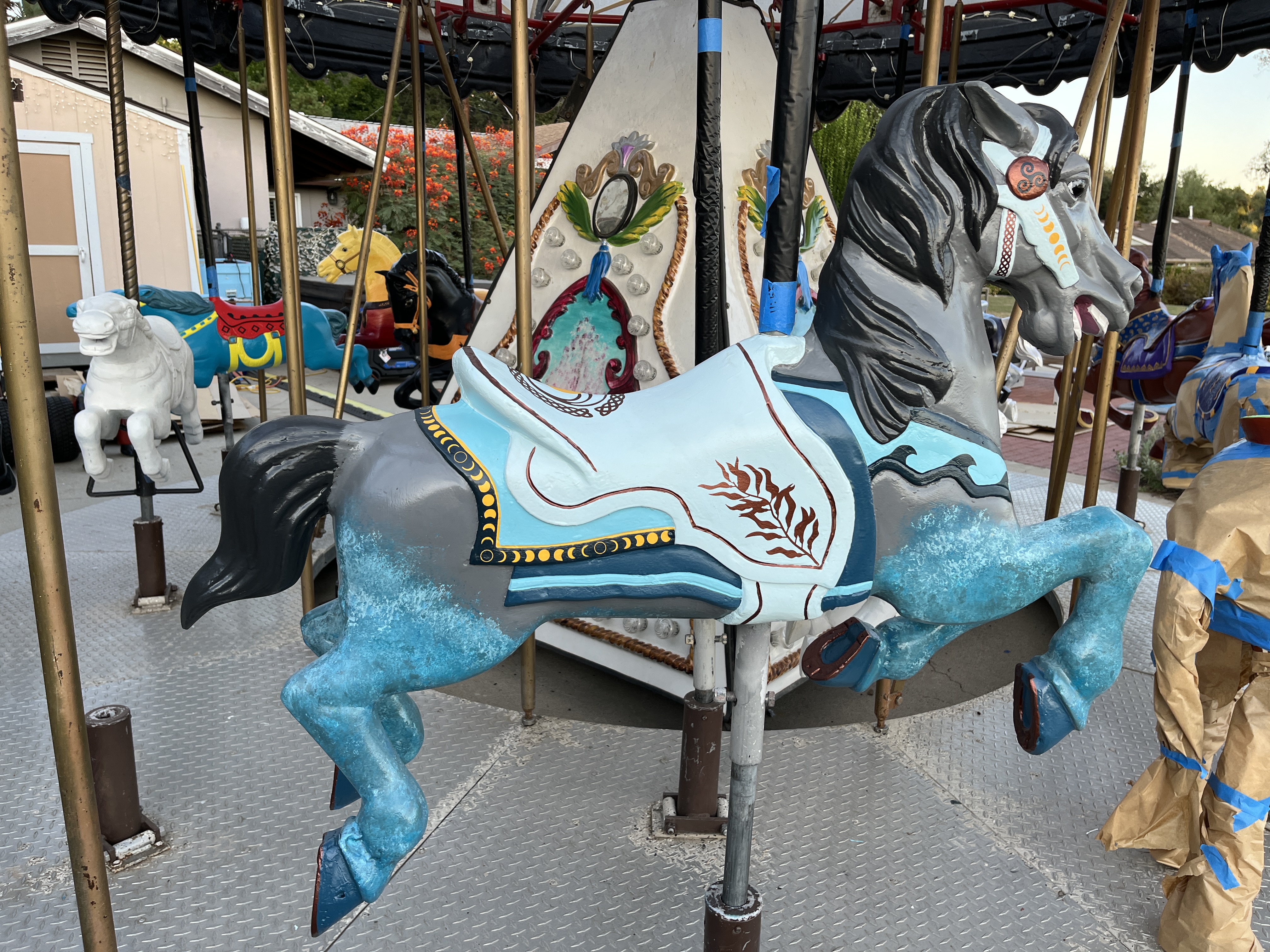


Énbarr belonged to the sea god Manannan mac Lir. He is described as a dark gray horse with a golden bridle who can run as fast over water as over land and was swifter than the wind. For the space of nine waves he would be submerged in the sea, rising on the crest of the tenth unwetted.
Here, we invoke the Moon via tides, which arise daily due to its gravitational pull on the ocean as the Earth rotates. Spring (new/full Moon) and neap (half Moon) tides also occur twice a month as the Sun’s gravity either enhances or diminishes the Moon’s effect as it moves in its orbit. Other worlds also have tides, such as Jupiter’s moon Europa, whose exterior ice shell is covered with copper-colored fractures caused by extreme gravitational interaction with other nearby moons.
Hikaru (Shinto)
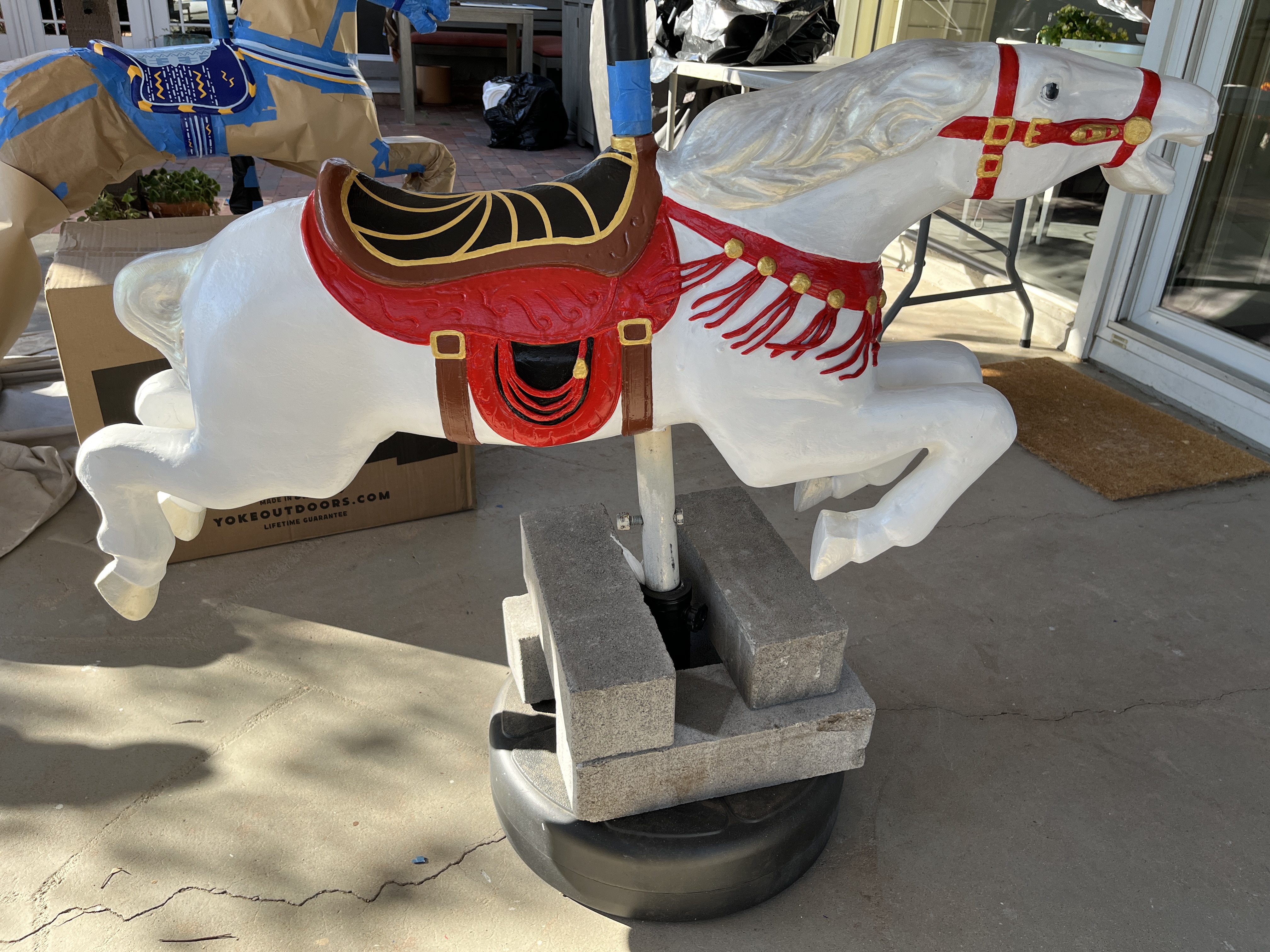
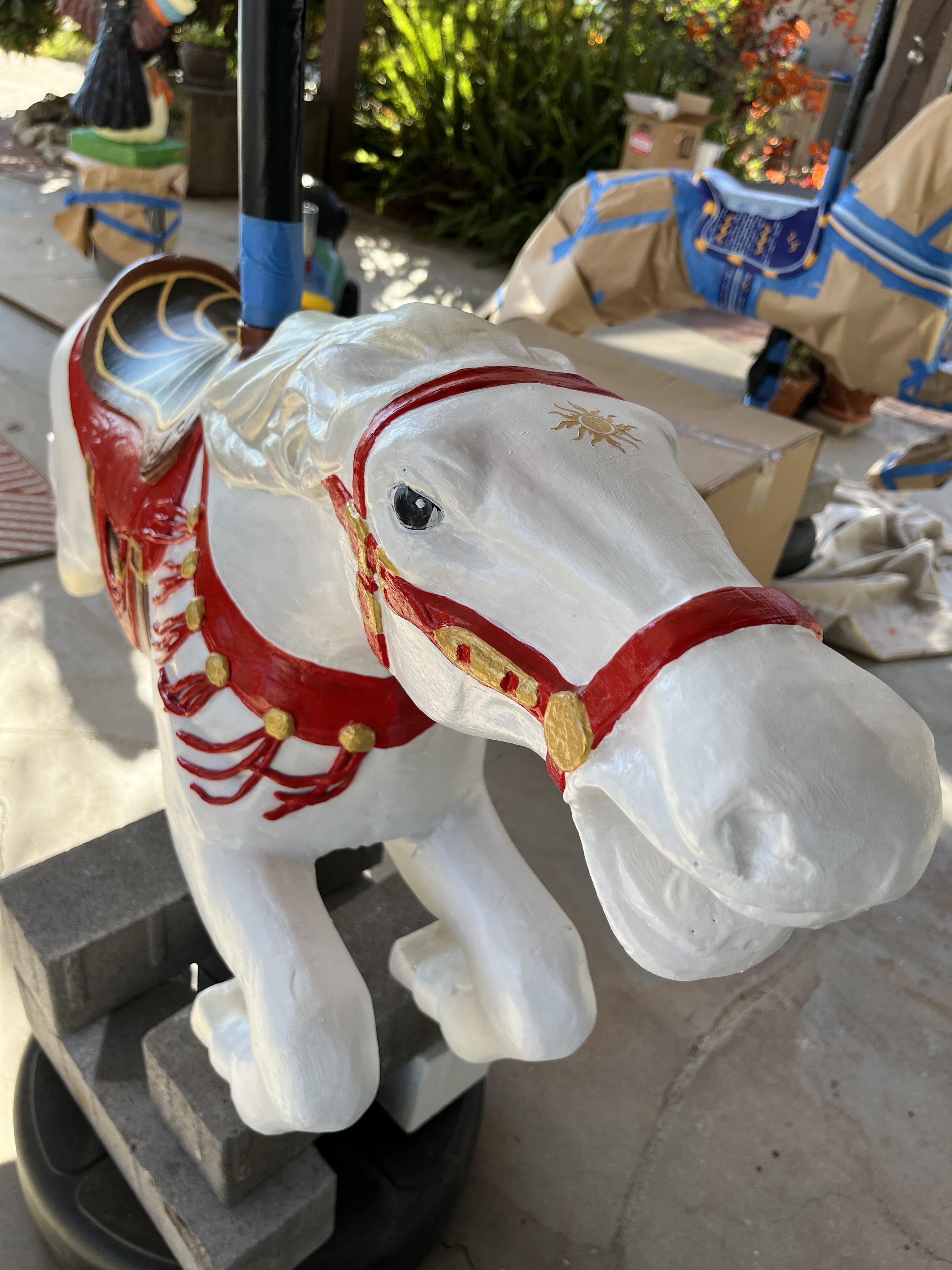
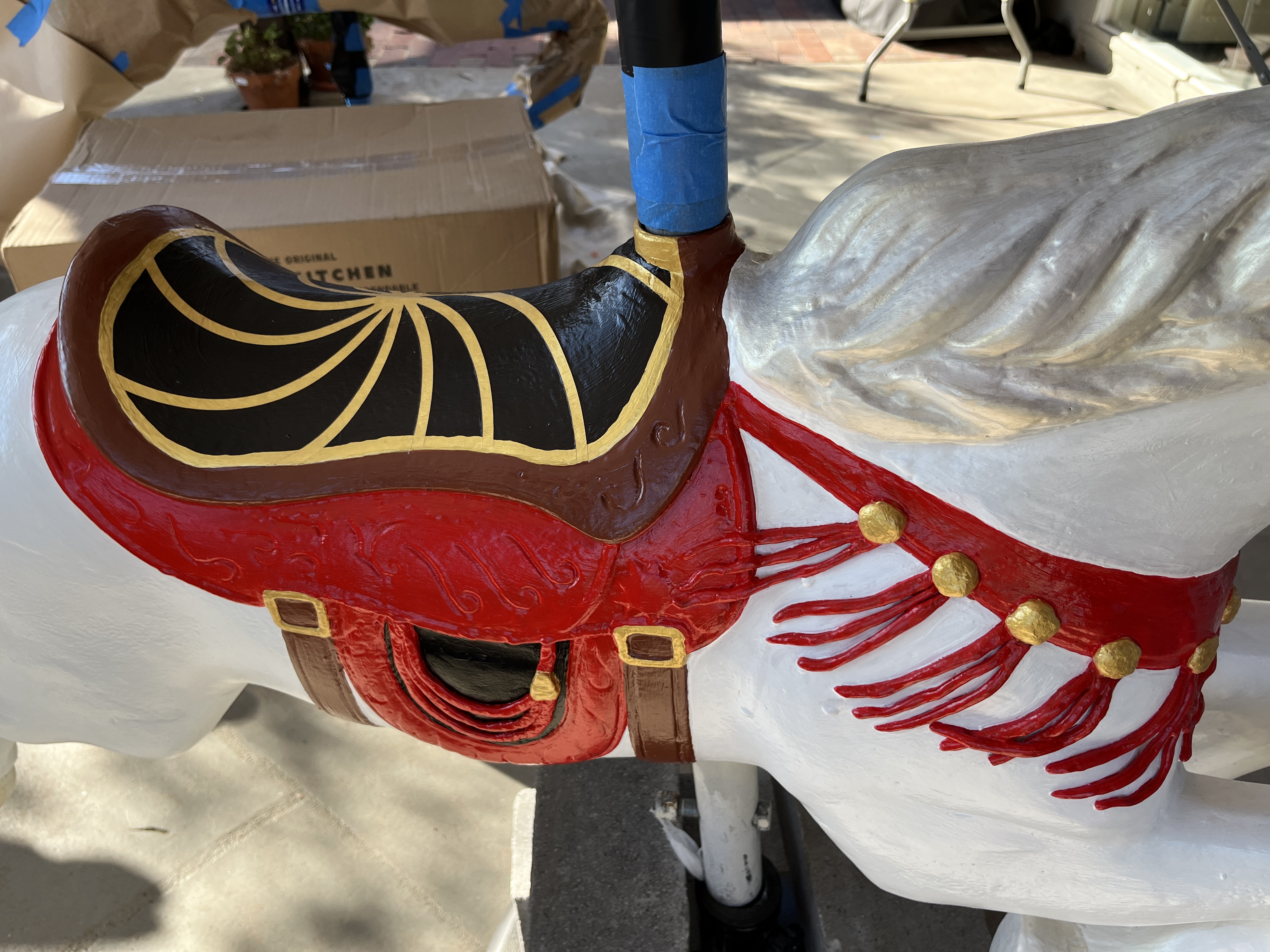
This horse is inspired by shinme, the sacred horses which are kept and cared for in Shinto temples as steeds for the gods. During rituals they may be dressed with fine ropes, tassels, and other adornments. The Sun goddess Amaterasu is the chief deity in the Shinto pantheon and the ruler of the heavenly realm, and shinme kept for her are traditionally white. Hikaru means “radiant.”
Amaterasu is often depicted with the Sun’s rays extending out straight from a halo around her. Here, the saddle instead depicts the shape of the Parker Spiral (also called the “ballerina skirt” spiral) which is the shape of the solar wind as it emanates from the Sun and spreads through the solar system.
ǃnábe (San)


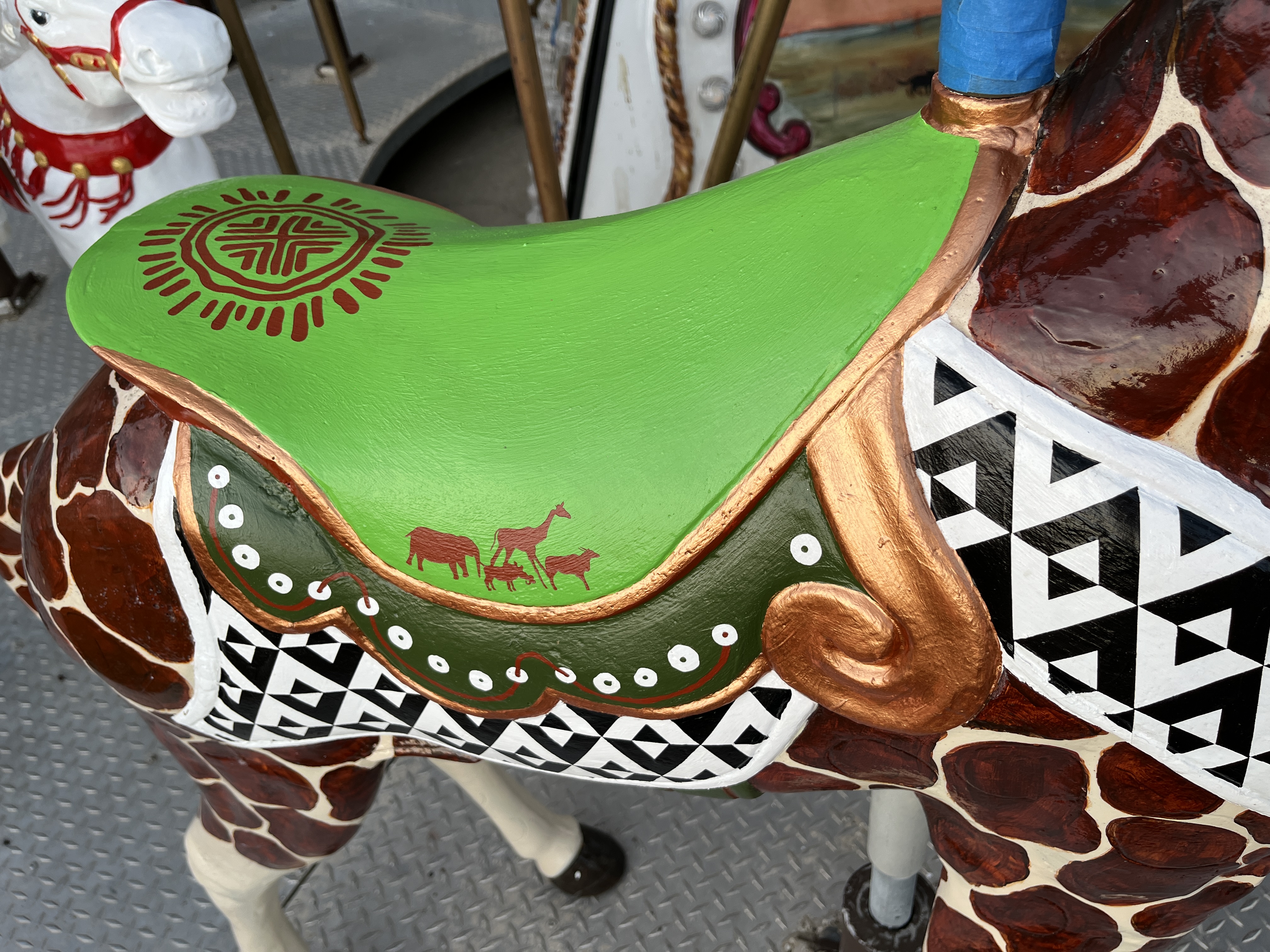
According to the San, all animals were created with a purpose but the Giraffe did not feel he had any special skills. However, it was seen after creation that the Sun kept getting lost as it traveled across the sky and only Giraffe was tall enough to guide it. He can be seen here on Earth or in the sky as the constellation which western cultures call the Southern Cross.
Khoisan is a catchall term for several indigenous peoples of southern Africa who speak click languages. ǃnábe means “giraffe” in Khoe, where the ! is a click. The Khoisan are known for their beautiful rock art, geometric designs, and ostrich shell beads. Here, the beads on the saddle connect the Giraffe’s spots to sunspots, with magnetic field lines arcing between them to form solar flares. The top of the saddle features rock art of the Sun and animals.
The Ebony Horse (Persian, Arabic)

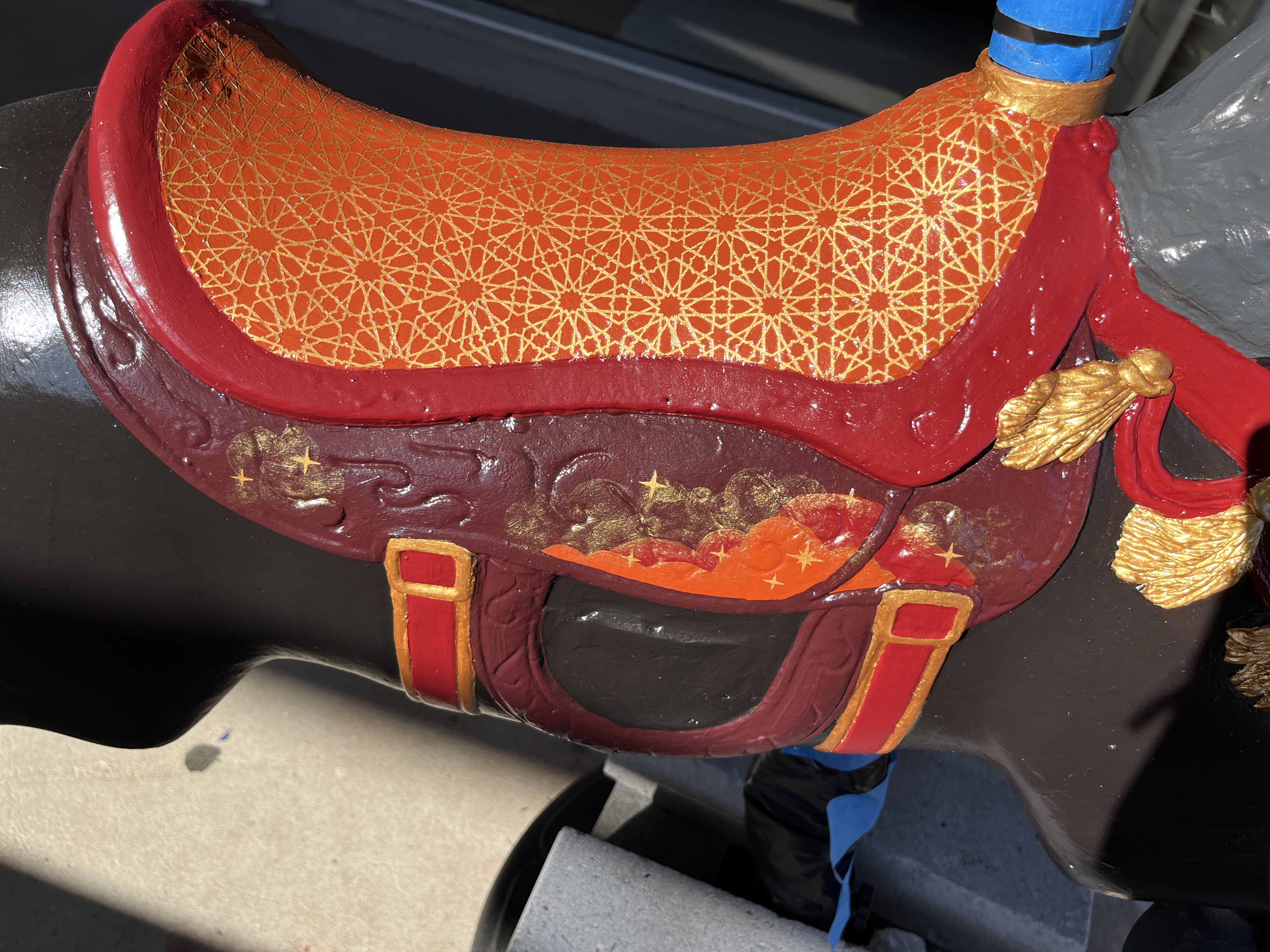
The Ebony Horse is a flying horse described in an adventure from 1001 Nights, a collection of stories from Arab, Persian, and even Indian traditions. It was said to be able to fly over mountains, going the distance of a whole year in one leap. What is extraordinary is that this horse was mechanical, not magical, highlighting the ingenuity of people in ancient times. Much of modern astronomy is founded in knowledge and instruments developed in the early Middle-East. This horse celebrates that legacy, connecting ancient and modern exploration technology.
The saddle depicts an Islamic geometric pattern of a field of stars, its hexagons a subtle nod to the mirrors of NASA’s James Webb Space Telescope, the largest telescope in space. The saddle blanket depicts a nebula.
Mēness (Latvian)
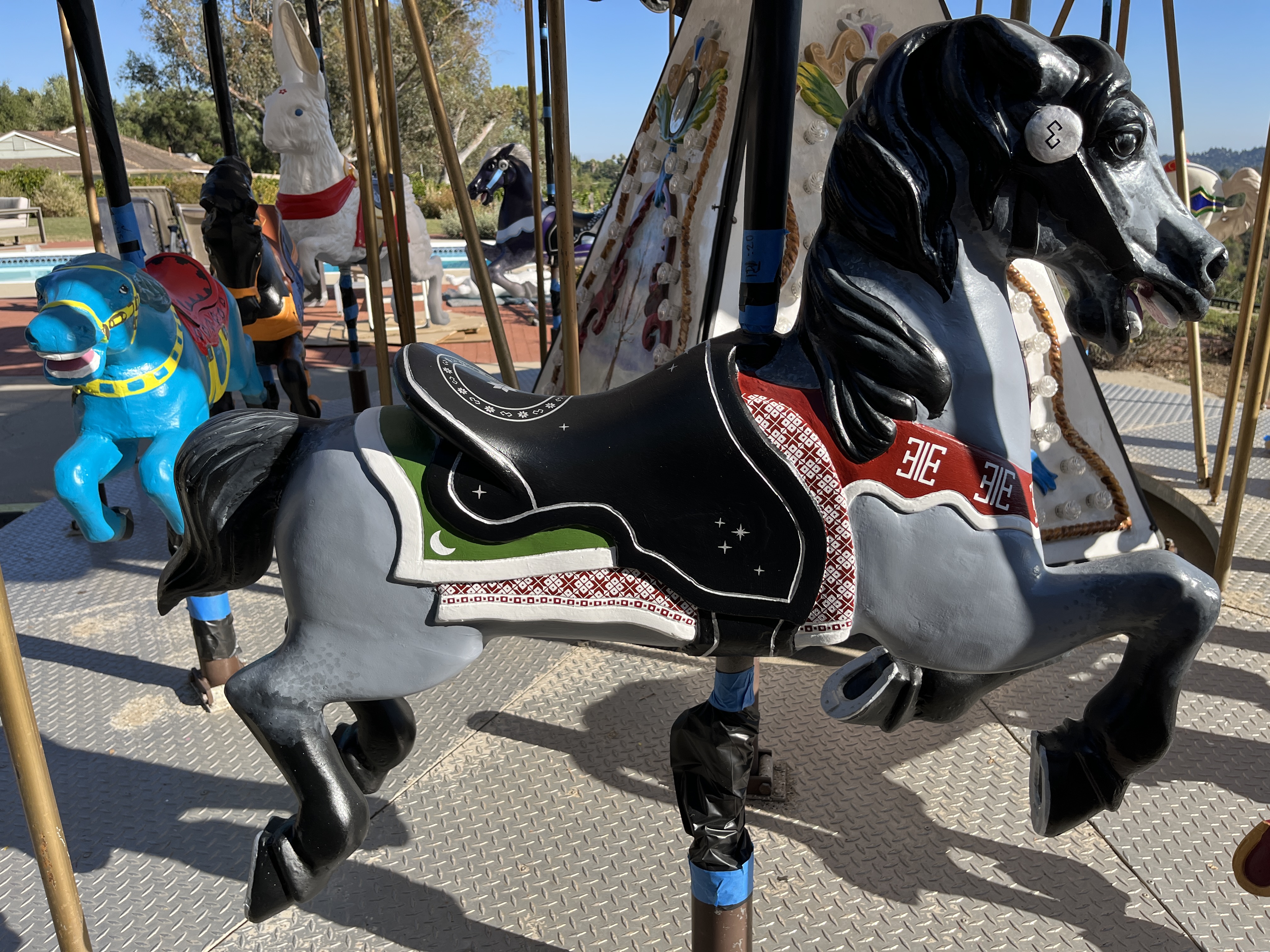
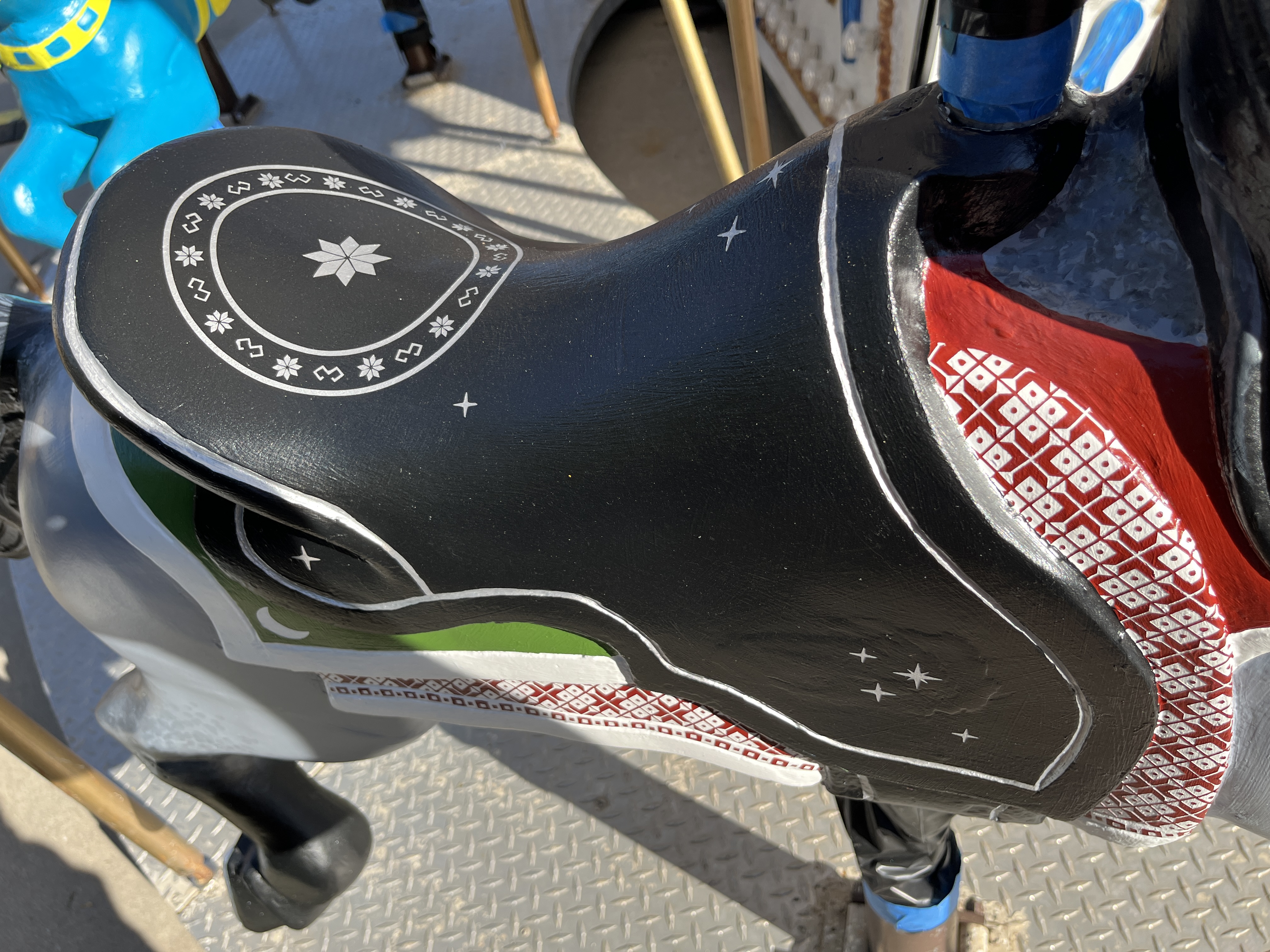

Mēness (the Moon) is a god of war and was once the husband of Saule (the Sun). He wears silver silk and a cloak of stars, and carries a sword at his side. The stars are his warriors who fight alongside him each night. He travels through the sky counting them to ensure they are in their place, often finding the morning star Auseklis missing. He was called upon to protect travelers at night and warriors in battle. Historically, soldiers would adorn their horses with Moon symbols.
The star pattern on the saddle blanket is one of many patterns woven into traditional textiles called Lielvārde belts. The ring on the saddle depicts an e-shaped symbol of the Moon moving among the twelve zodiac constellations (stars) along the ecliptic plane in the sky.
Shitsilí (Diné)
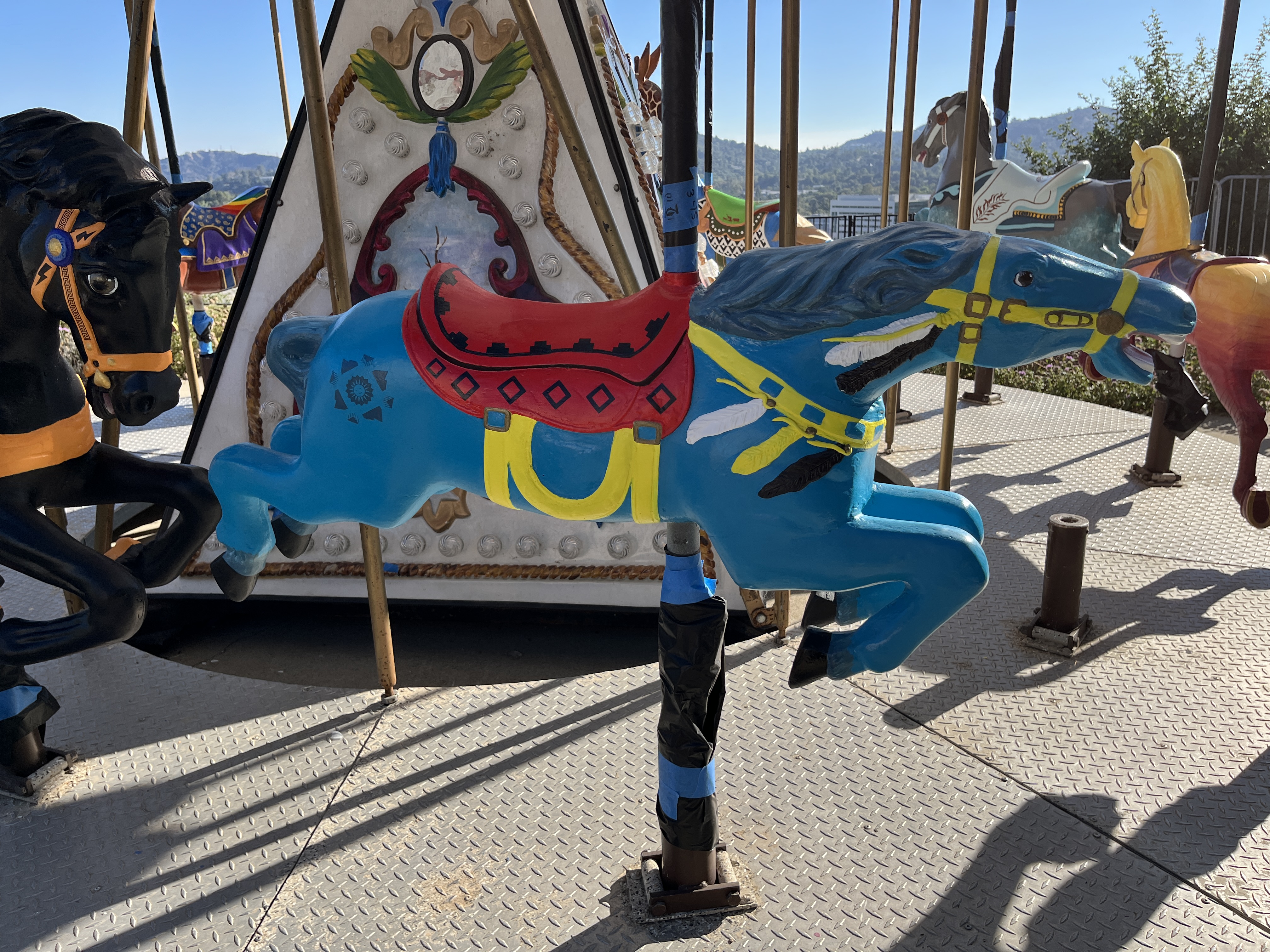
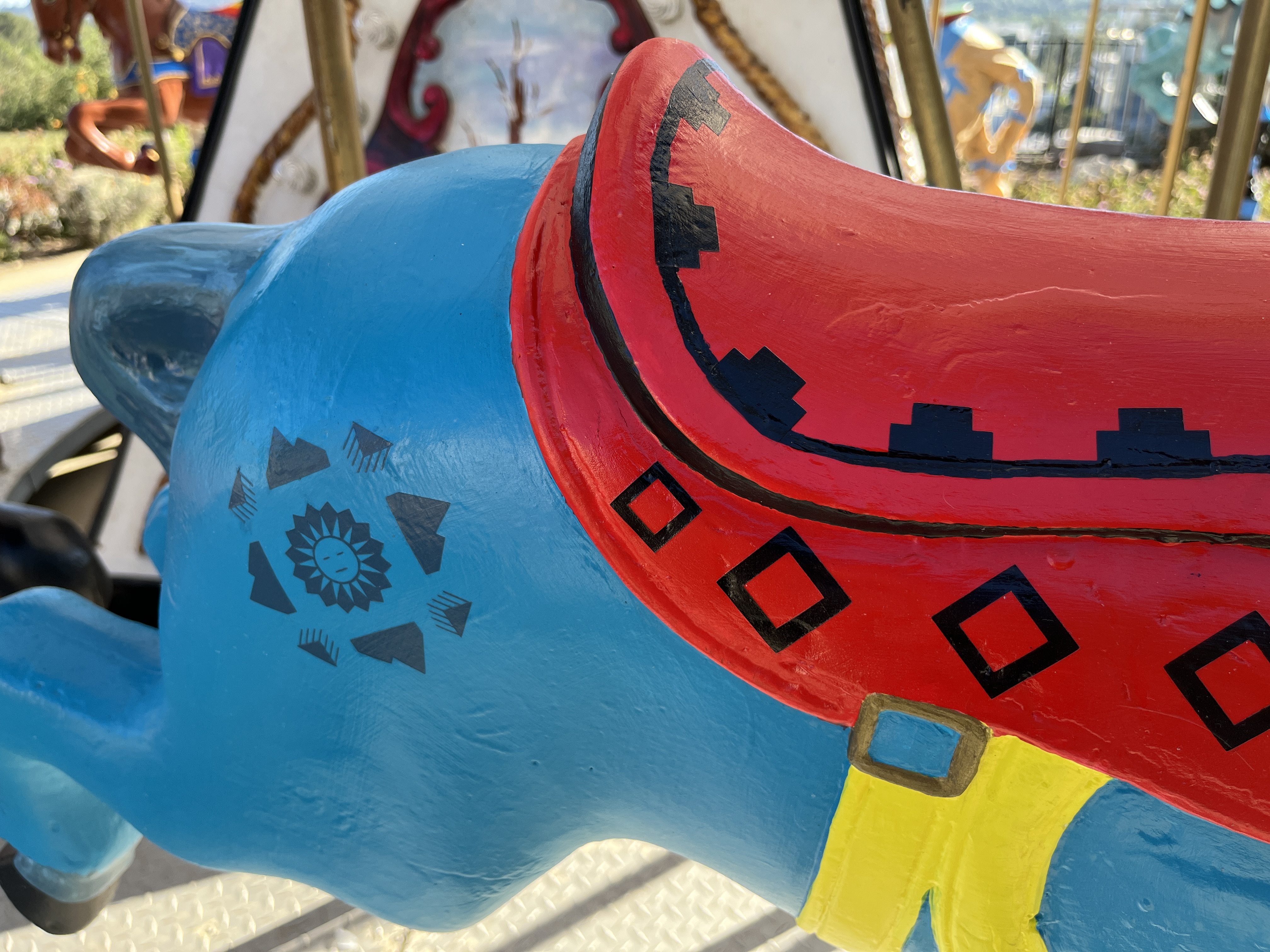
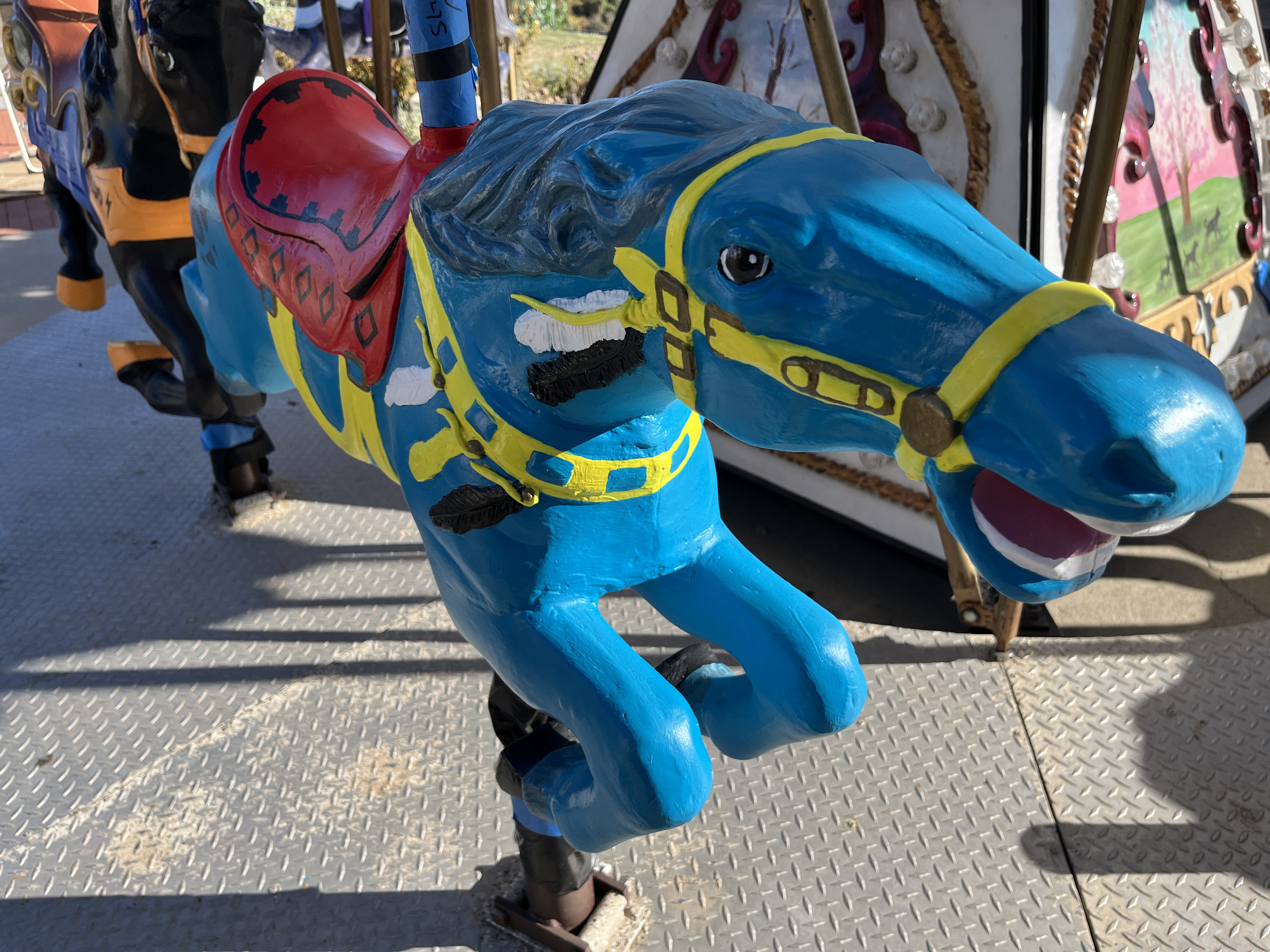
Turquoise is a gift from the Holy People sacred reminder of the second world (the blue world) where the Diné (Navajo) lived as spiritual beings, before moving into this one. It is also the namesake of Turquoise Boy, who along with White Shell Girl, became the Sun bearer and the bearer of night. Turquoise Boy created the horse for the Dine people, using corn for its ears, shells for its teeth, precious stones for its hooves, and placing the stars in its eyes. When it gallops, its legs flash like lightning, its hooves make the sound of thunder and its mane swirls like clouds.
In Diné culture, turquoise is associated with water and sky. As a stone, it connects sky to Earth, forming when rain seeps into the ground and chemically reacts with copper. The symbol on the horse’s hindquarter shows Turquoise Boy in the center of the four sacred mountains with rain falling in between
Lungta (Tibetan Buddhist)
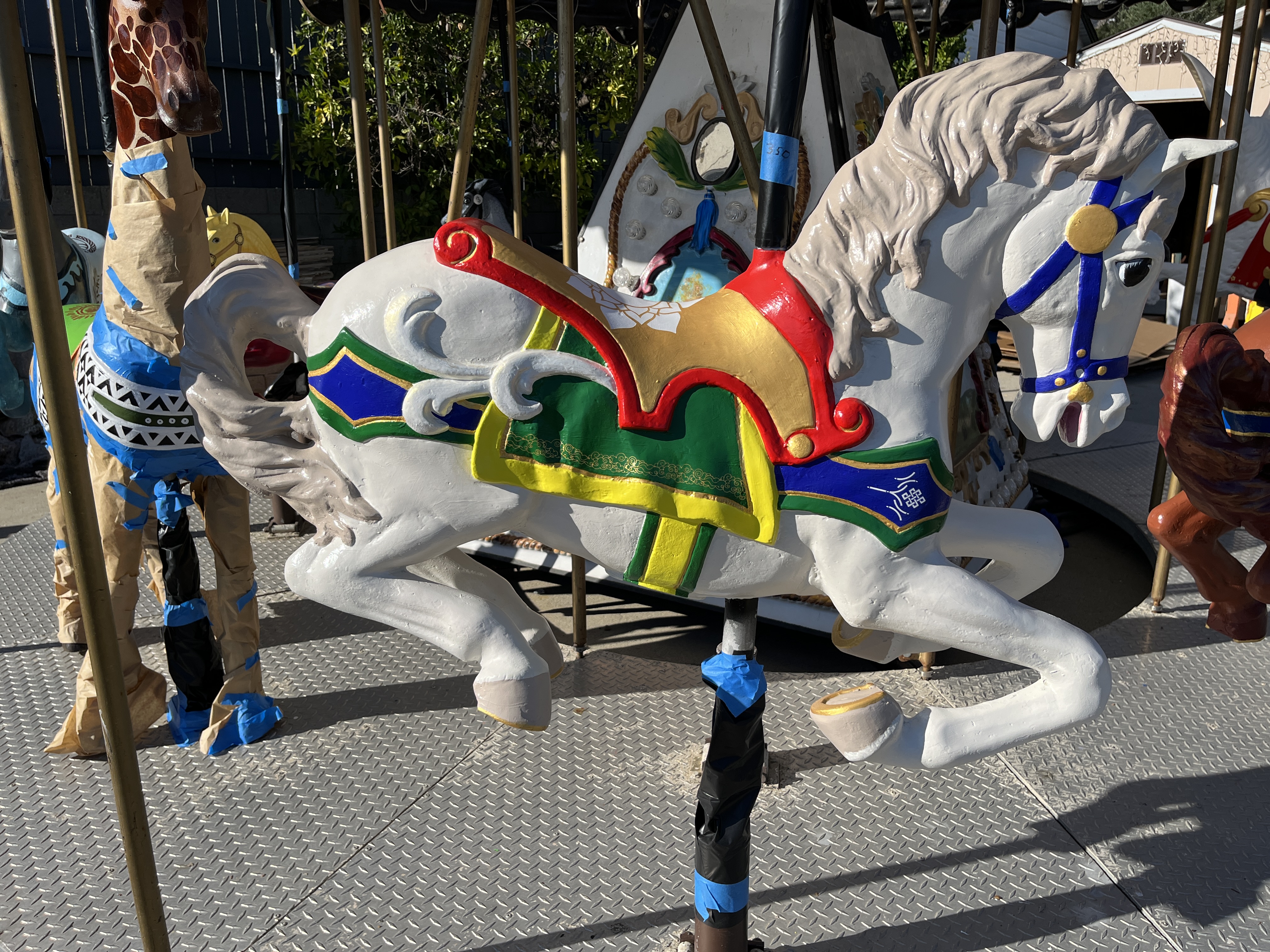
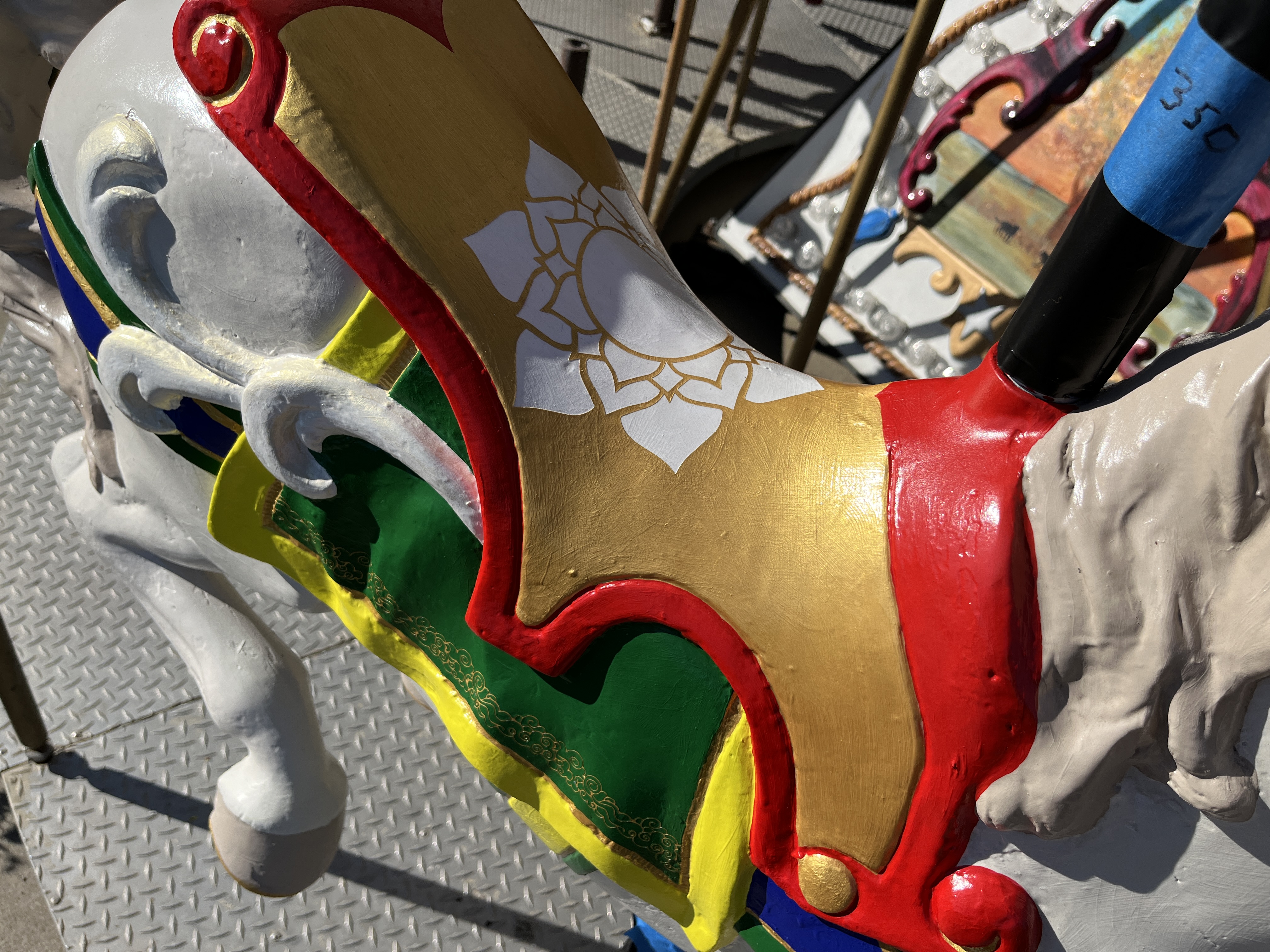
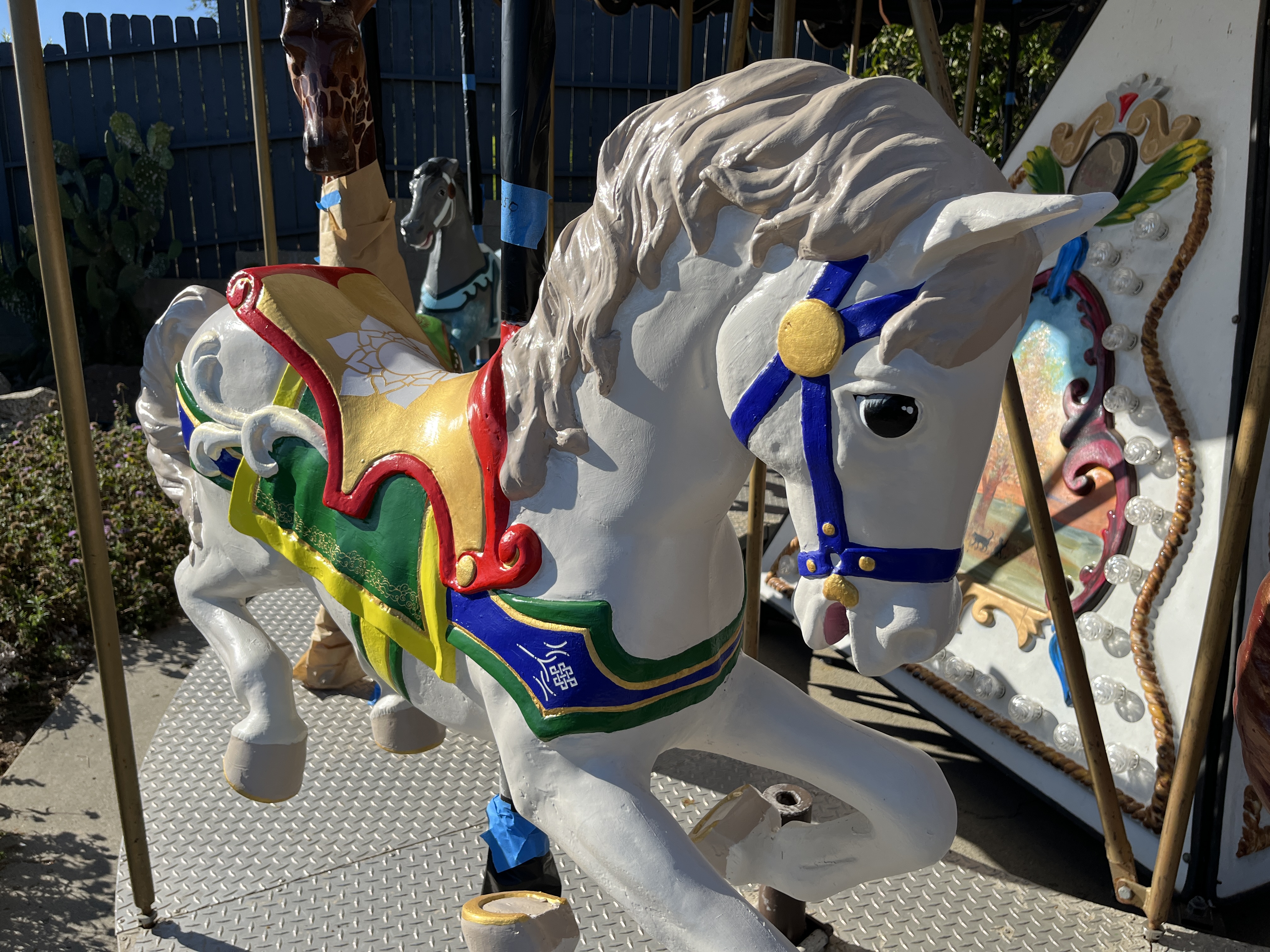
Lungta means “wind horse,” the figure depicted on Tibetan prayer flags associated with the vital life force and basic energy of goodness. The concept of “riding the wind” means to invoke that goodness in your life, though this energy cannot be possessed. Prayer flags spread lungta by the act of the wind blowing through them and carrying their mantras away. Rituals can also be performed to help raise one’s lungta.
The Eternal Knot on the chest strap has several meanings, among them the interconnectedness of everything in the universe. Here it is embellished with arrows showing Earth’s Hadley cells, the direction of air circulation between different latitudes that drives changes in weather. Combined, these symbols remind us that everything in our climate, culture, and practices are connected.
Àmụ̀mà (Nigerian)
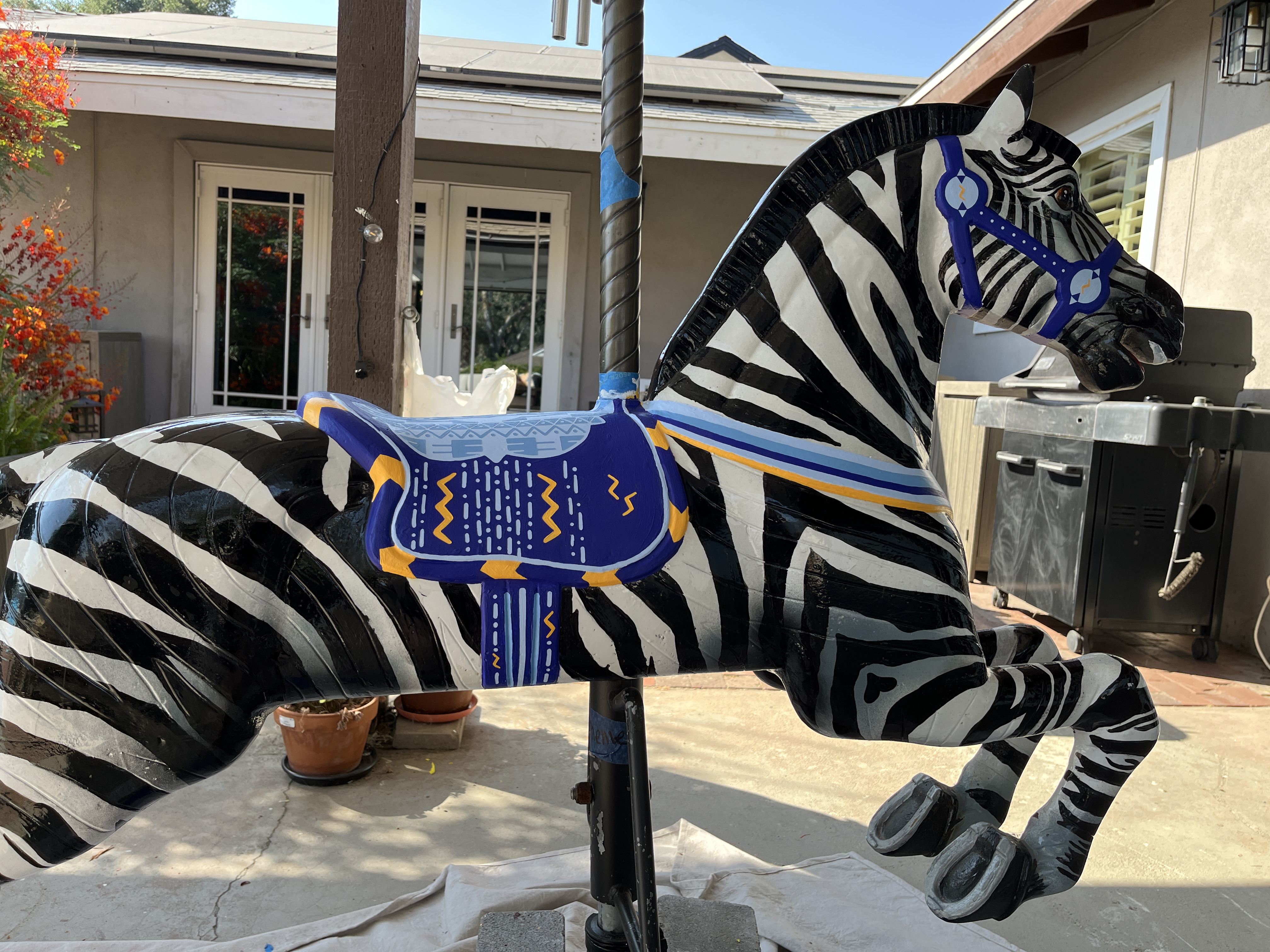
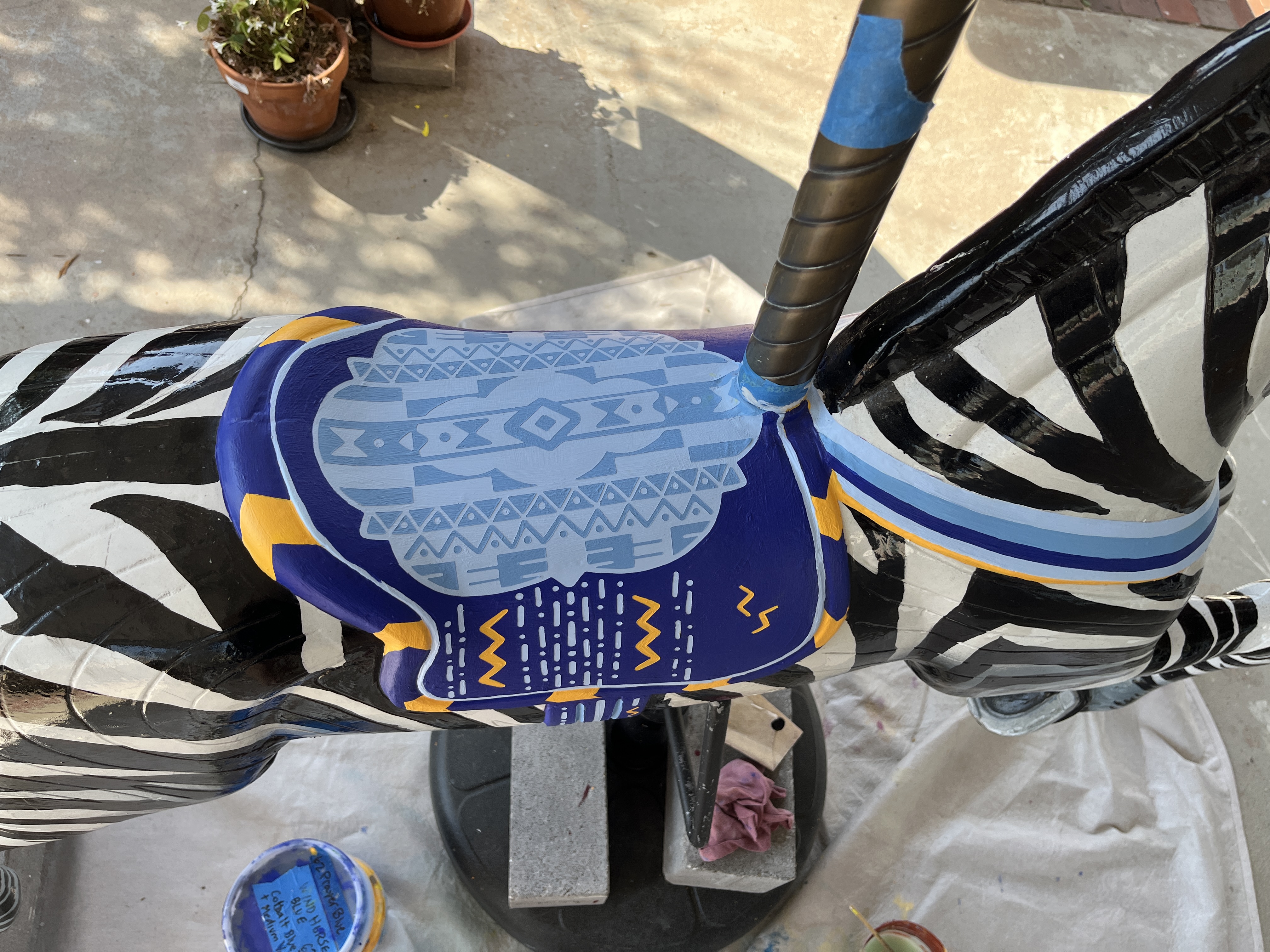
A Nigerian folk tale tells of a mother sheep named Thunder and her son Lightning the ram. The ram had a poor temper and whenever he became angry he would start fires, knock down trees, and damage buildings in the village. The sheep would call in her loud voice for him to stop, but he would not listen. Fed up, the villagers eventually banished them to live in the sky. Àmụ̀mà means “flash” in the Igbo language, short for amụmammiri (“lightning”). He is re-imagined on this carousel as a zebra.
The pattern of the saddle’s cloud is designed based on aso-oke textiles of the Yoruba people. Its inverted colors represent the separation of positively and negatively charged particles inside storm clouds as water molecules become stripped of their electrons, which migrate to the cloud’s edge until they discharge to Earth’s surface in the form of lightning
Note: We understand that zebras do not actually live in Nigeria, but being unable to find a suitable zebra story it was a compromise to better representing more African folklore on the carousel and in a visually prominent way.
Seshat (Egyptian)
Known as the Mistress of the House of Books, Seshat was the goddess of writing, knowledge, measurement, and astronomy. She was a scribe and record keeper, credited with the invention of written language, and her notched palm rib (the hieroglyph symbol for “year”) was used for recording the passage of time. Under the epithet Lady of Builders, she was invoked in the important “stretching of the cord” ceremony used by builders and architects for surveying and laying out building foundations and aligning them to astronomical or geographic features. The object on her head is a surveying instrument consisting of a vertical rod with several radial horizontal rods, used to make straight lines and measure angles. She wears a leopard-skin dress, whose spots associated her with the stars.
There were no horses in ancient Egypt, but here we invoke Seshat’s leopard motif with this horse’s spots, representing them as craters instead of stars. The impact craters on the surface of a planet or moon contain a record of its history. Scientists can count the number of craters to determine its age, by comparing it to the “cratering record” of the lunar surface. On the saddle, Seshat is shown drawing the lines of a typical “crater count” diagram used in the study of planetary chronology.
Apuchin (Andean)
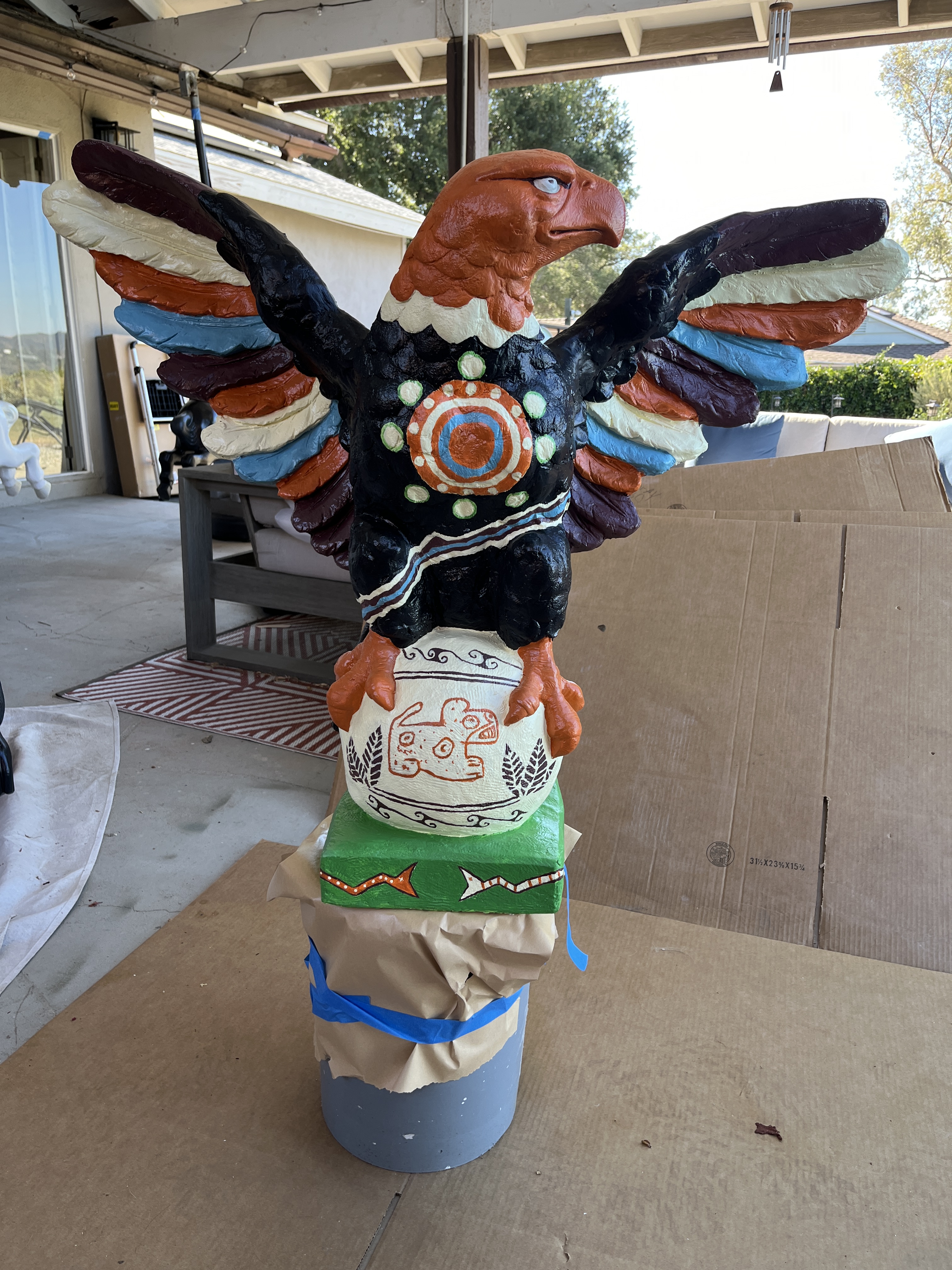
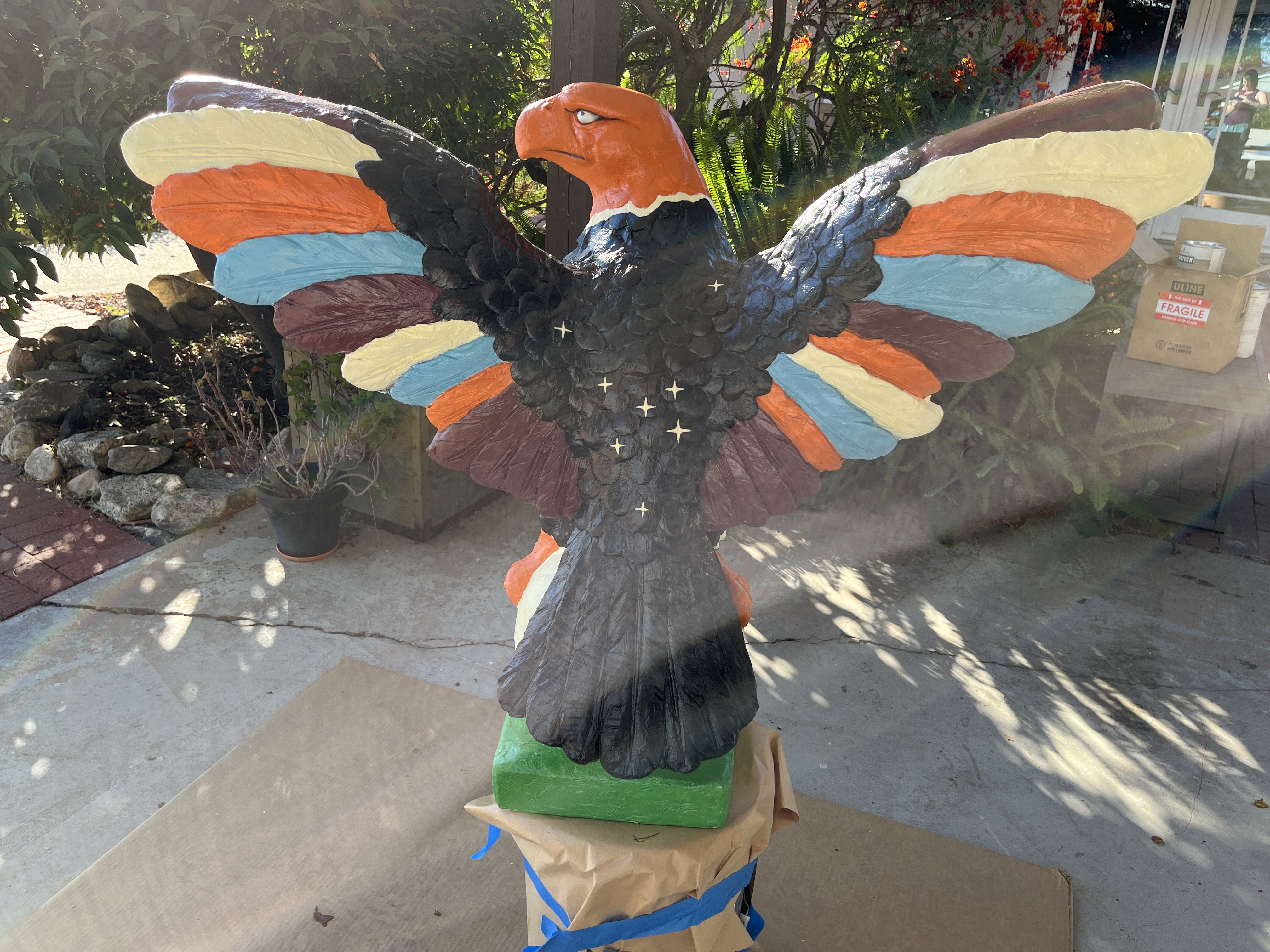
Indigenous Andean cultures (who historically made up the Inca empire), recognize a trio of sacred animals: the condor associated with the sky (Hanan Pacha), the puma the Earth (Kay Pacha), and the snake the underworld (Ukupacha).
Condors are the divine messengers between people and gods, especially the Sun god Inti and the deities of the sacred mountain peaks, called apus. Apus provide protection and sustenance to villages, so the condor flies up to bring them the people’s offerings and prayers. The messenger role gives the condor an association with apuchin, a Quechua word meaning “all that is or will become” (something similar to destiny). The condor even plays an ecological role, flying down to the coast to forage and bringing water as rains back up to the highlands, and is part of the night sky as a constellation.
Na-gah (Northern Paiute)
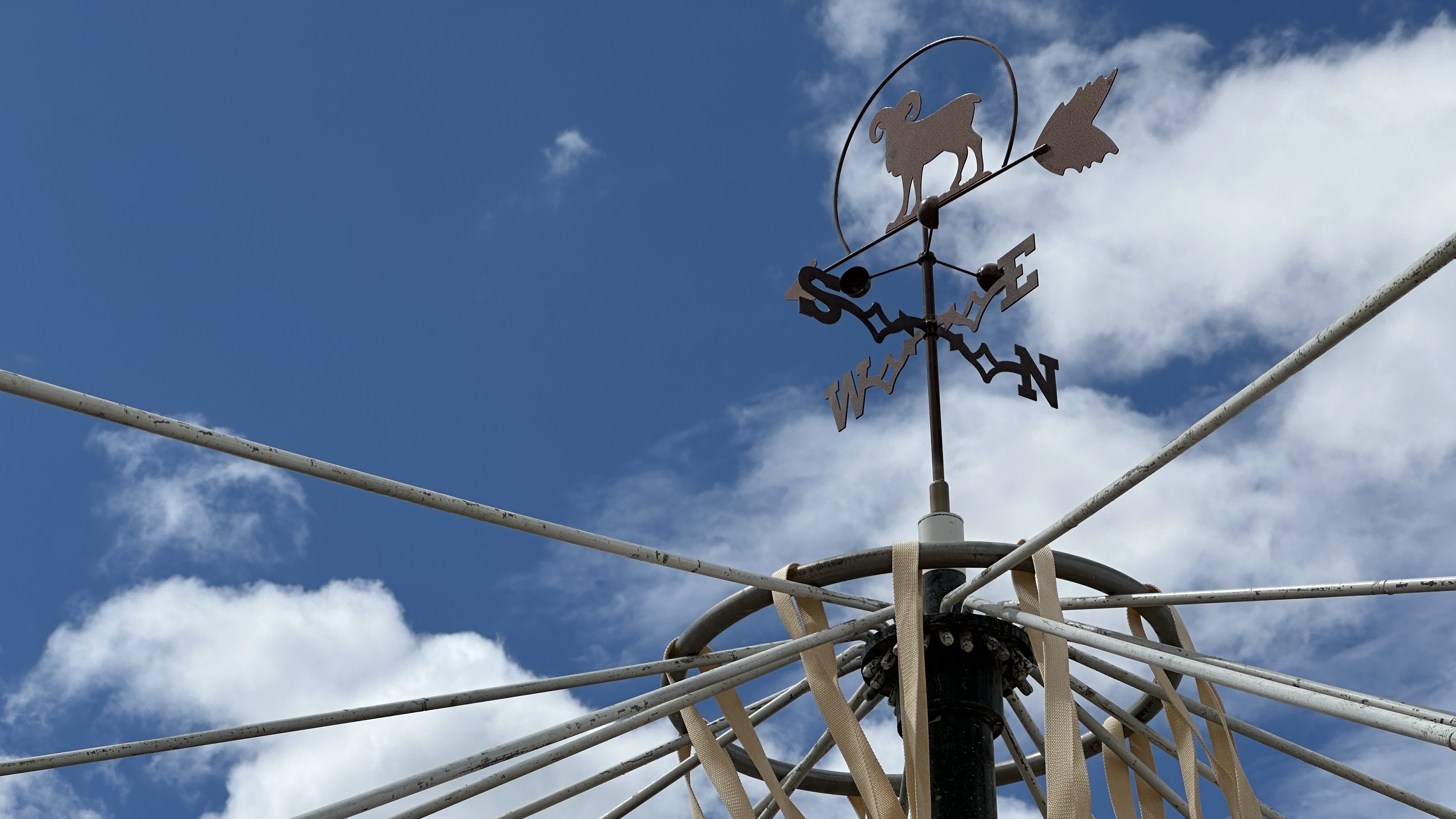
A weather vane at the top of the carousel depicts Na-gah, a bighorn sheep and son of the god Shinoh. He wished to climb the tallest mountain peak, but near the top it was impassible. Eventually he found a cave which led him to the top, but it collapsed behind him trapping him there. Shinoh was walking across the sky searching for his son and turned him into a star to save him. This star would never move in the sky so that it could be a beacon to guide others.
Stars move in our sky because the Earth is rotating, but the North Star stays still because it’s in line with our axis of rotation, and therefore can always guide us.
Land Acknowledgement: Black Rock City is built upon the traditional lands of the Pyramid Lake Paiute Tribe. We thank them for stewarding this land and commit to doing the same while visiting.
Celeris (Greek)
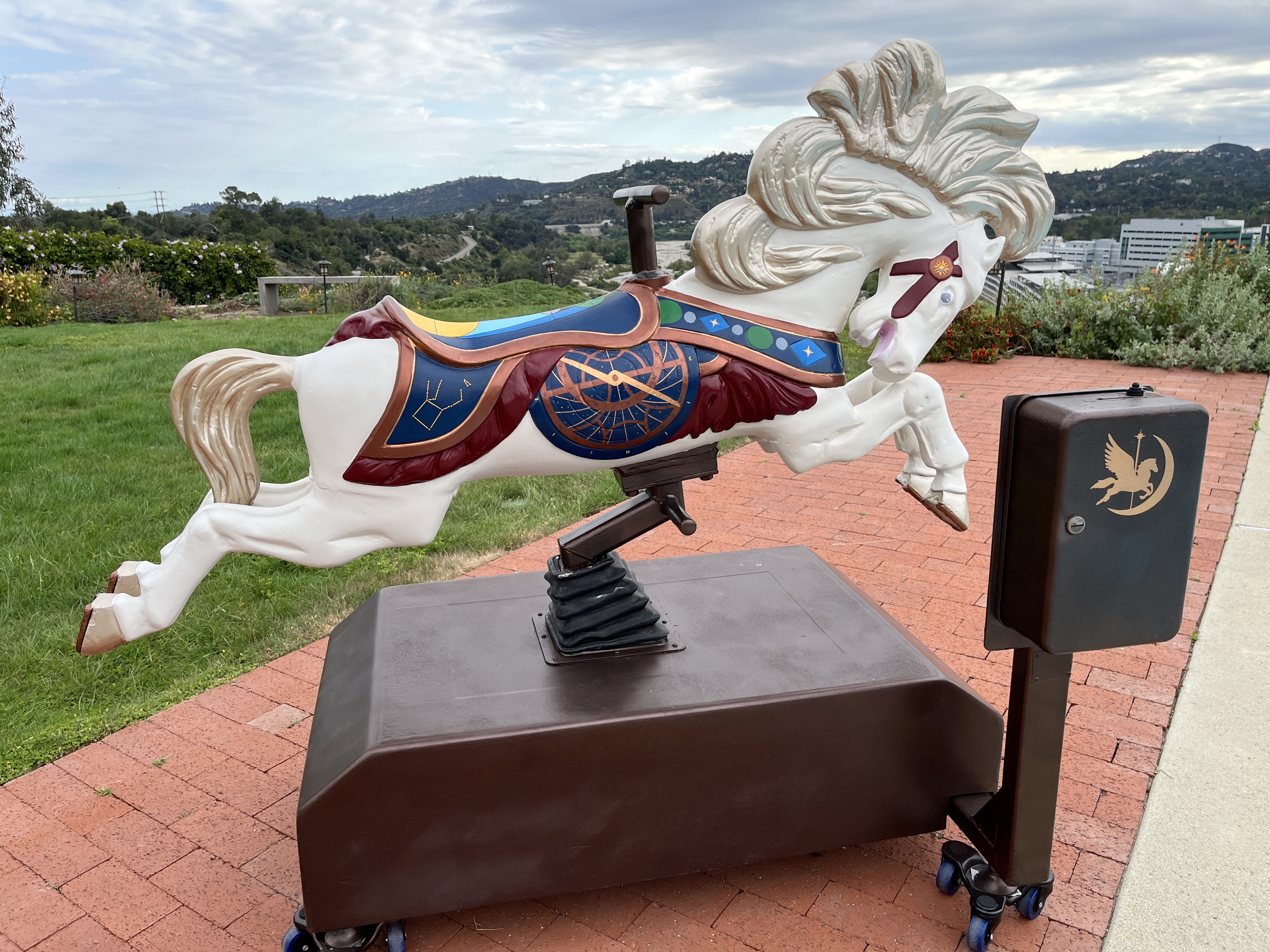
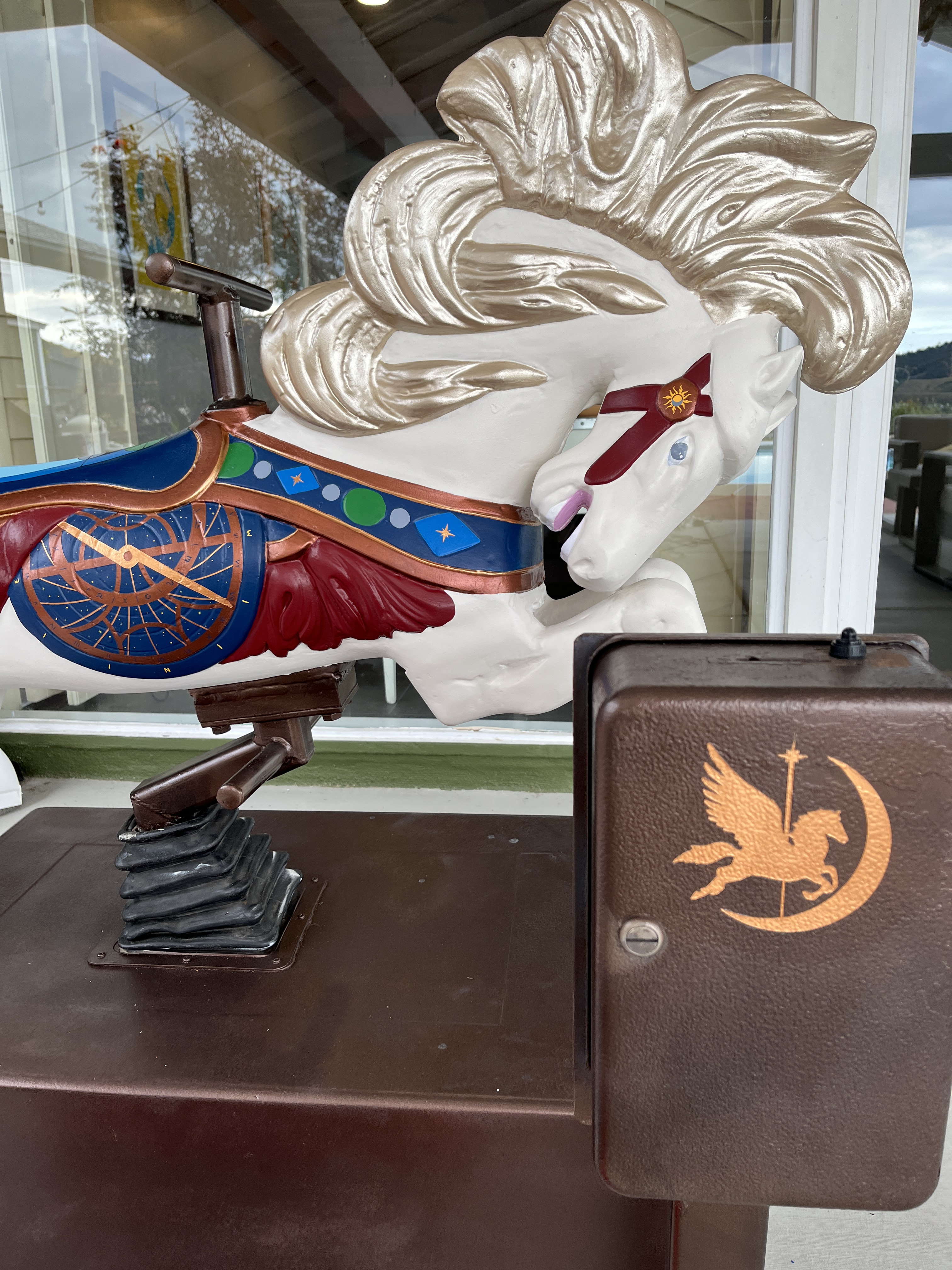
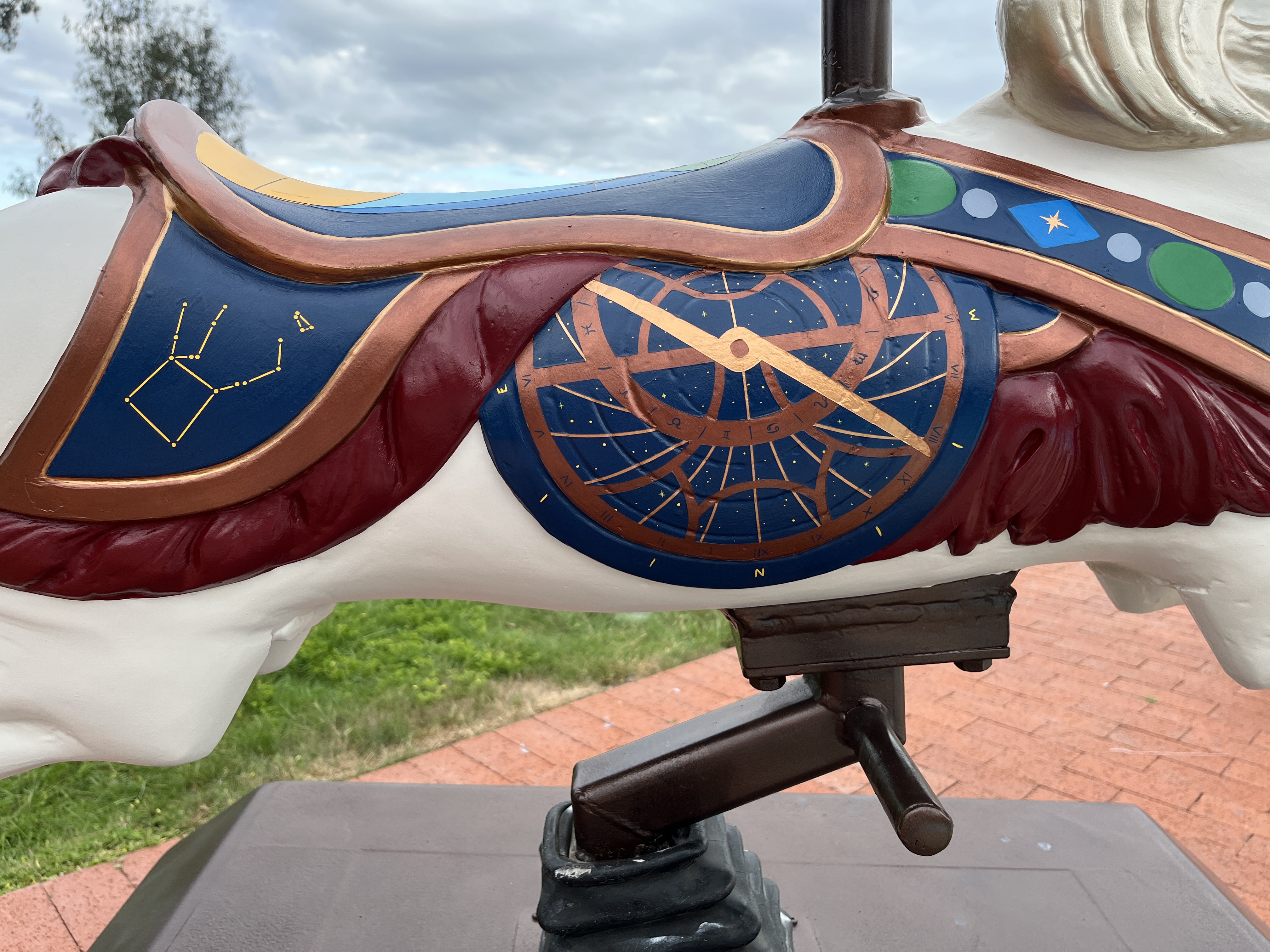
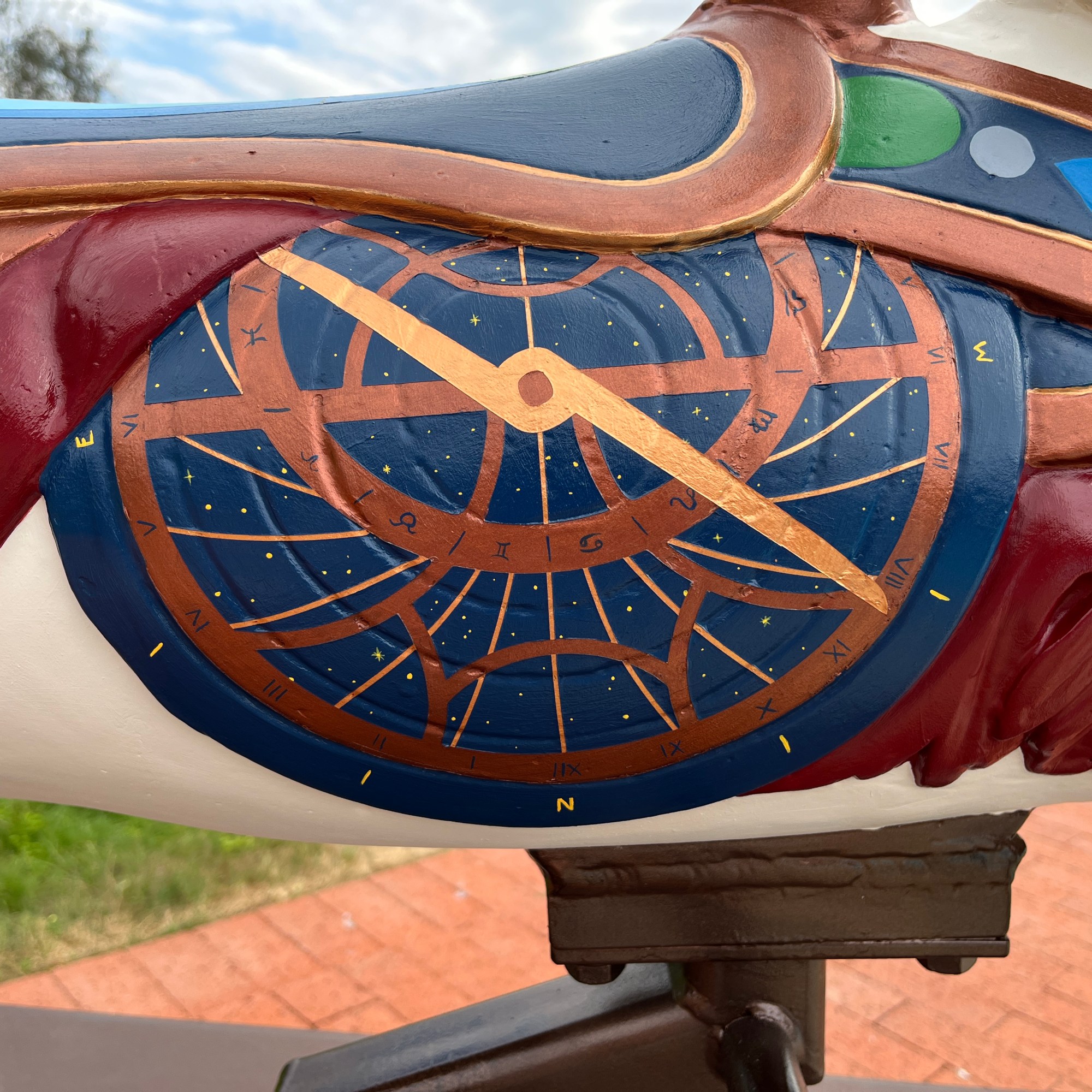
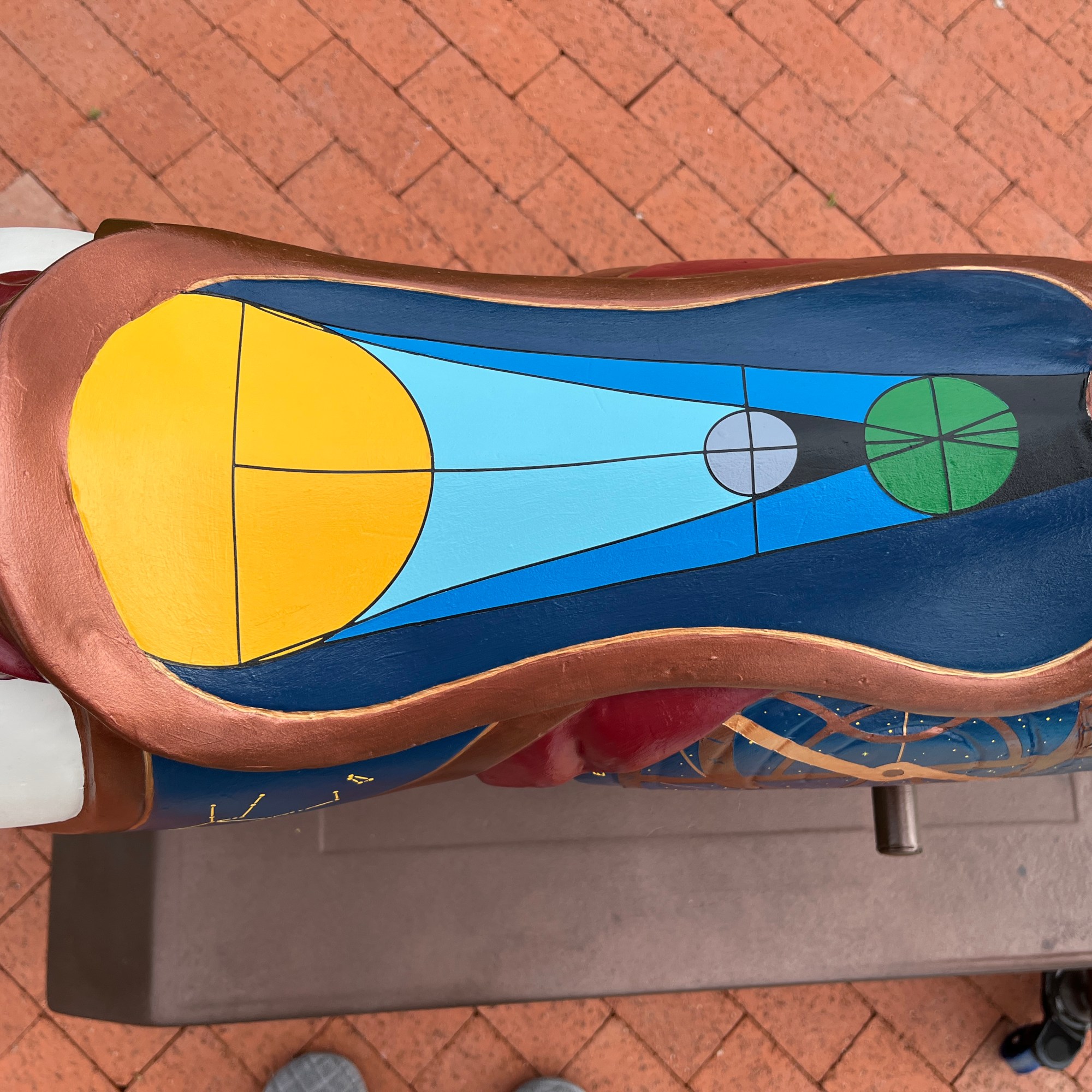
Celeris is named for the foal of Pegasus and themed after the work of ancient Greek astronomer and mathematician Hipparchus who was said to name the Equuleus (“little horse”) constellation. Hipparchus was one of the most foundational mathematicians in history, famous for inventing trigonometry and being the first to estimate the the relative distance to the Moon using eclipse geometry, shown on the saddle top. On the side of the horse is also shown the Pegasus and Equuleus constellations as they appear in the sky as well as an astrolabe, an astronomical instrument also invented by Hipparchus.
Nēšum (Mesopotamian, Babylonian)
This figure hasn’t been painted yet! Stayed tuned!
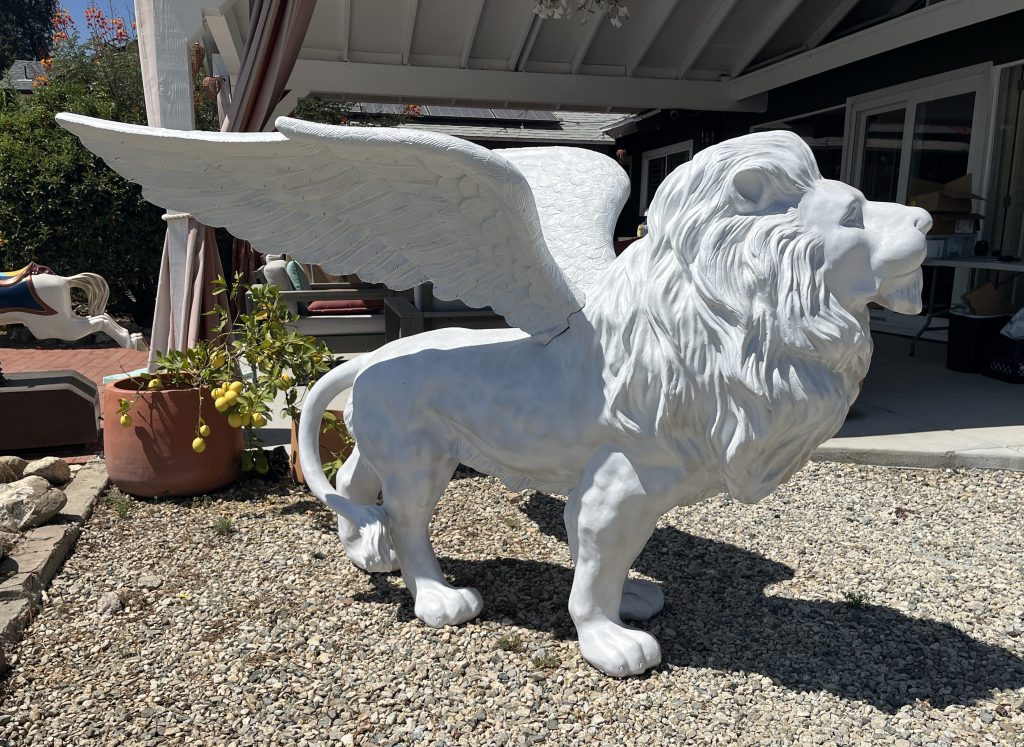
Ishtar was a goddess of both love and war from ancient Mesopotamia, and associated with the planet Venus. She is depicted riding a winged lion and alongside the symbol of an eight-pointed star. Ishtar was linked to and/or known as Inanna in some regions. The colors used for this design are inspired by the mosaics of the famous Gate of Ishtar in modern-day Iran.
The reason the planet Venus is commonly represented by fertility goddesses is because it spends nine months in the sky as the Morning Star and then again as the Evening Star, and its transition between the two was an important time marker to many early civilizations. Venus’ location in our sky during retrograde rotates in a circle to five different points over a period of eight years, making five and eight numbers commonly associated with these deities. The orbital diagram of Venus’ location as seen from Earth is sometimes called the “flower of Venus” for its five-petaled shape. Here, the flower and Ishtar’s eight-pointed star are combined.
Photos will be up soon! Check our Facebook page if you can’t wait 🙂
Lanalana (Hawaiian)
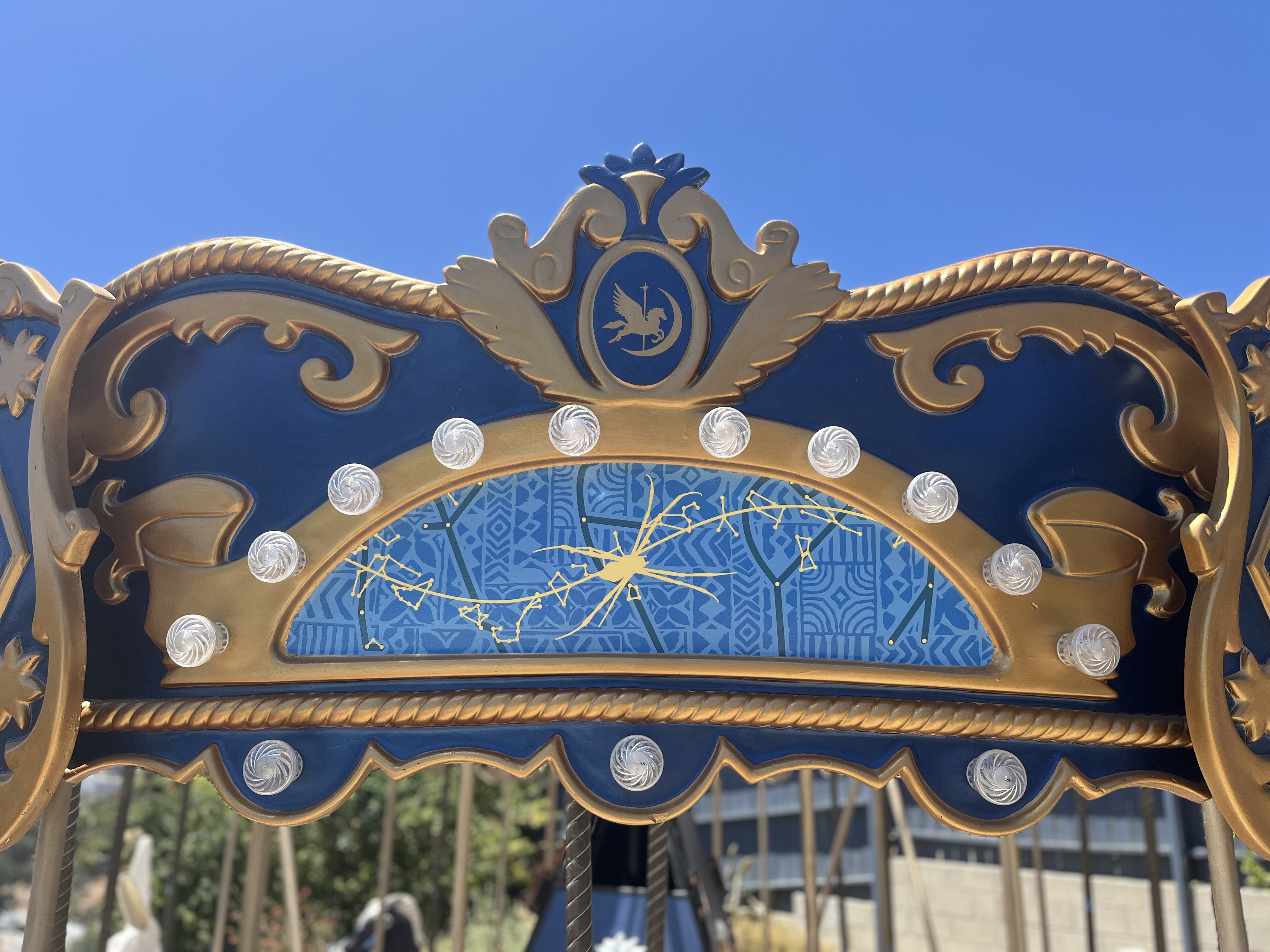
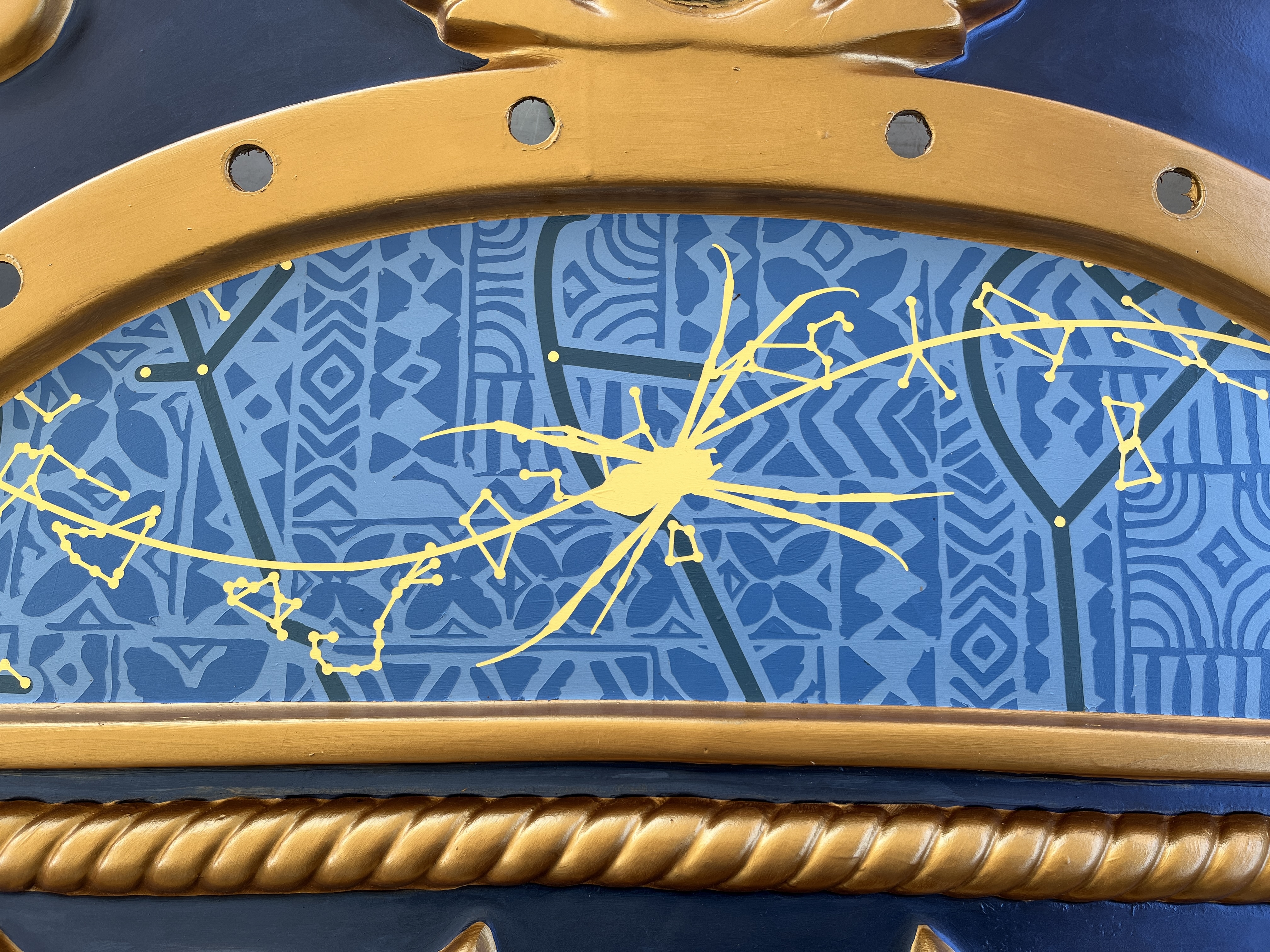
This panel depicts the path of the ecliptic, called Ke Ala a Ke Kuʻukuʻu (“The Way of the Spider”) by native Hawaiians. Ancient Hawaiians organized the night sky into four sets of “star lines” (the darker lines in the image), each filling one fourth of the sky and used for navigation and timekeeping. The star lines are called Ke Ka O Makalii (the canoe-bailer of Makalii), Ka Iwikuamoo (“the backbone,” which ran from Polaris to the Southern Cross), Manaiakalani (the fish hook of Maui incorporating the Greek constellation Scorpio), and Ka Lupe a Kawelo (the kite of Kawelo, including the great square of Greek Pegasus).
The style of the background pattern may look familiar. It comes from the indigenous art of making kapa (pronounced “tapa”), a textile made of tree bark. Geometric patterns are beaten into the texture of the cloth during the making process, and afterwards dyes were applied using the beaters as well as other carved wooden blocks.
Tepēyōllōtl (Aztec)
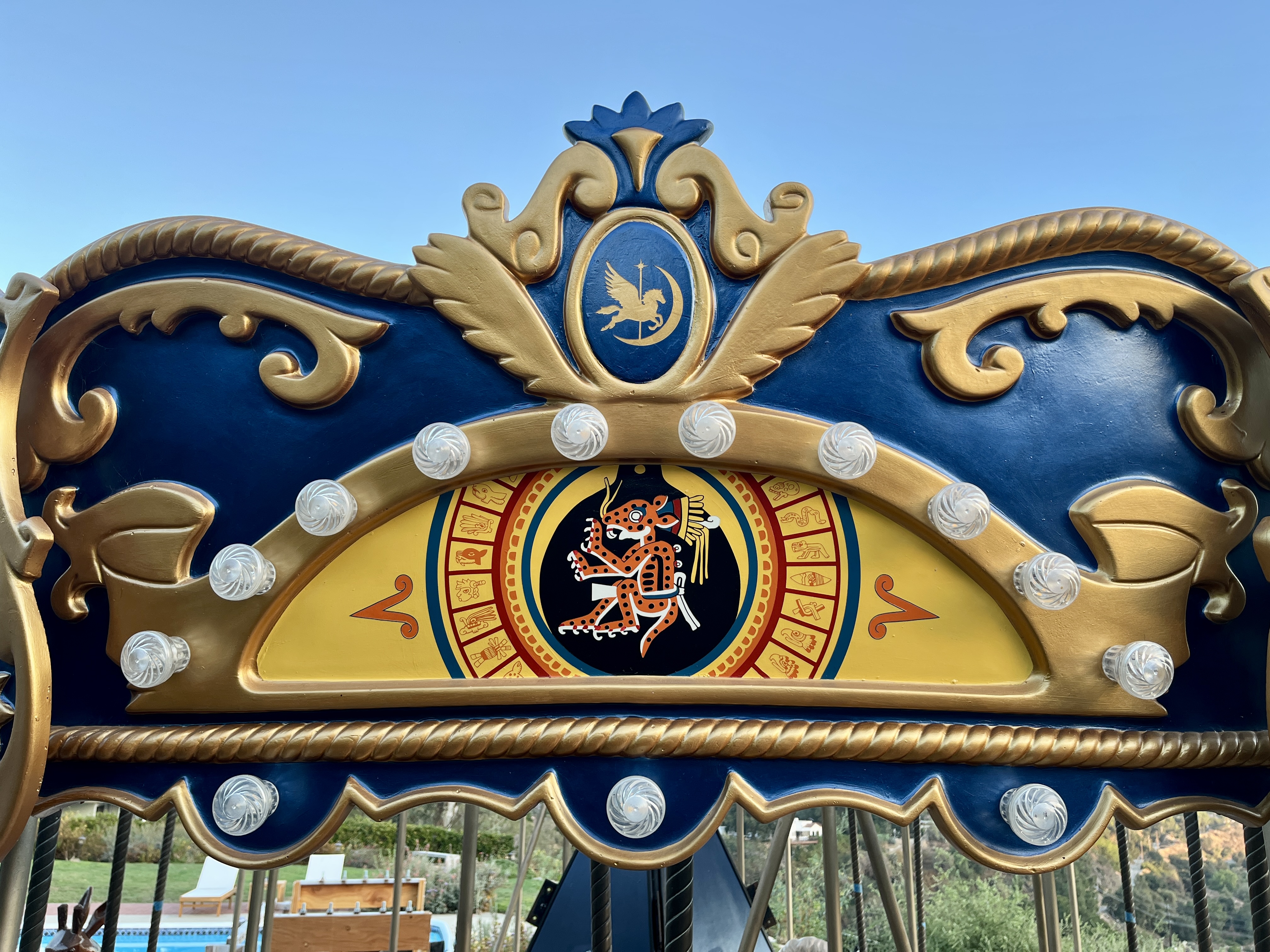
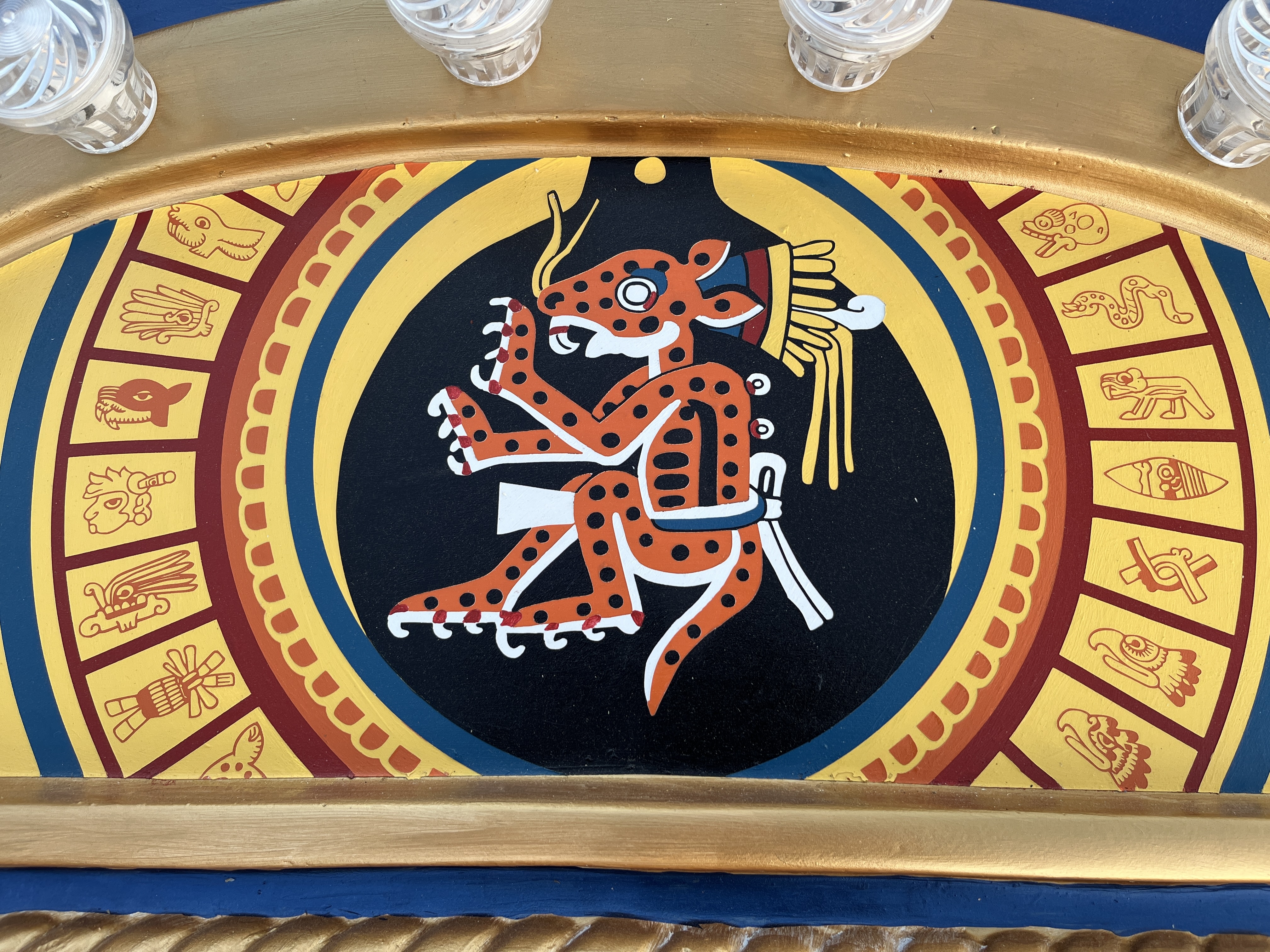
Tepēyōllōtl (“Heart of the Mountains”) a god of dark caves, echoes, and earthquakes, as well as the god of the eighth hour of night. He is the nagual, or animal counterpart, to Tezcatlipoca (“Smoking Mirror”), one of the creator deities and the god of the night sky. Smoking Mirror is a reference to obsidian, which was polished and used by leaders for ritual and divination purposes. Here Tepēyōllōtl is pictured against an obsidian mirror and surrounded by symbols of the trecena, a 13-day period used in the Aztec calendar and with which both gods are associated.
The link between these two figures connects Earth to the cosmos not through the air or the light of the Sun’s rays, but instead through the darkness of night and the deep underground.
Saliguga (Cherokee)
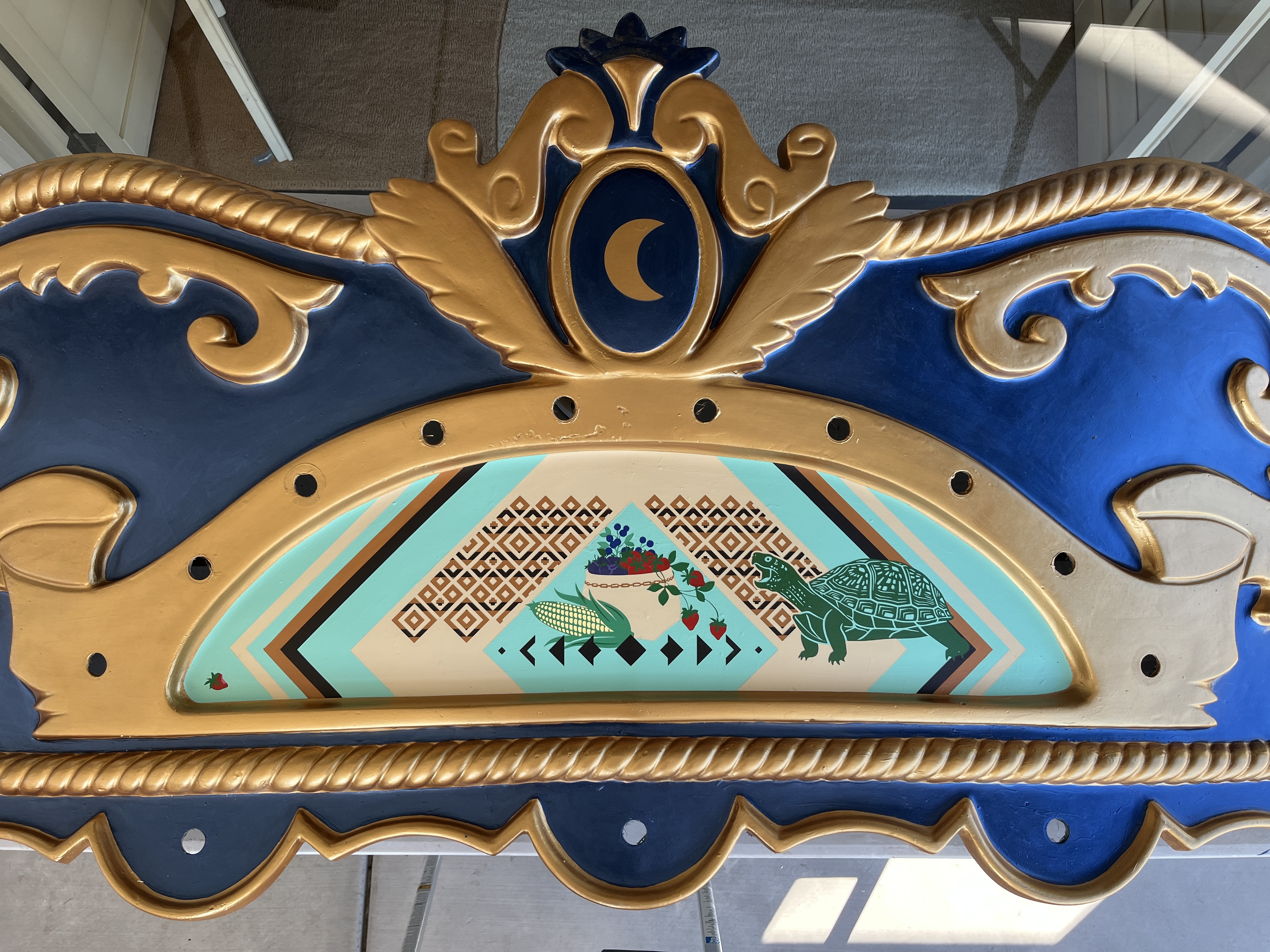
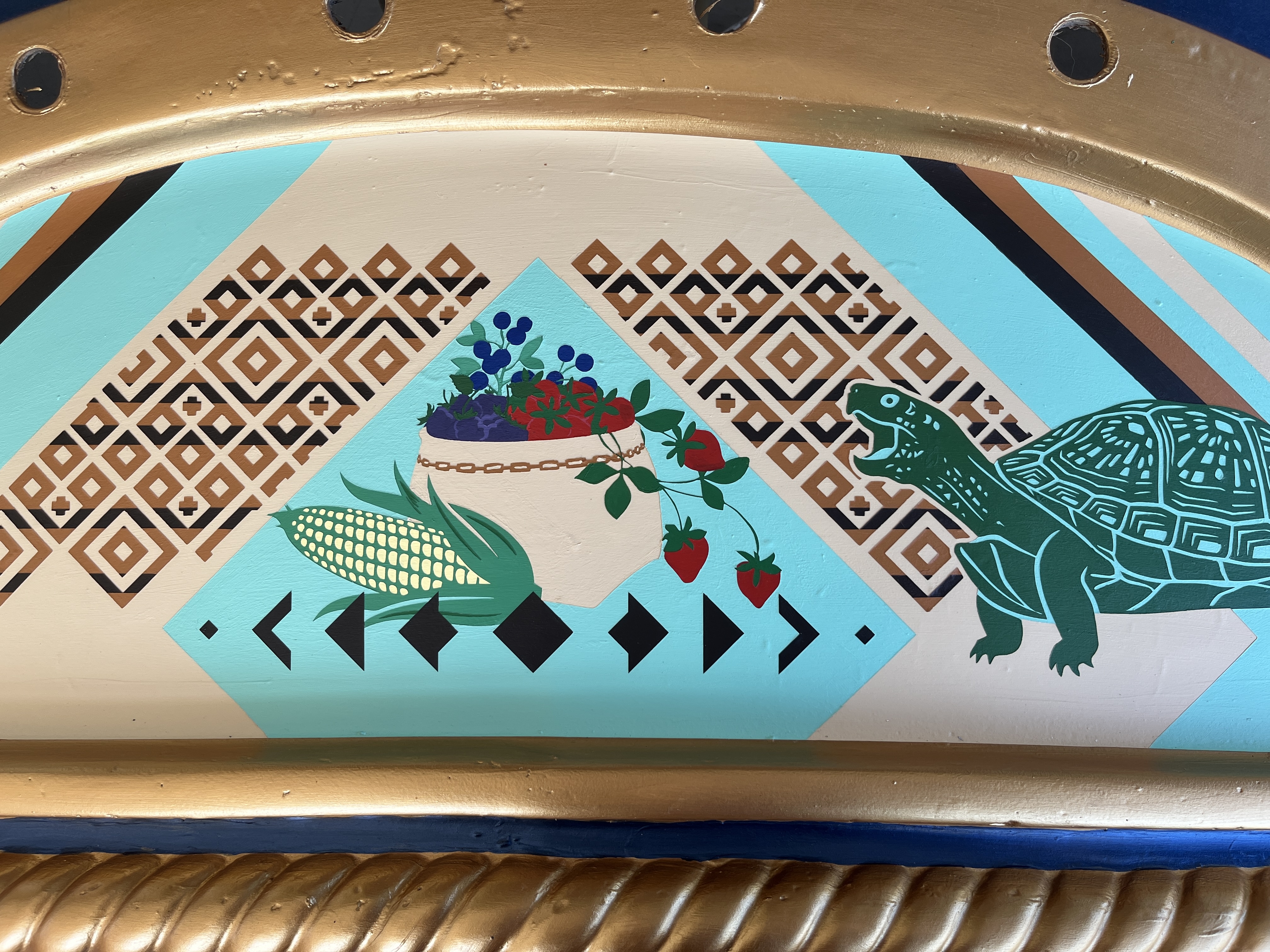
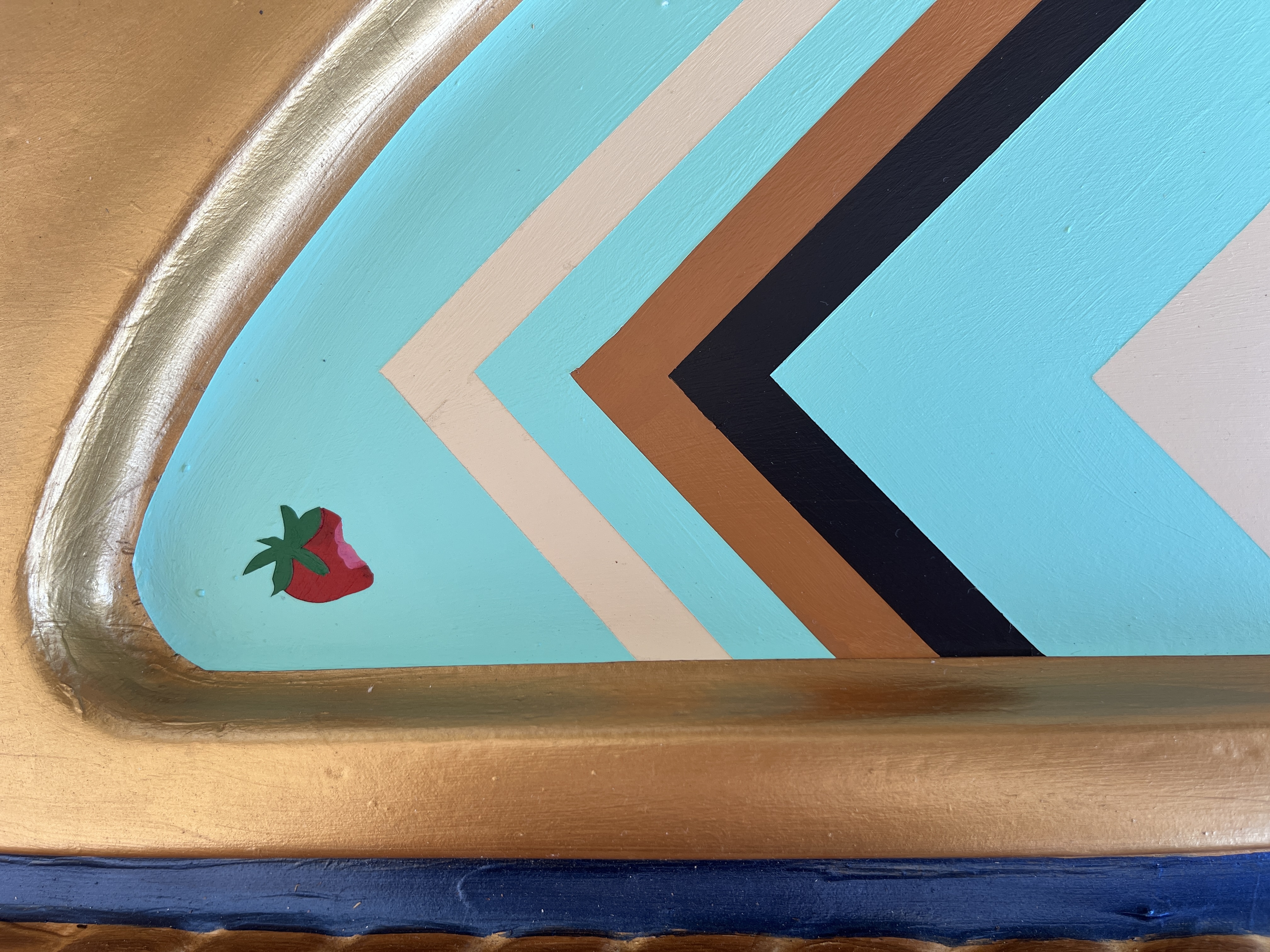
This panel has a Cherokee theme focused around their view that the 13 scutes on a turtle’s shell represent the months of the lunar calendar. The 13 cycles of the 27.3-day lunar month produce a lunar year of approximately 354 days. Turtles are of great cultural importance, playing a pivotal role in their creation story and representing a keeper of knowledge. In the scene are shown some of the foods with which their months and/or month names are associated, such as strawberries, blackberries, and corn.
The geometric pattern is a traditional Cherokee basket weaving pattern. Their incredible baskets are made from materials like white oak and rivercane and dyed vibrant colors using other plants like black walnut bark and bloodroot. At the bottom, the moon phases are shown in a similar geometric style.
Havlan (Evenki)
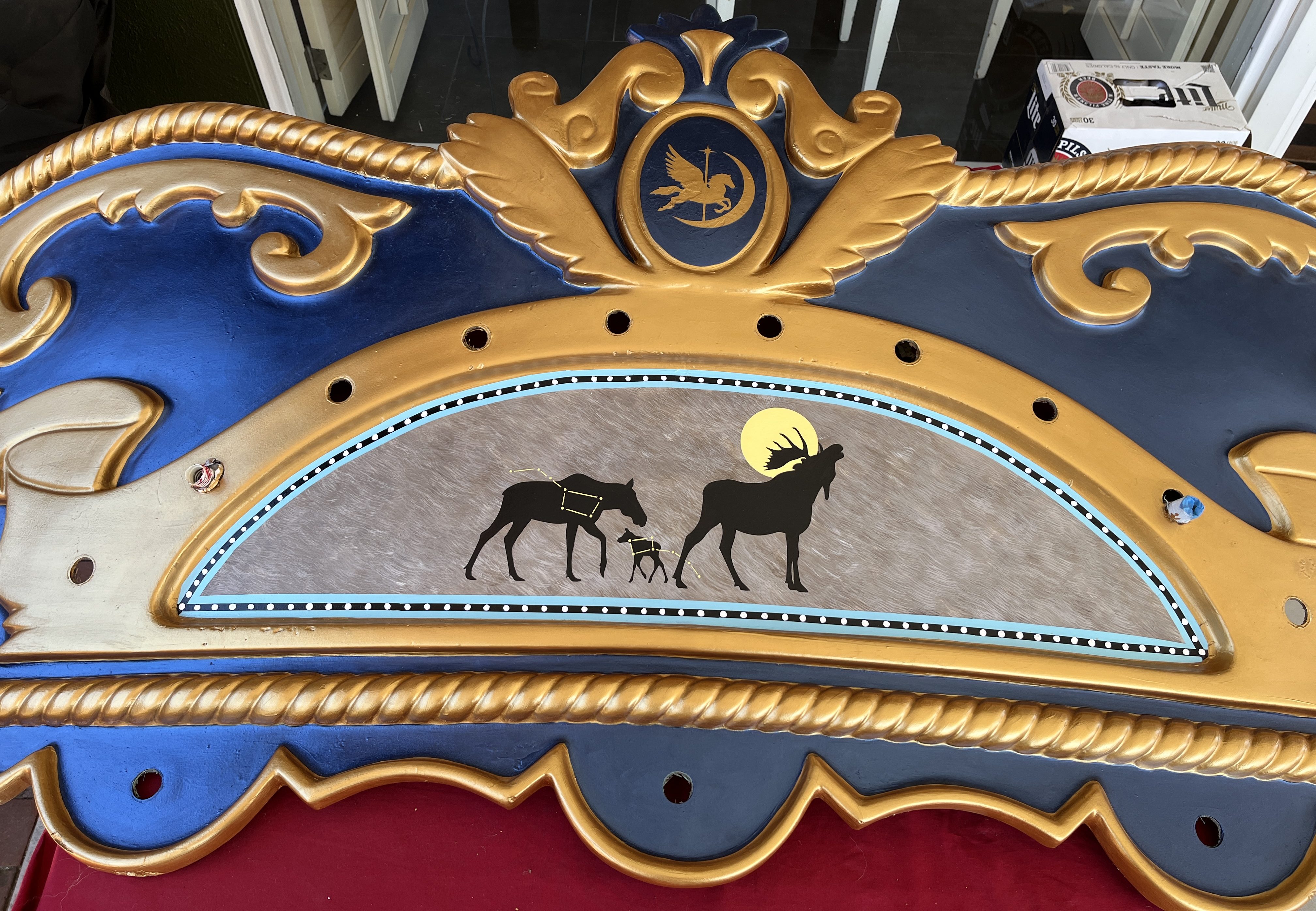
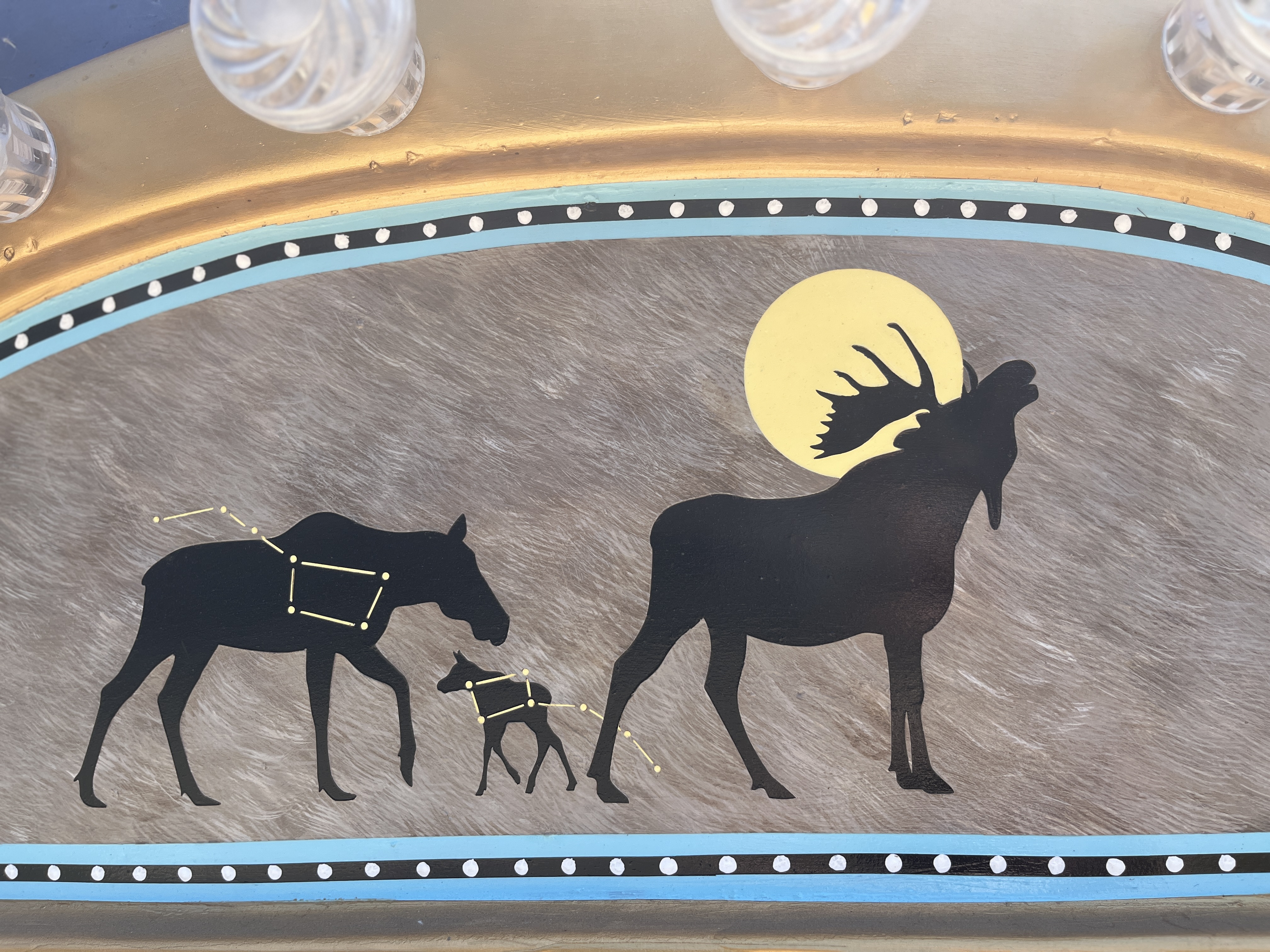
The Evenki have two stories of cosmic elk, represented by the Big Dipper constellation, which explain the movement of the stars and/or Sun. In one, the elk and her calf (the Little Dipper) hide in the forest during the day but come out at night to graze. A hunter pursues them across the sky leaving a wide trail on his skis (the Milky Way) and kills the mother, but the calf escapes. The next night, the calf has grown up and takes her place with a new calf and the hunt begins anew. In the second story, the cosmic elk steals the Sun and hides it under her belly, taking daylight away from the Earth. The hunter pursues her to retrieve the Sun putting in place the cycle of day and night. Here, the second elk is painted as a male to depict an elk family. The species they refer to as an elk in these stories we would call a moose in North America.
The Evenki people are originating from the Tungusk region of Siberia. They are known for their reindeer fur clothing and their beadwork. Fur was also used to make small circular (representing the Sun) rugs used ceremonially by women. The population of Evenki people today is less than 80,000, living in areas of Russia, China, and Mongolia.
Mboreví (Guaraní)
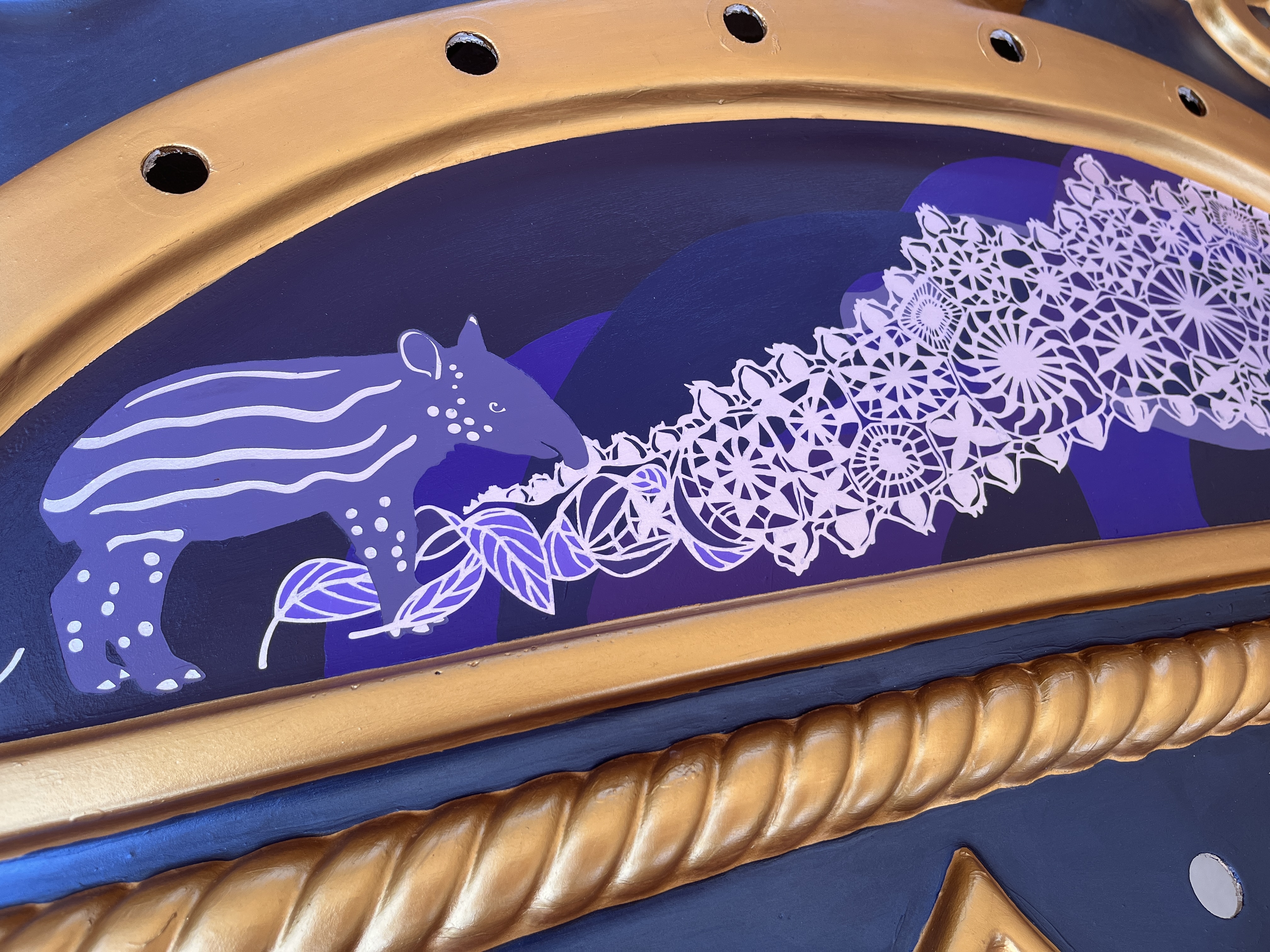
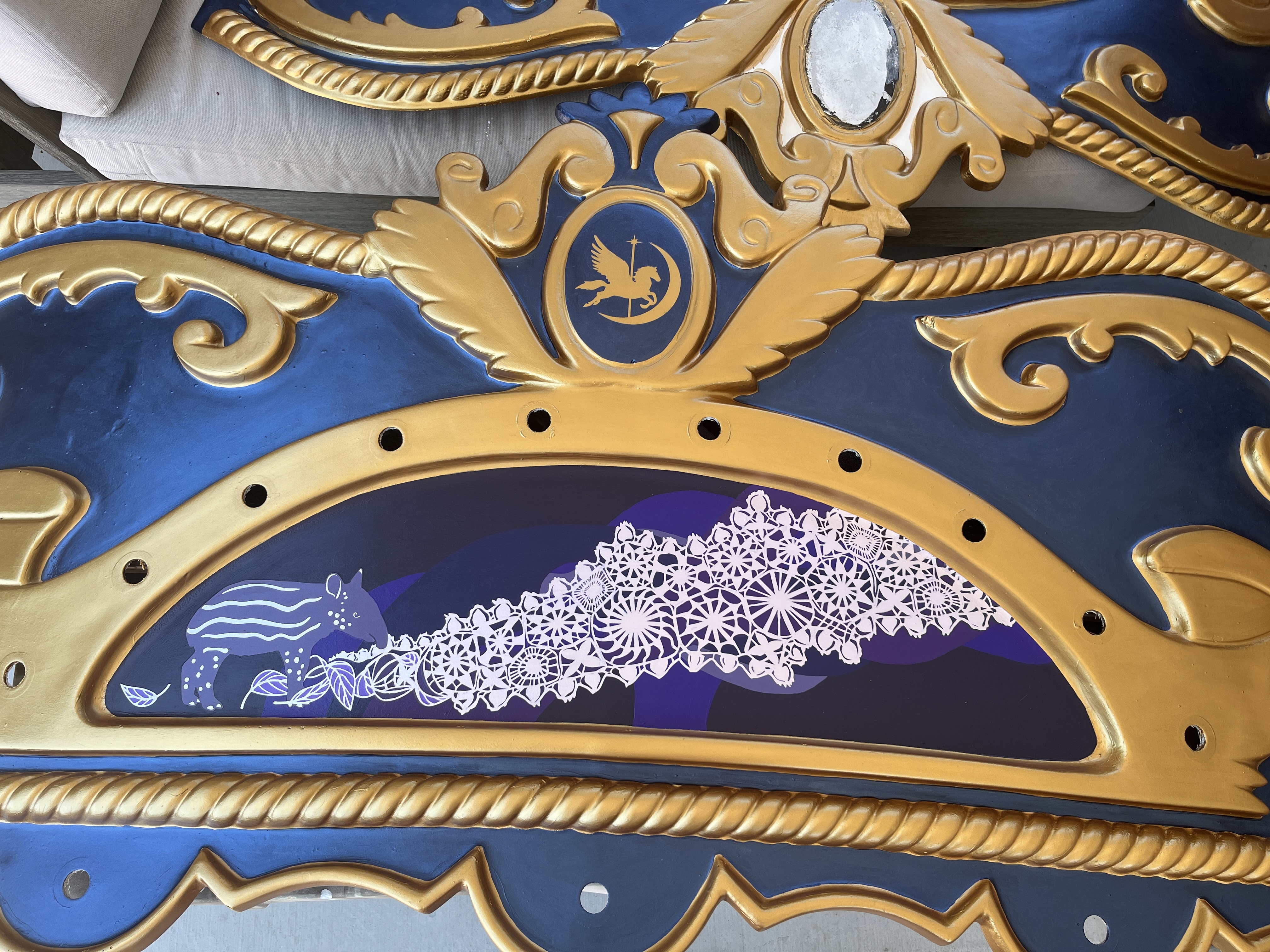
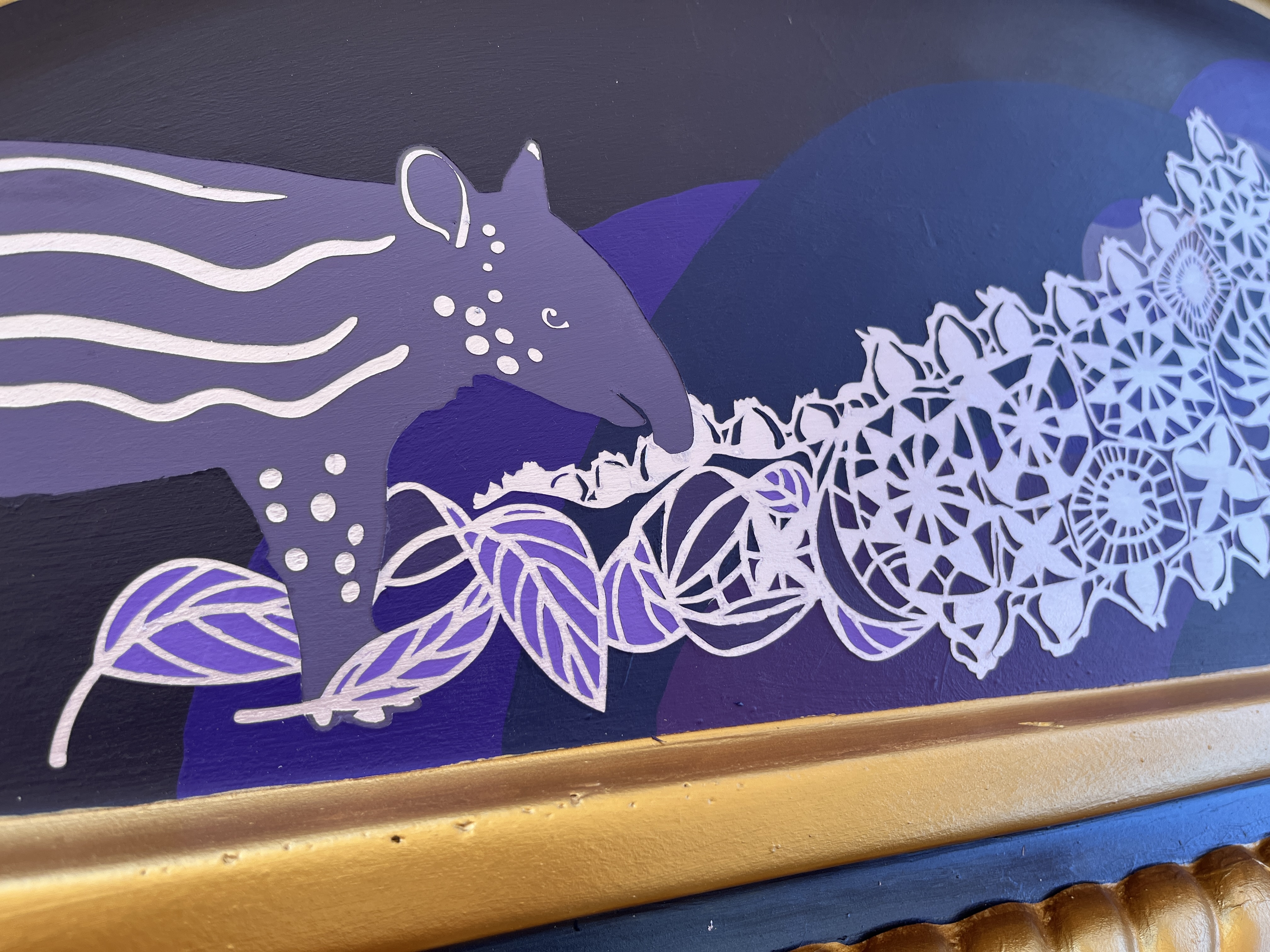
In the Guaraní cosmovision, the Milky Way is known as “the Tapir’s Path” (“Mboreví Rapé”) because it looks like light shining on crumpled leaves on the forest floor. Tapirs take a single path from their den to their water source each day and are a culturally important animal and food source.
The Guaraní are an indigenous linguistic group of over 5 million with many sub-groups spread throughout South America, but primarily located in Paraguay. The stars on the stencil were made from Ñandutí lace, a nationally celebrated Paraguayan traditional textile. Sincere thanks to the folks at the Planetarium Canopus in Asunción, Paraguay for sharing their knowledge on this topic.
Amisk (Cree)
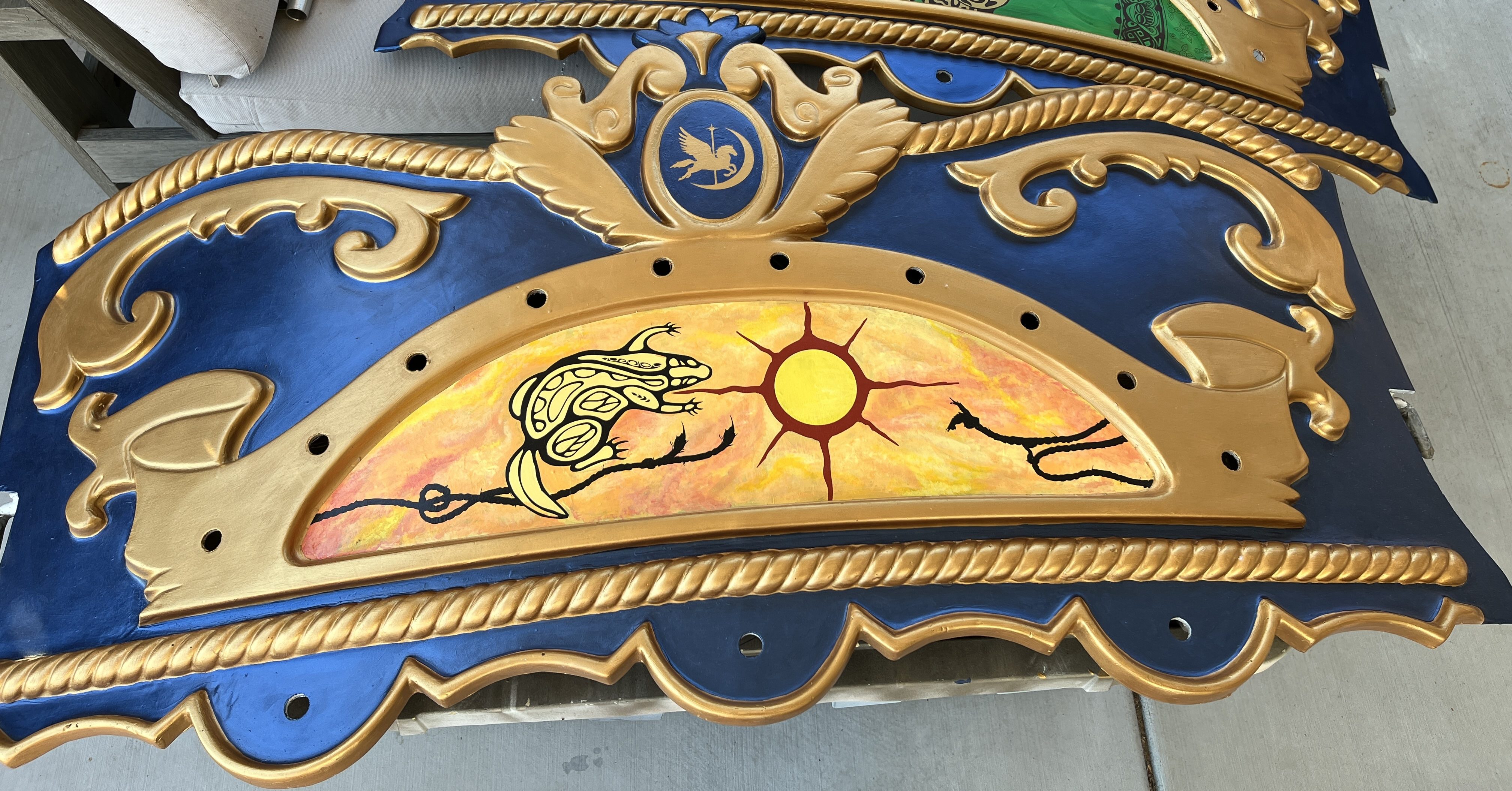
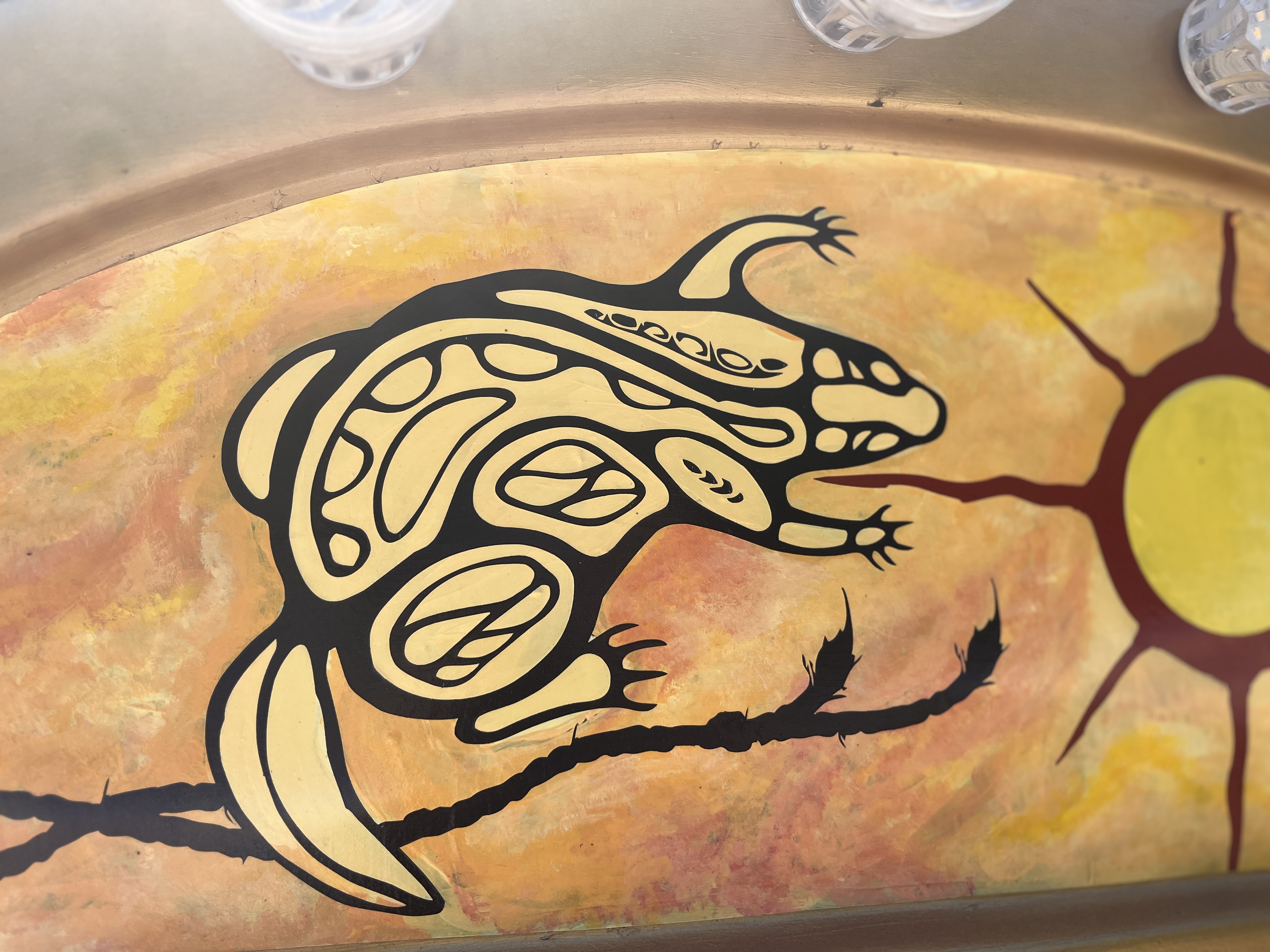
According to a Cree story, the Sun did not always visit the sky every day. To bring more light to the Earth, a hero caught the Sun by setting a snare along its path. However, soon the land became scorching hot because the Sun was too close and the hero knew he needed to release it. He made a compromise with the Sun that he would liberate it if it would visit the Earth each day, but only coming to the edge of the sky. The problem was then how to release it! Though many animals tried, only the beaver was able to bear the heat and get close enough to chew through the ropes of the snare.
The style of the beaver pays homage to artist Carl Ray, one of the “Indian Group of Seven”, a group of First Nations artists who first brought Canadian indigenous art into the mainstream art world in the 70s.
Manaul (Filipino)
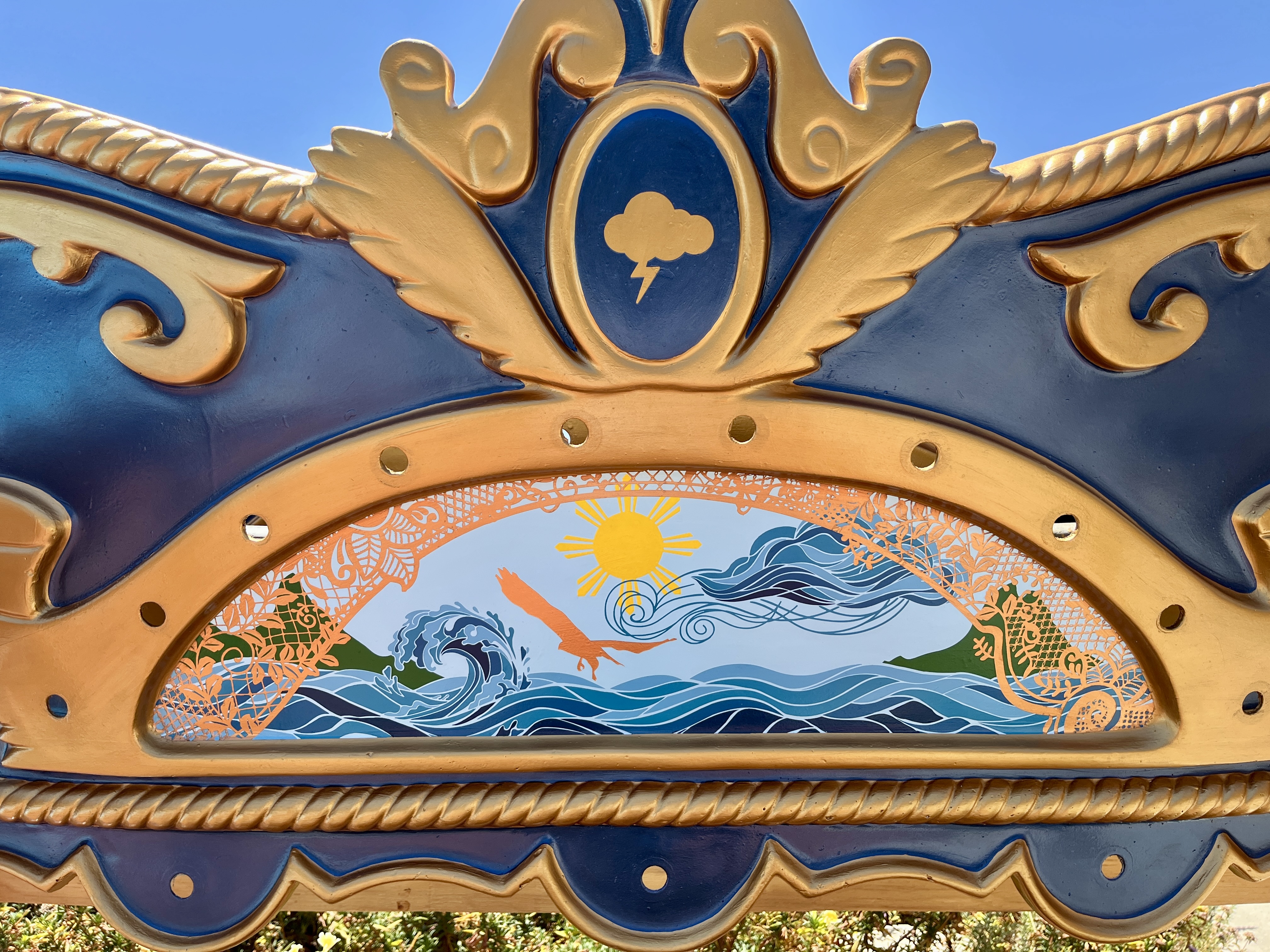
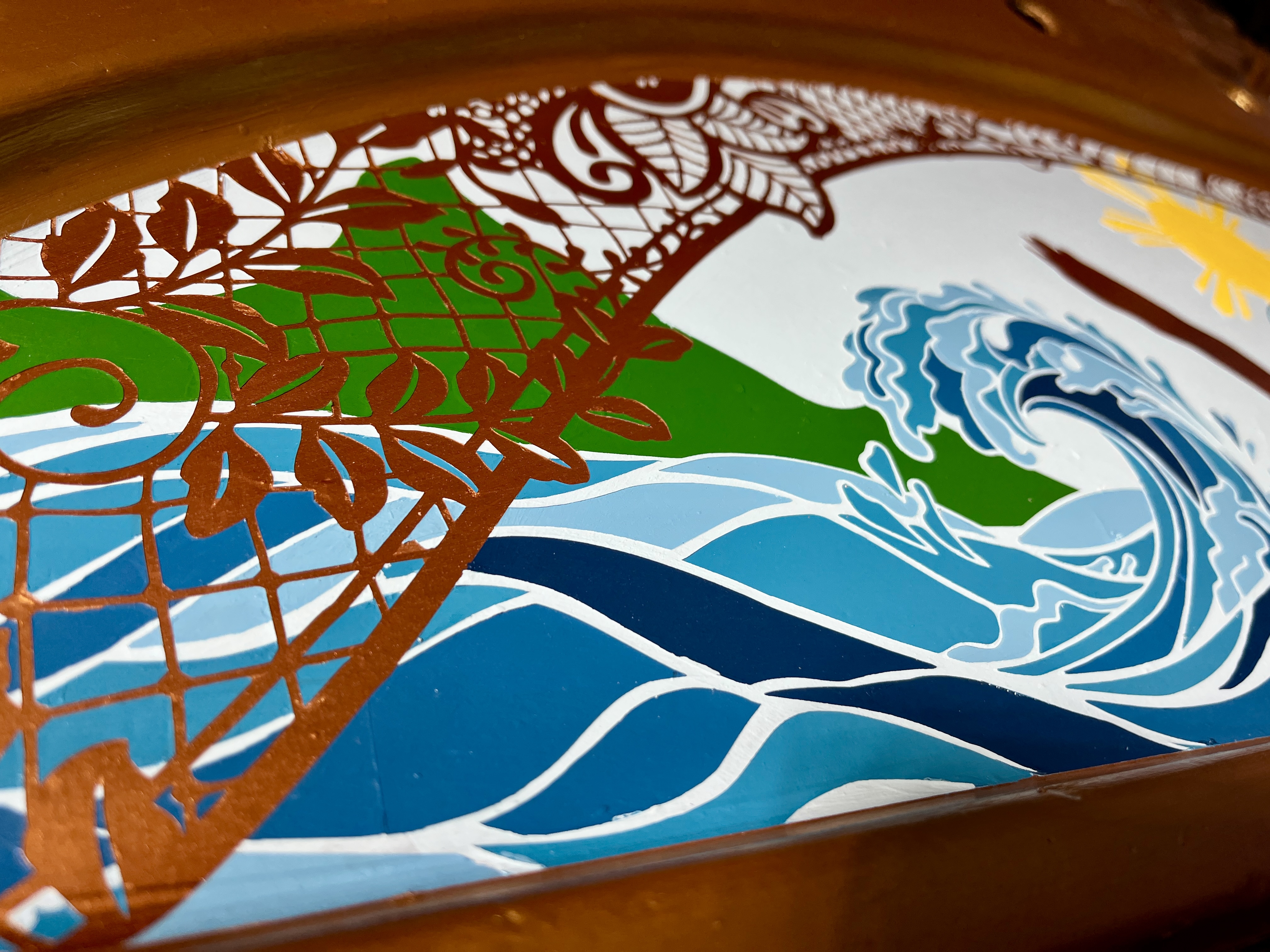
Creation lore in the Phillipines from the Visayan and Tagalog traditions, among others, often centers around a cosmic clash between the sea goddess and the sky god. In some versions of the story, a great bird becomes tired of flying with nowhere to rest so he stirs up discontent between the two gods. They fight, hurling waves and lighting at each other, and great boulders which crash into the ocean and become the Philippine islands. In another version, it is the wind goddess who starts the divine war, and later takes the form of a bird flying between them to return peace.
The bronze detail bordering this piece is based on traditional patterns used to hand embroider the barong tagalog, a formal shirt for men that is part of the national dress of the Philippines.
Te Māngōroa (Māori)
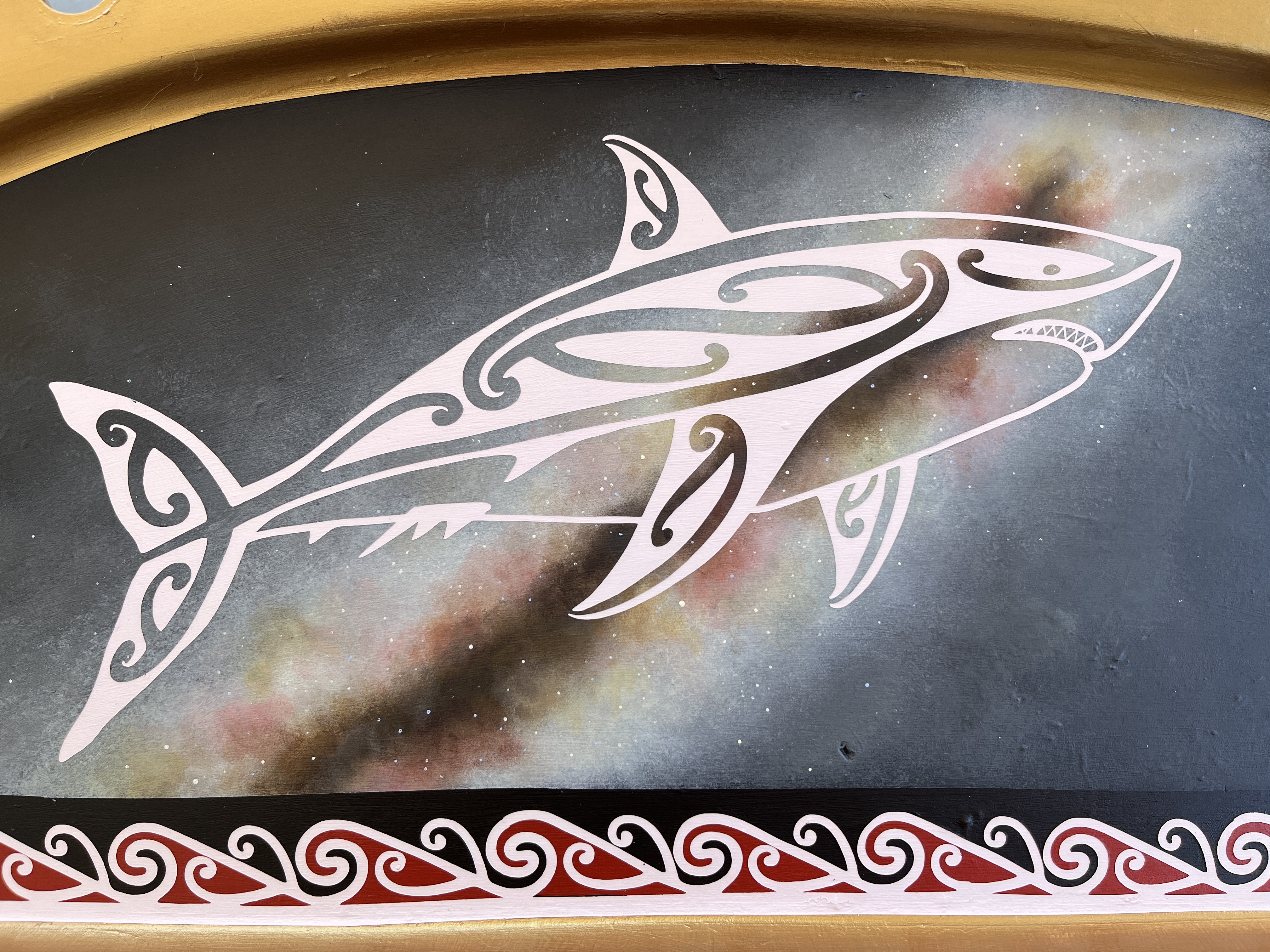
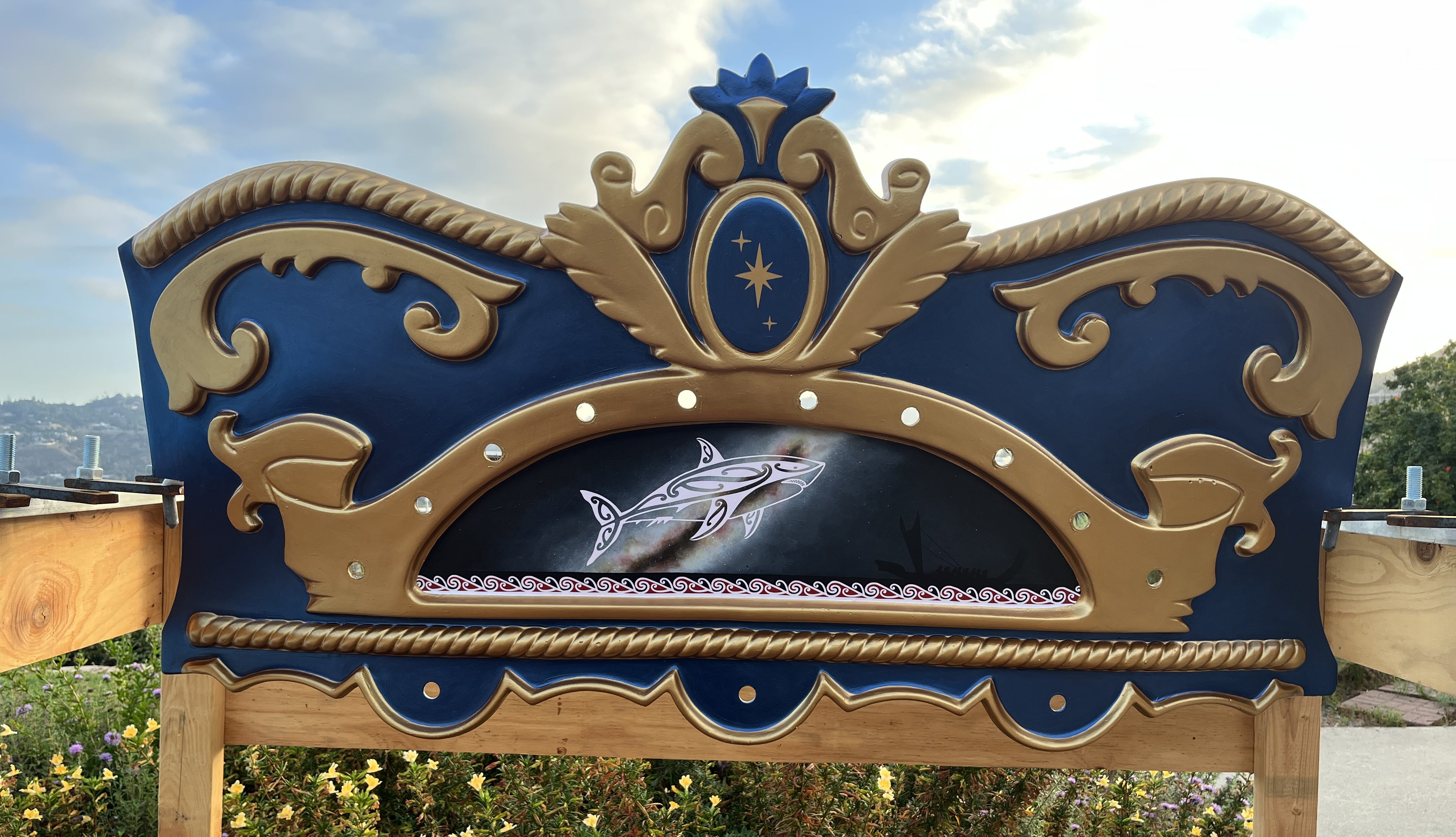
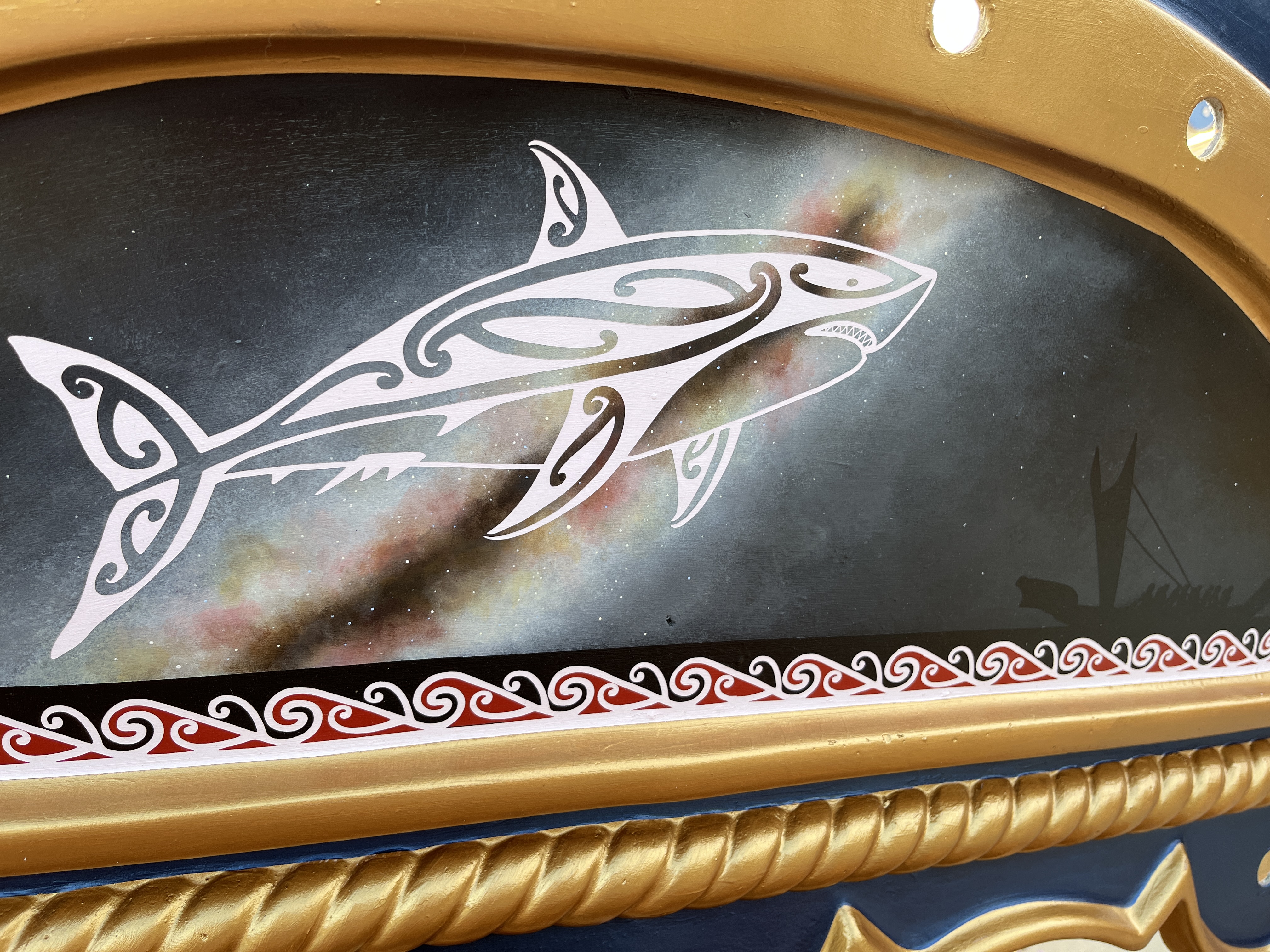
text desciprtionTe Māngōroa (“the long shark”) is one Māori name for the Milky Way, referring to a shark that Māui placed in the sky as a celestial guardian for the people below. Below him, travelers in a canoe gaze up in awe as they glide through the night over the ocean waves.
Like Hawaiians, the ancient Māori were experts in celestial sea navigation. They used the concept of the kāpehu whetū (“star compass”), dividing the sky into four quadrants associated with four winds and four additional quadrants associated with cardinal directions. The quadrants contained specific stars whose positions in the sky and relative to the movement of the Sun and Moon were used for wayfinding and timekeeping.
Special thanks to Māori artist Pip Hartley (Karanga Ink) for the custom drawing of the shark for this painting.
Ayida-Wedo (West African)
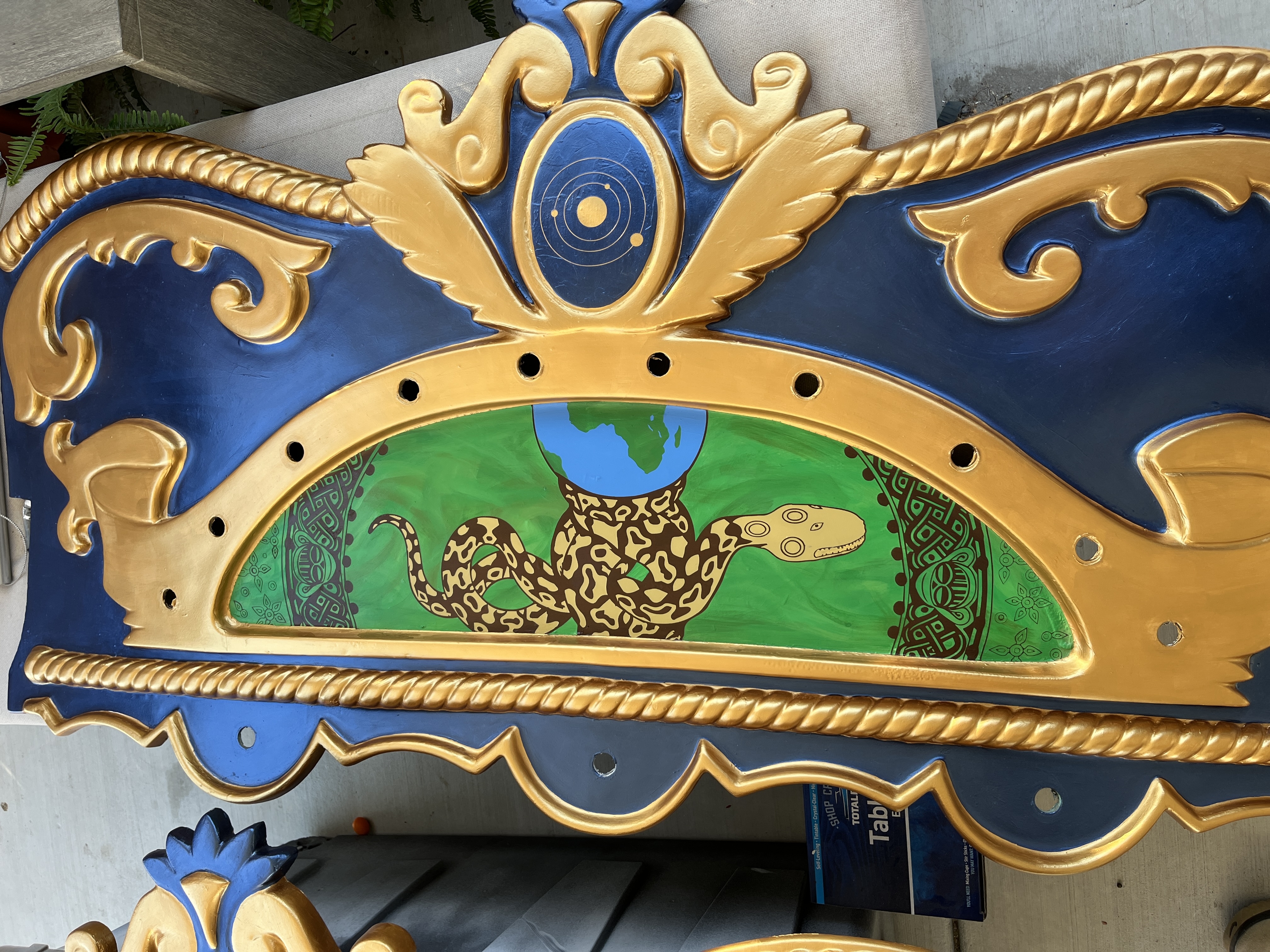
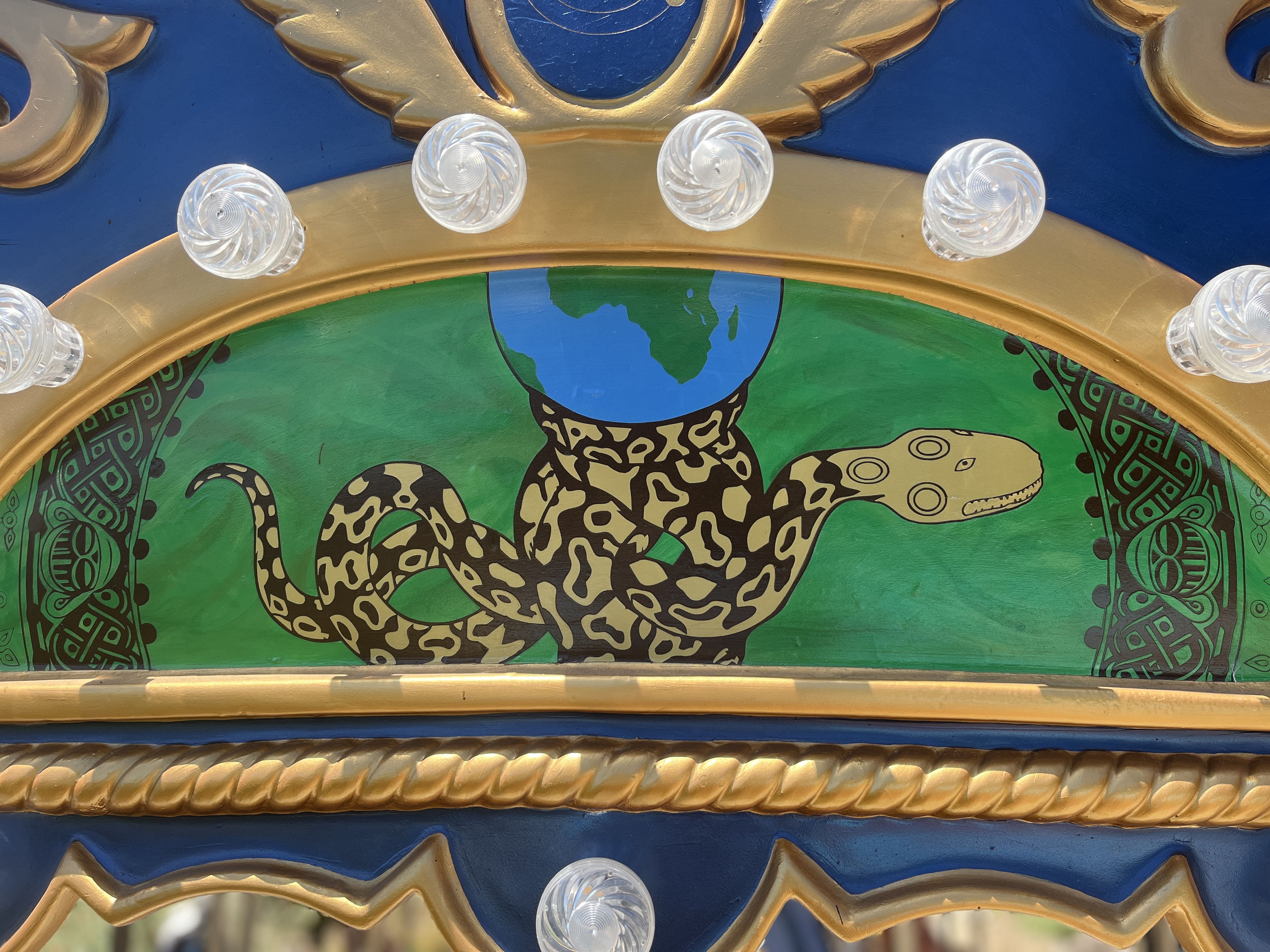
In Gbe and West African Vodun mythology, the cosmic snake Ayida-Wedo was a servant of the creator goddess Mawu-Lisa associated with the Sun and Moon. Mawu-Lisa created the Earth, the first huamsn, and all of life out of clay. Concerned the Earth was too heavy, she asked Ayida-Wedo to curl up underneath it and hold it up in the heavens. In modern times, Ayida-Wedo also plays a role in Haitian Voodoo.
The snake and other elements in this paintings are modeled after a famous historical artifact from the kingdom of Benin, a royal stool featuring an encircled snake holding up the seat on which the user sat.
Kutkh (Chuckchi)
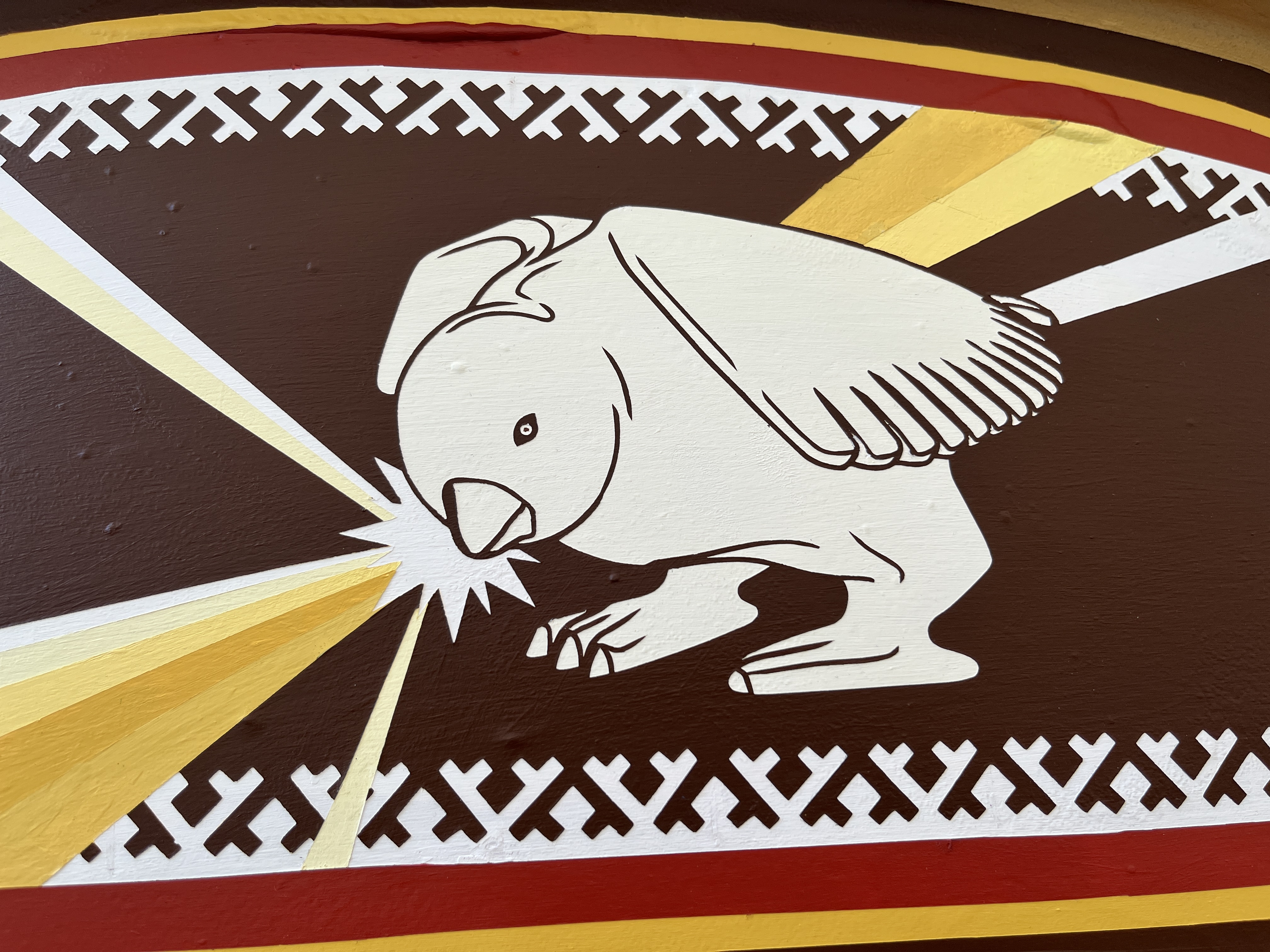
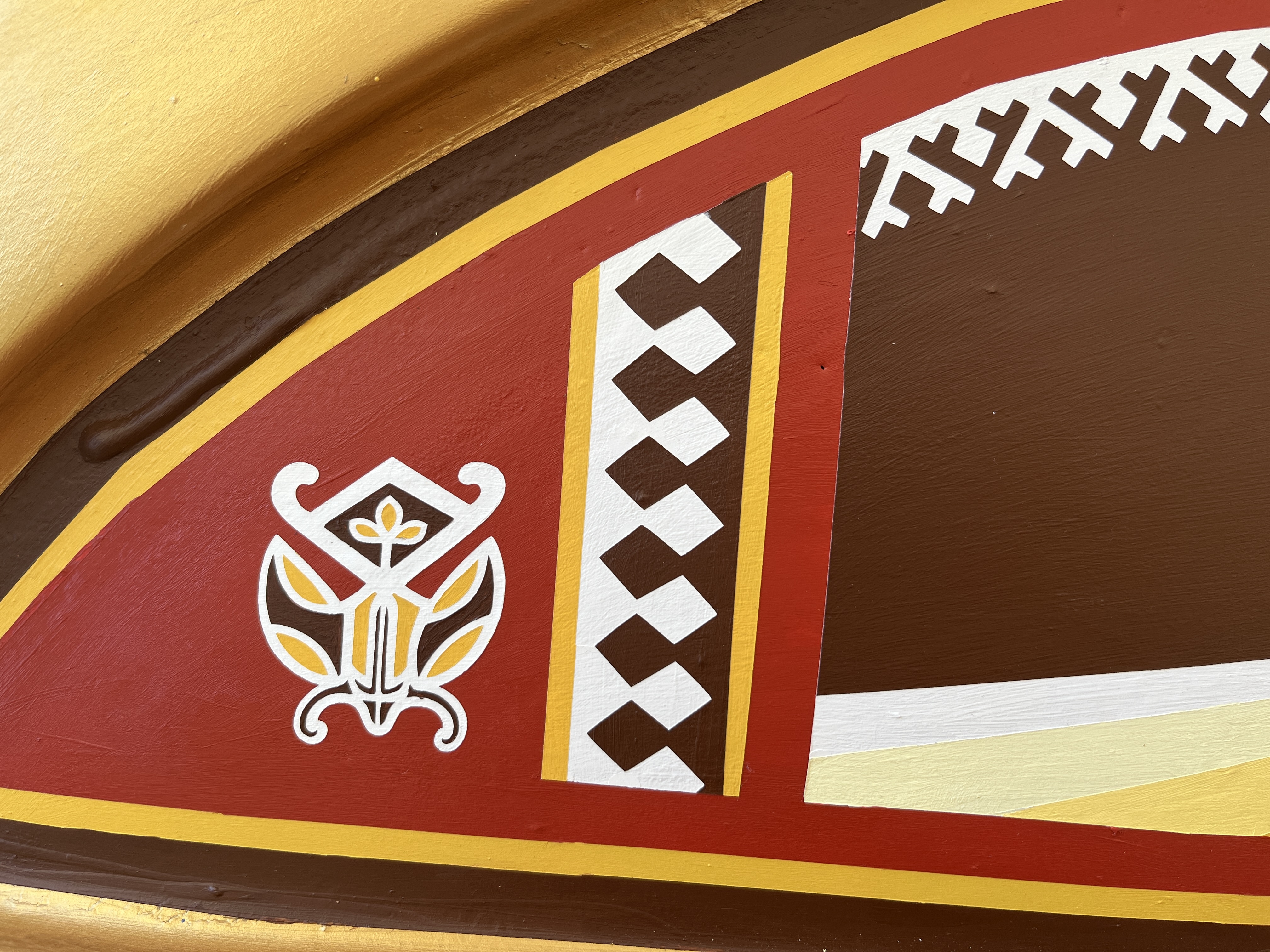
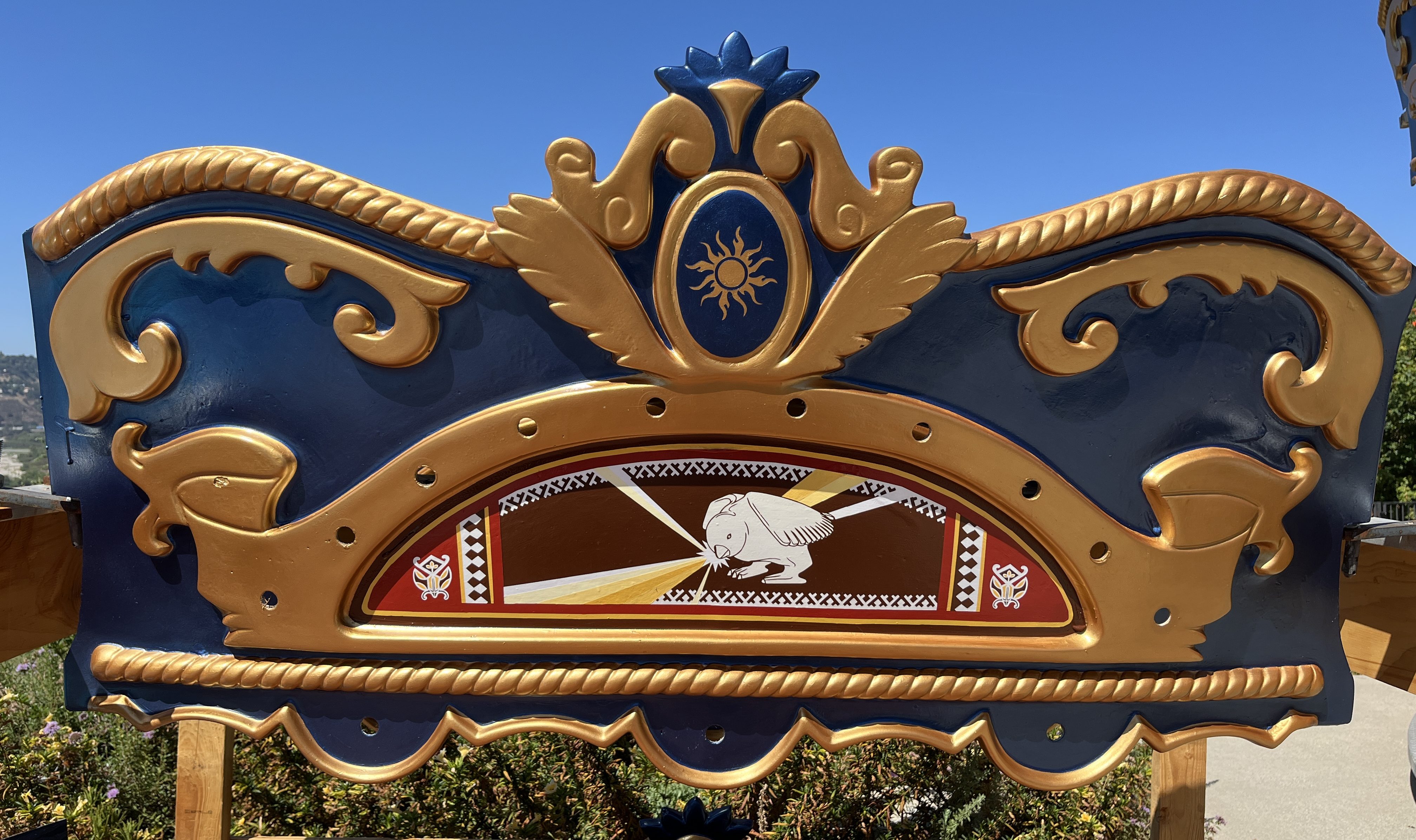
In the creation myth of the Chukchi from northeastern Siberia, the First Bird Raven flew through a great expanse and created landmasses from his droppings. However, he did not like that the world was dark, asking the other birds to help him peck through the sky. Many birds tried, creating only small holes that let in pinpricks of light (stars). Only the tiny snow bunting could peck a hole large enough for the Sun to emerge, though is caused his beak to become short and got blood on the feathers of his face and breast.
The Chukchi people are known for the craft of their fur clothing and for bone carving, both of which were used to create the elements in this scene. The nested, symmetric patterns they use are typically fashioned out of brown and white reindeer fur, the design along the top representing reindeer antlers. The population of Chukchi people today is less than 20,000, living solely in remote northeastern Russia.
Kharaatsai (“swallow”, Mongolian)
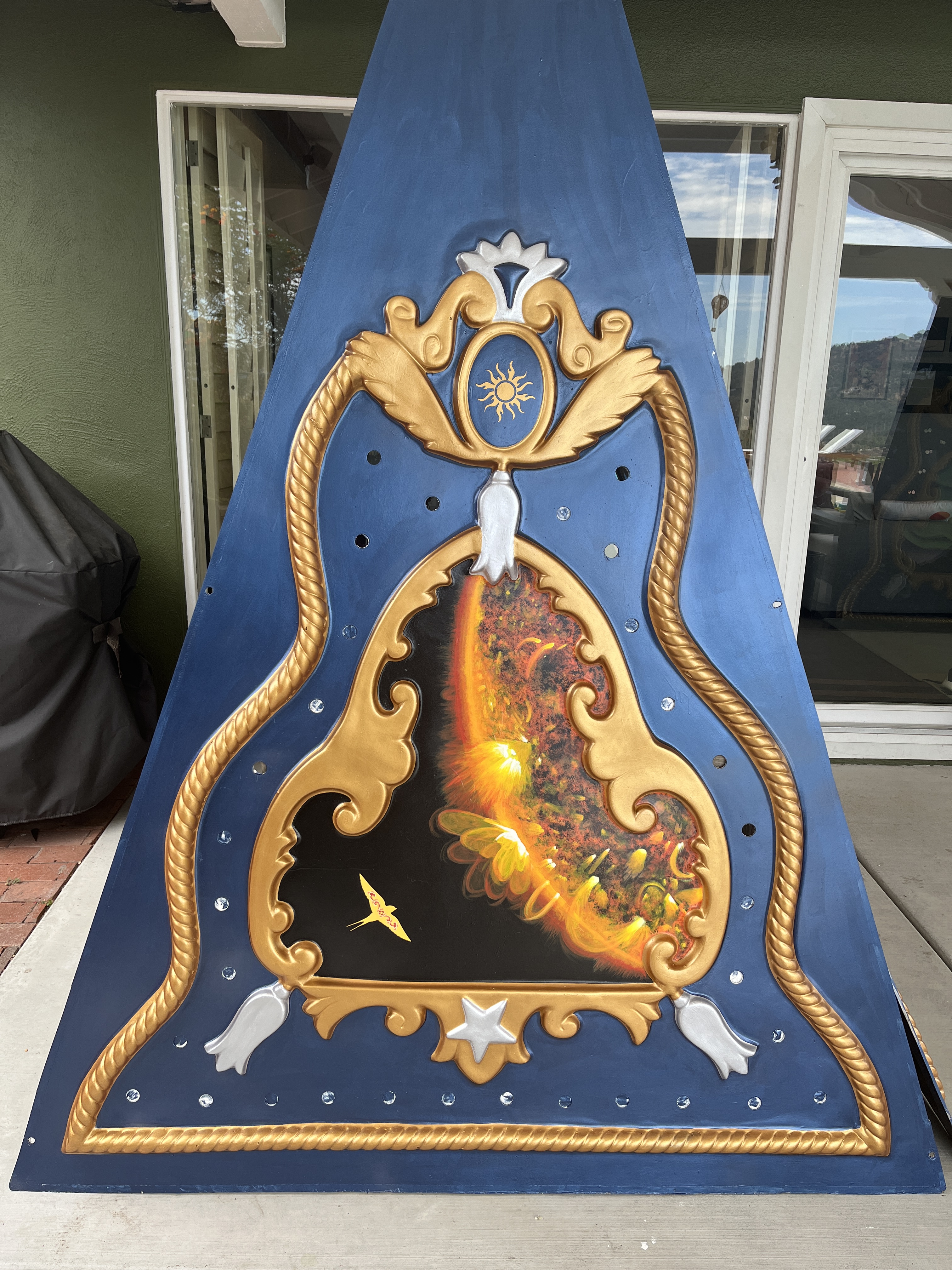
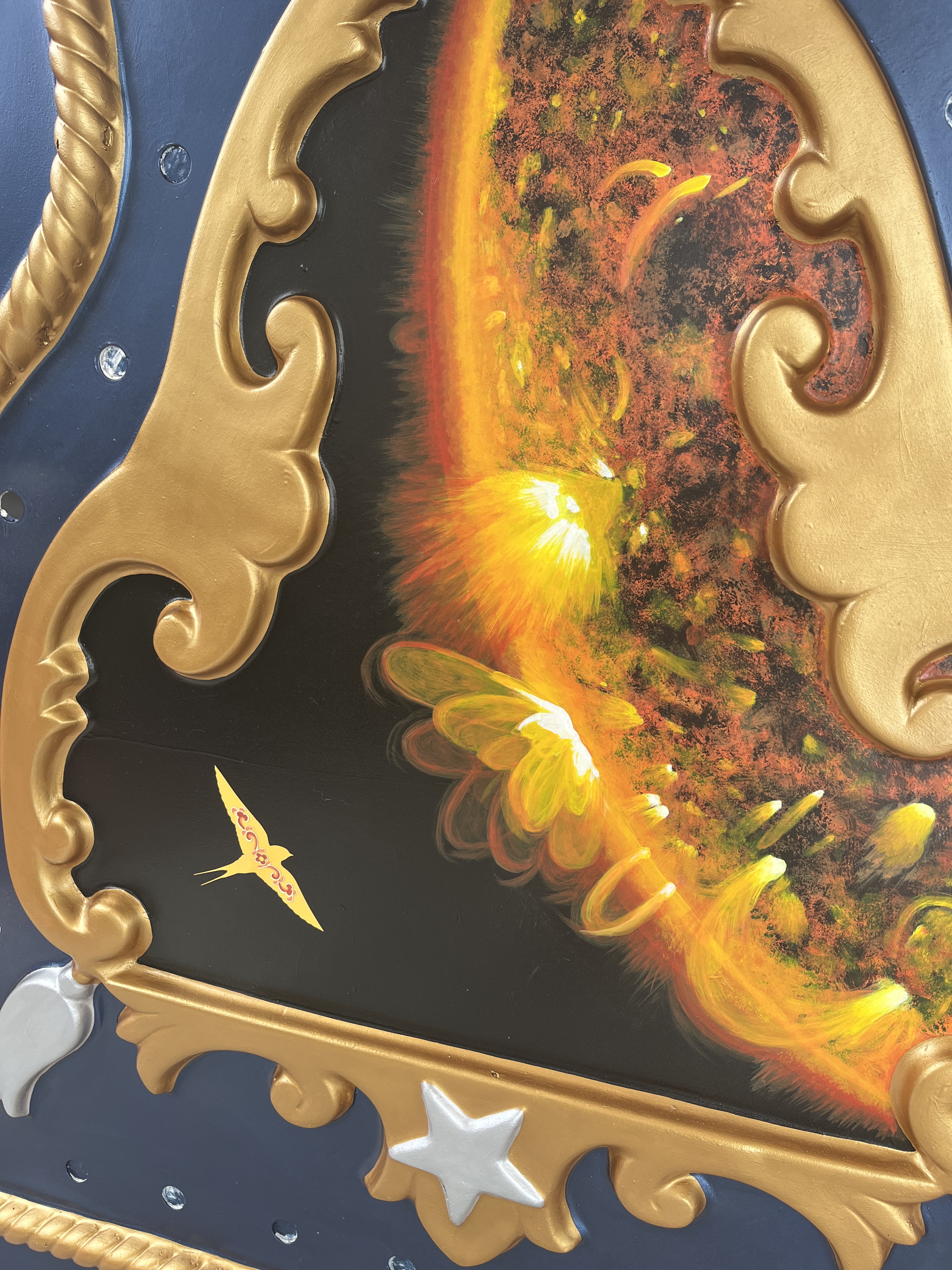
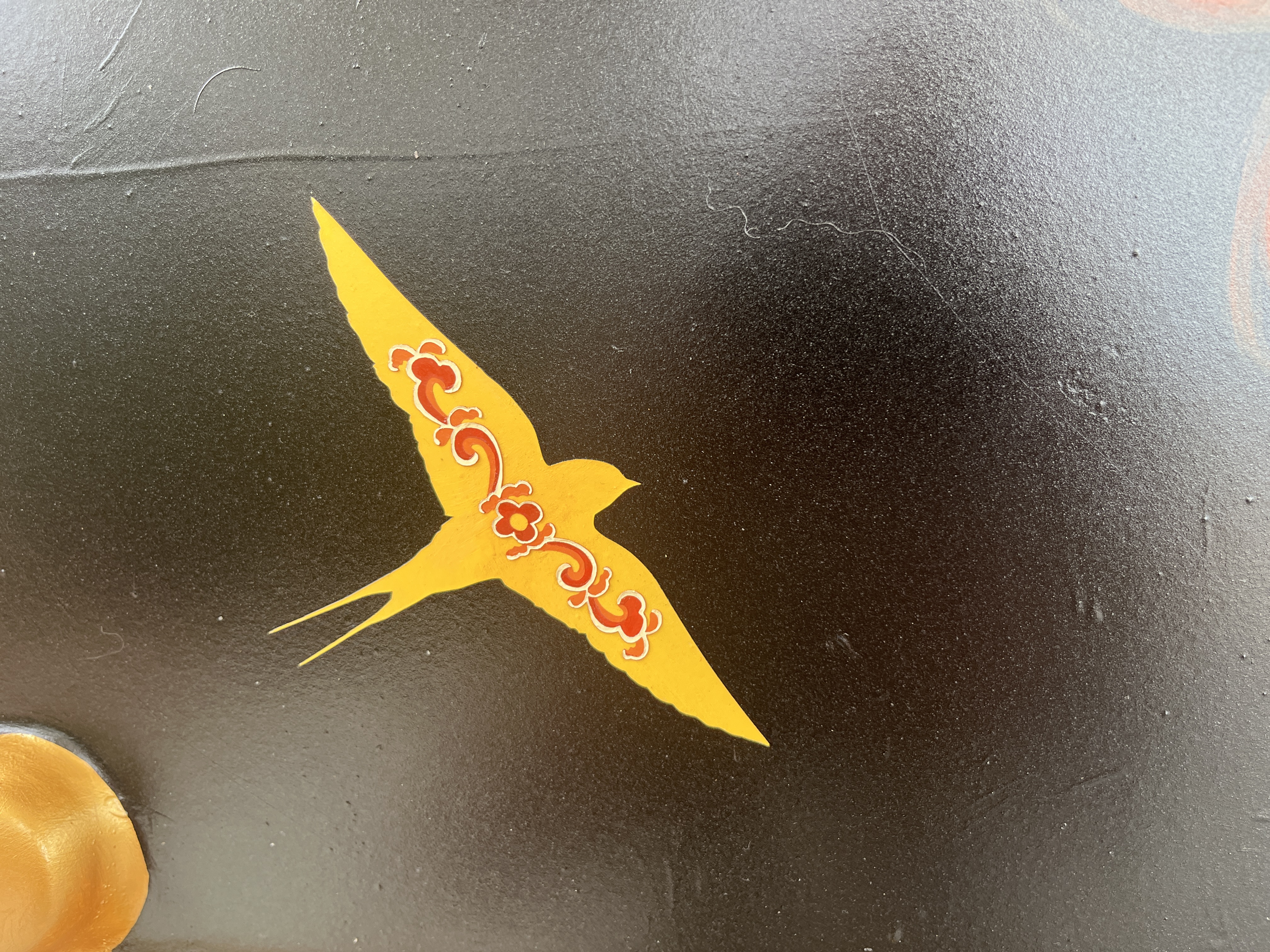
This panel depicts a swallow who is viewed as a protector of the planet by the Mongolian people. Long ago, seven suns appeared in the sky bringing intense heat and drought to the land. A hunter vowed to shoot them all down with his arrows, but before he could shoot the last one a swallow flew in front of his arrow causing it to miss and saving the seventh sun. This is also the reason the swallow has a split in its tail. The swallow is decorated with flowers motifs traditional in Mongolian art.
Here the Sun is depicted up close, showing the dramatic coronal loops and solar prominences produced in the hot plasma at the Sun’s surface and shaped by its complex magnetic field.
Gavaevodata (Zoroastrian)
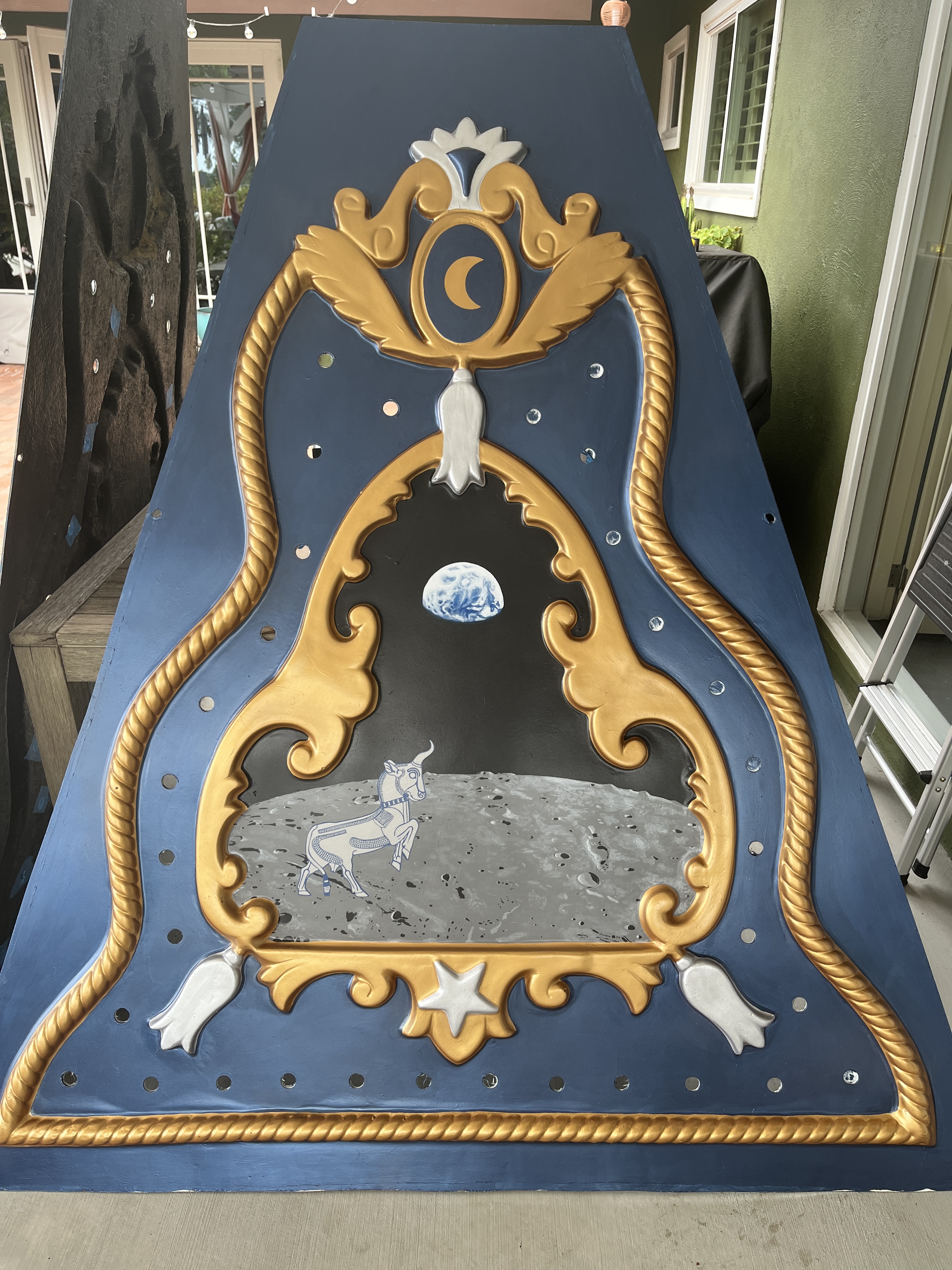
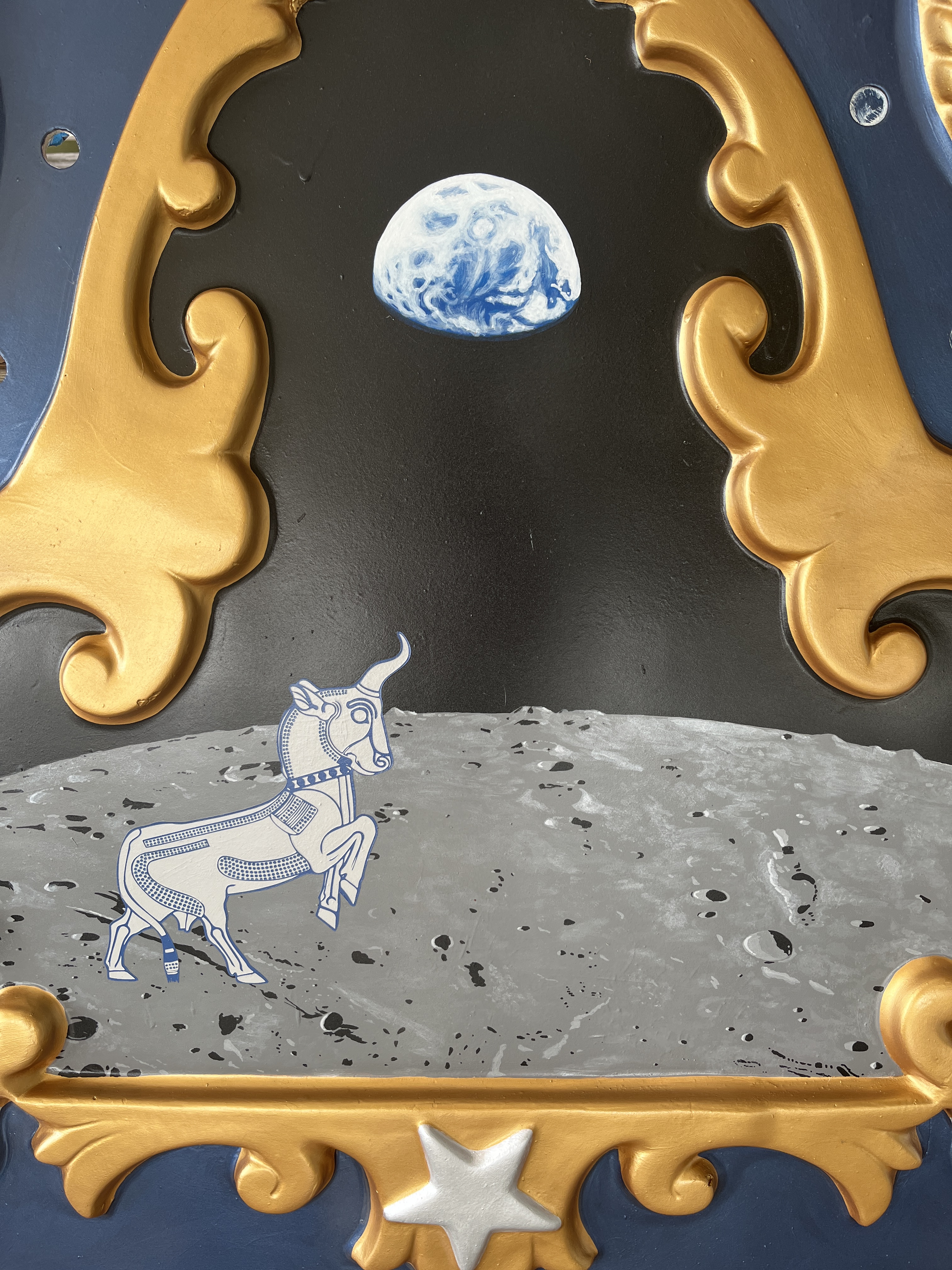
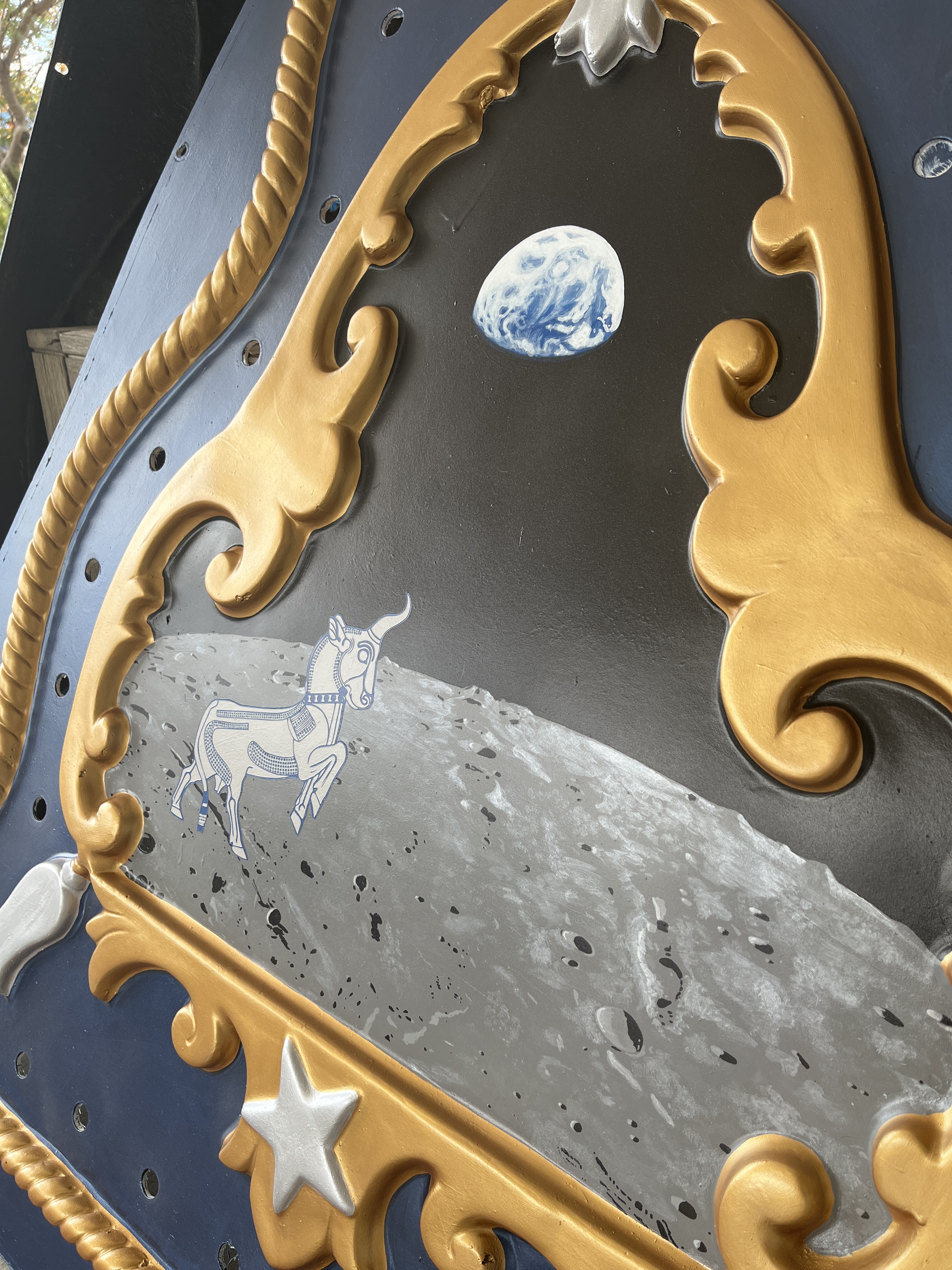
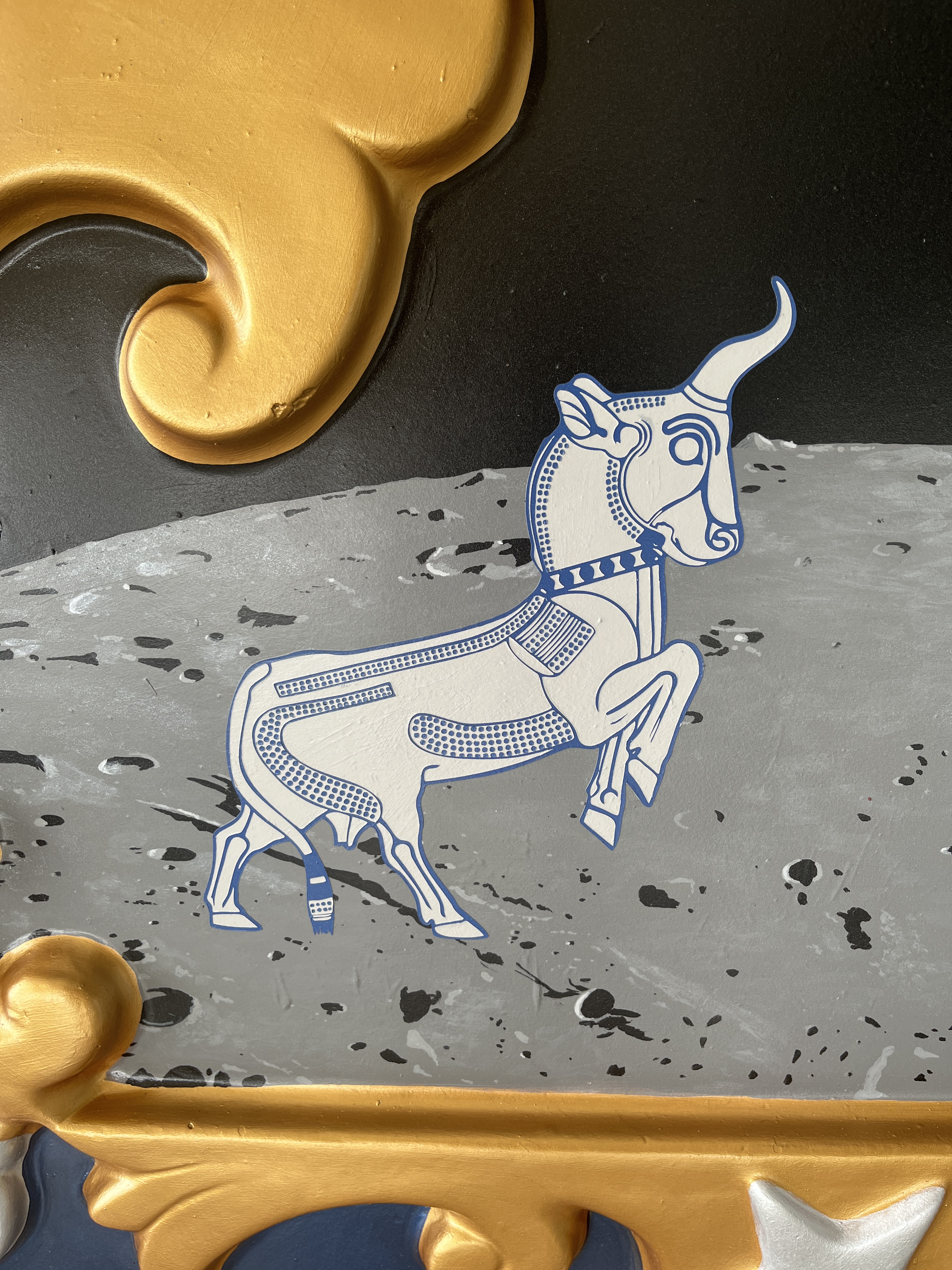
Gavaevodata is a primordial cow in Zoroastrian myth who died during a divine conflict between gods. Its body was carried to the Moon who purified it, and from its bones, marrow, and organs came the many plants and animals which flourished on Earth. The bull in the image is created from a carving at the ruins of Persopolis in modern-day Iran.
The presence of the Moon orbiting Earth played a huge role in the evolution of our world, helping to stabilize our climate after planet formation and slowing its rotation to the current 24-hour day. Both of these were important to the emergence of biological life, which started in Earth’s oceans. Eventually, the tides produced by the Moon enabled life to move onto land and evolve into more complex animals like mammals.
Wanampi (Aboriginal Australian)
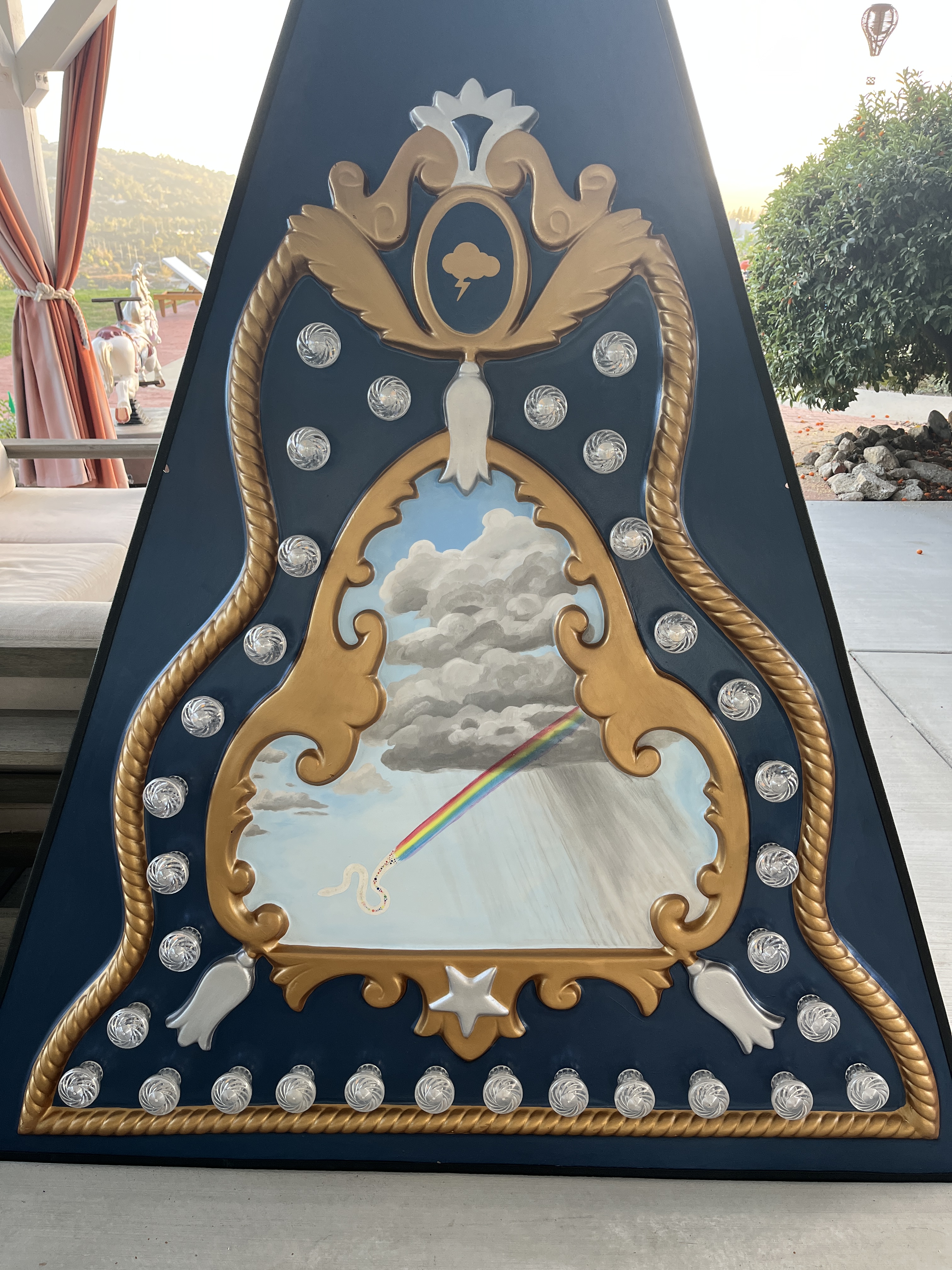
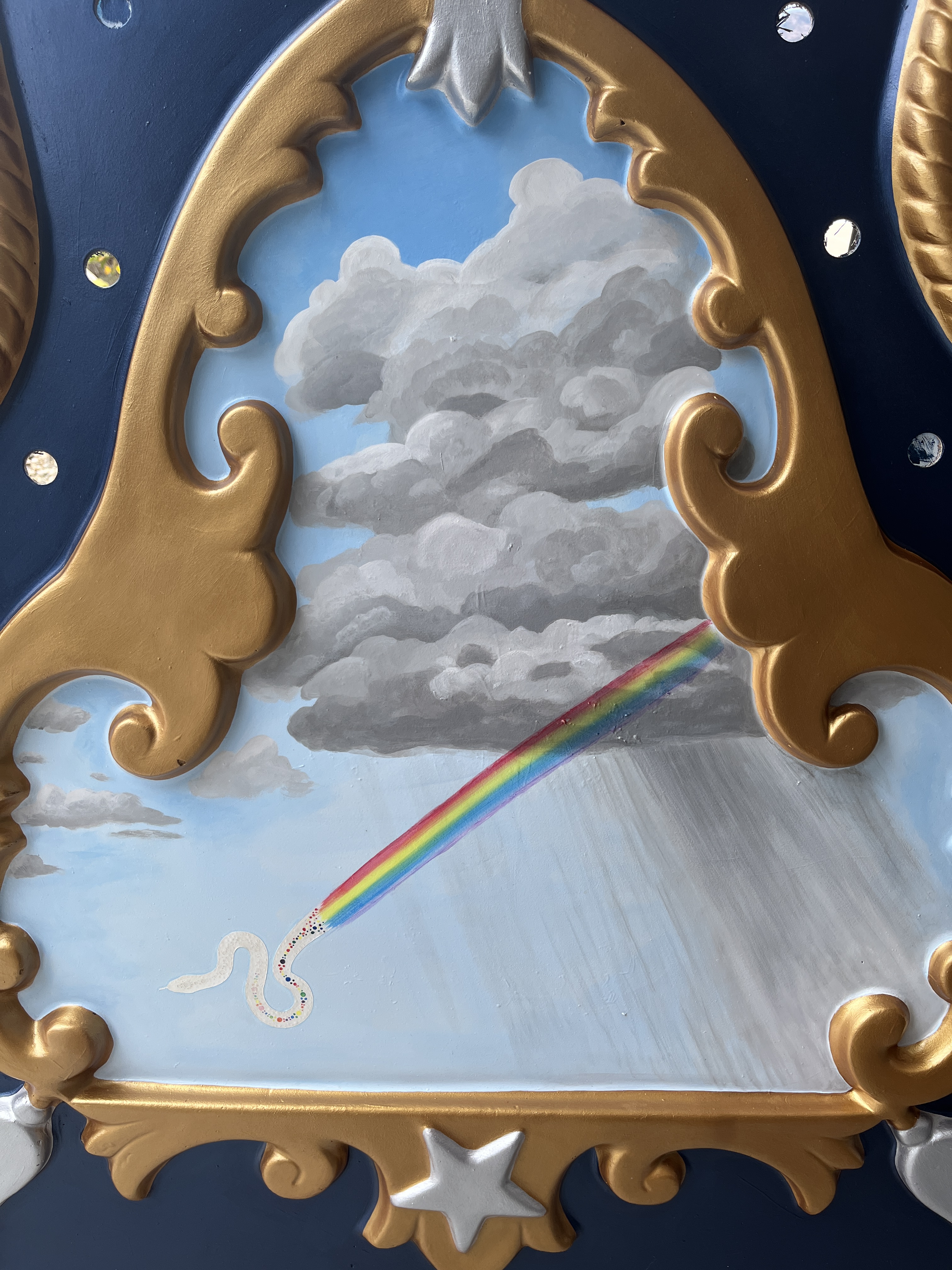
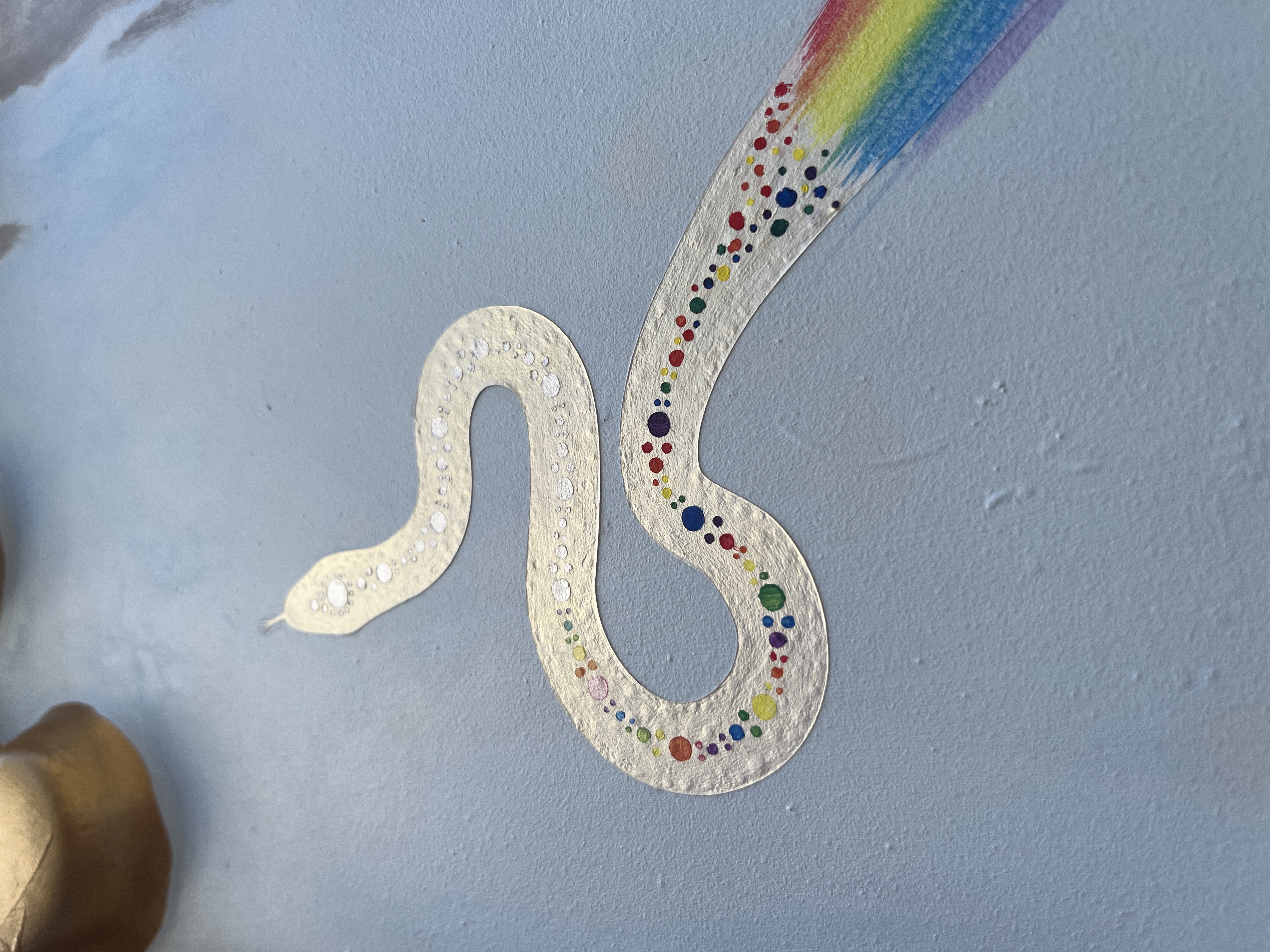
The Rainbow Serpent is a water deity featured in Dreamtime stories from various Australian Aboriginal peoples, each with their own name for the deity. When the rainbow is seen stretched across the sky it is said to be bringing water from one watering hole to another, controlling the cycle of rain and drought and granting access to life’s most precious resource.
The Dreaming, Dreamtime, or “Everywhen” was a time of creation in which the land was inhabited by gods and heroic figures as well as the ancestral cycles of every person. Dreamtime stories contain knowledge of creation, significance of specific places and creatures, and lay wisdom and patterns for the daily life of these cultures.
The dots on the snake are an homage to traditional Aboriginal dot paintings typical of central desert tribes. This art movement started in the 70s initially to hide indigenous iconography from colonizers and is continued today in various styles by modern Aboriginal artists.
Revontulet (Finnish, Sami)
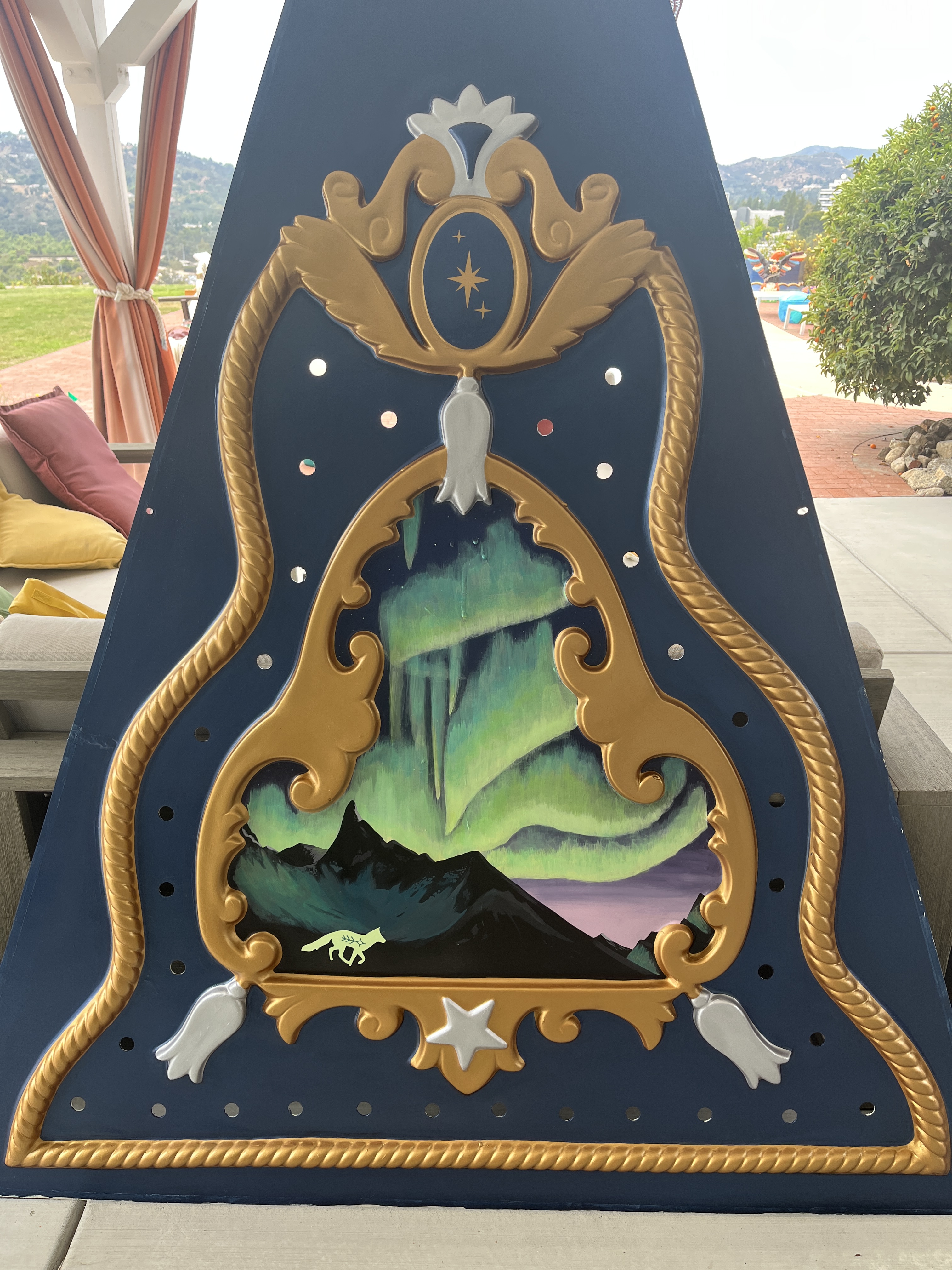
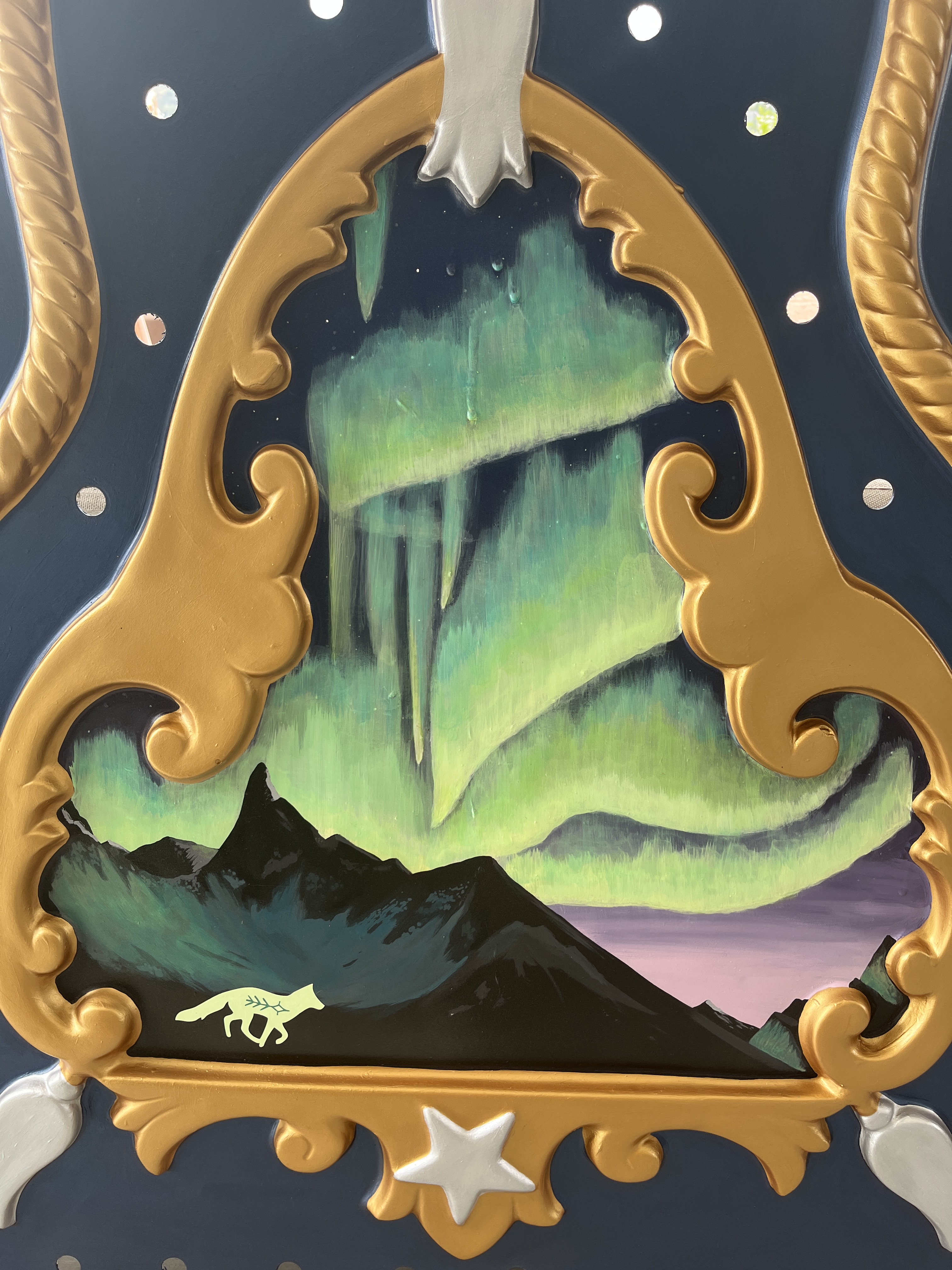
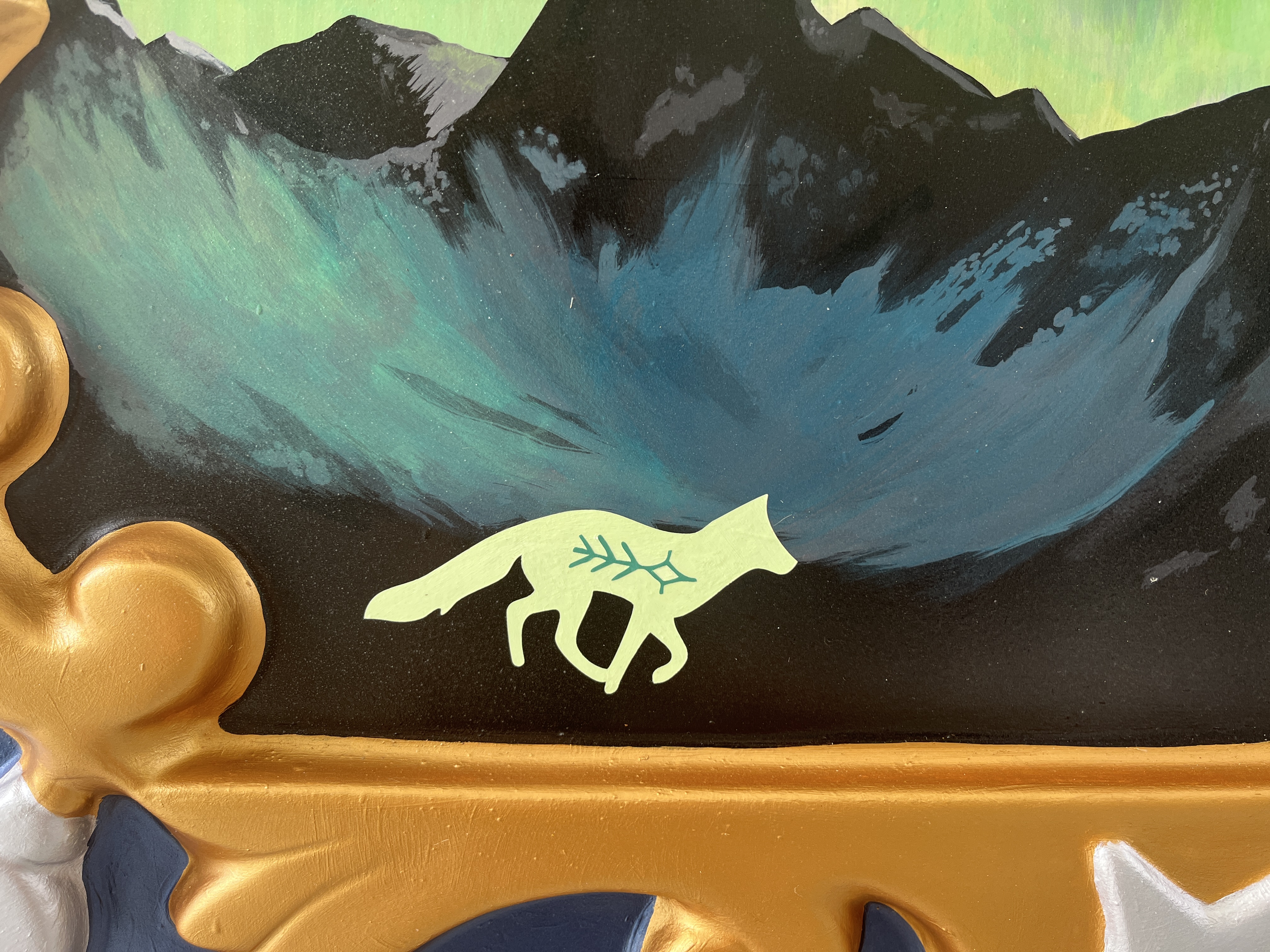
In Finnish folklore, the aurora is called “foxfire” and said to be caused by the brush of a fox’s tail spraying snow up into the sky. The indigenous Lapps or Sami people call it guovssahas (“the light you can hear”) and believe it to be the energy of departed souls. Honoring both modern and ancient stories, the fox in this image bears a symbol for the aurora from a traditional Sami shamanic drum.
In scientific terms, the aurora is caused by strongly charge particles from the Sun being funneled towards Earth’s poles by our magnetic field and colliding with air molecules to produce light. The color of the aurora is controlled by collisions occurring with different gases at varying altitudes.

